

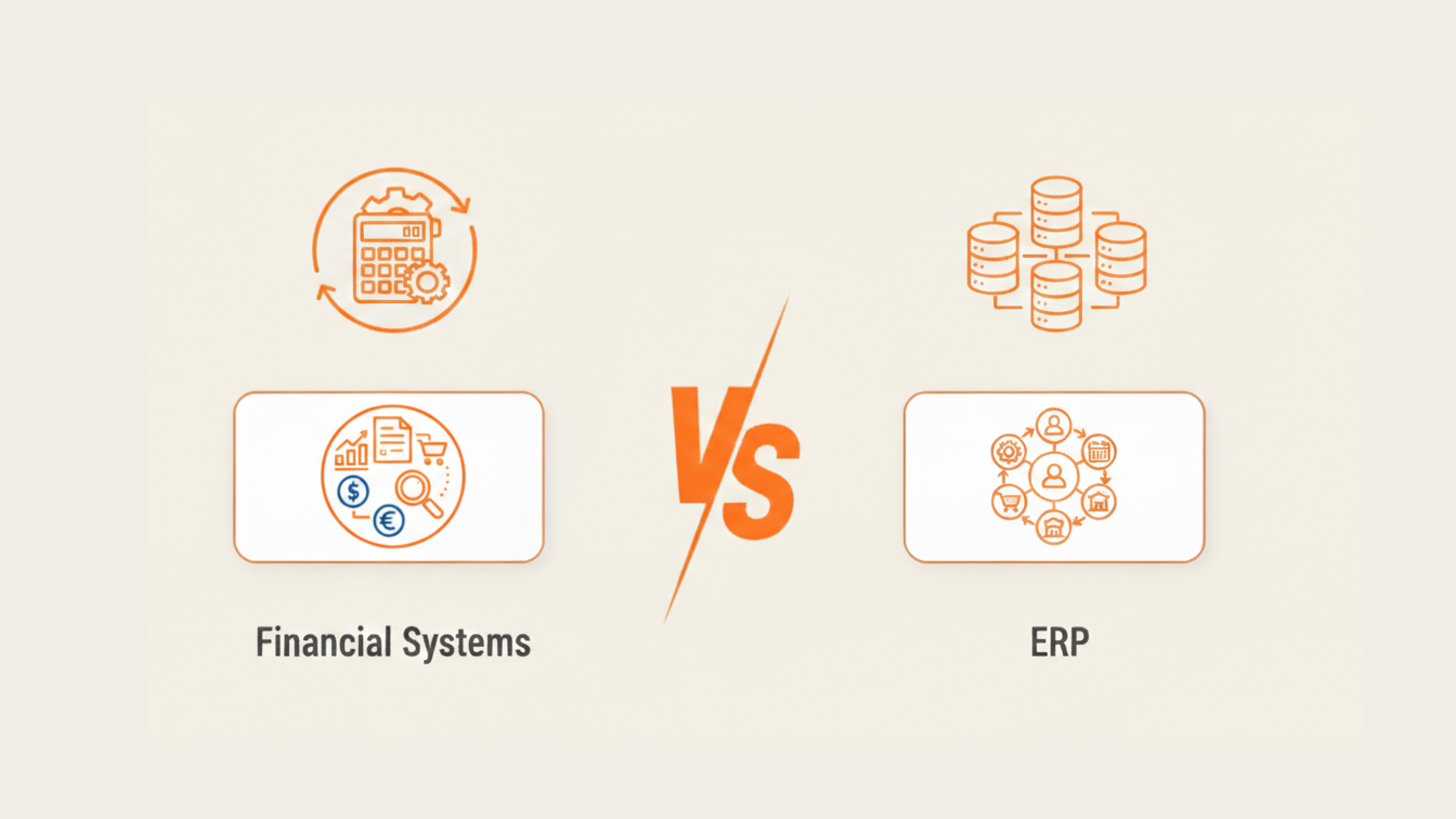
Every business starts with the basics: clean books, simple reports, one or two tools to get things done. As growth happens, processes naturally become more interconnected: sales affects inventory, purchasing affects cash flow, and reporting suddenly matters much more.
Every business starts with the basics: clean books, simple reports, one or two tools to get things done.
As growth happens, processes naturally become more interconnected: sales affects inventory, purchasing affects cash flow, and reporting suddenly matters much more.
This is where leaders begin asking:
“Is our current system still supporting the way we operate today?”
That question is often the moment companies start comparing ERP vs accounting software, evaluating whether tools like QuickBooks are still enough or if platforms like NetSuite are a better fit for the next stage of growth.
Understanding the options
Financial Systems (The Right Fit for Early Stages)
Platforms like QuickBooks, Xero, FreshBooks, Sage 50, and Wave focus primarily on:
Accounting
Basic financial management
Limited operational tools
They work best for early-stage or single-entity organizations with minimal complexity.
ERP Platforms (Designed for Growing, Multi-Function Operations)
Cloud ERPs like NetSuite integrate beyond finance to integrate multiple business processes including:
Inventory
CRM
Supply chain
HR
Manufacturing
Multi-entity consolidation
Analytics
They provide a unified view of your operations and support high-growth, multi-location, and multi-currency requirements.
Choosing between a financial system vs ERP depends on:
Business size
Operational complexity
Required workflows
Growth plans in the next 2–3 years
How to know which one you need
A financial system works best when:
Your operations are straightforward
You’re in a single location/currency
You want low cost and fast setup
You don’t need integrated inventory, CRM, HR, or manufacturing
This is common for early-stage or stable single-entity companies.
An ERP makes more sense when:
You manage multiple business units or subsidiaries
You need multi-currency or intercompany consolidation
Inventory, fulfillment, production, or supply chain play a big role
You want cross-department workflows and one source of truth
You expect significant growth in the next 2–3 years
This is where NetSuite becomes a strategic investment, not just a software upgrade
Businesses outgrow software the same way they outgrow manual processes. Most businesses start with financial systems but shift to ERP once their operations require more integration.
Financial Systems vs NetSuite ERP
Feature | Financial Systems | NetSuite |
Core Accounting | Strong for basic–mid complexity; best for single-entity | Advanced accounting; supports complex, multi-entity environments |
Multi-entity / Multi-currency | Limited; often manual or with add-ons | Native multi-currency + real-time consolidation |
Integrated Modules | Separate systems for inventory/HR/CRM | All in one unified platform |
Scalability | Good for SMEs; may need future migration | Built to scale across entities, locations, and processes |
Reporting & Analytics | Standard reporting; manual exports common | Real-time dashboards; customizable KPIs |
Implementation & Cost | Lower cost; quick deployment | Higher investment; implementation takes longer |
Flexibility & Customization | Moderate | High; supports automation and complex workflows |
It’s an evolution The Bottom Line
Most businesses begin with financial systems because they’re practical, affordable, and familiar. But as operations grow, the gaps become visible.
This is a natural progression, not a failure of the initial system.
A cloud ERP like NetSuite often becomes the right choice once companies need unified operations, real-time insights, and a scalable foundation that supports long-term growth.
Practical Questions to Guide the Decision
How complex is your business today and how complex will it be in 2–3 years?
If you foresee multi-entity or operational expansion, lean toward ERP early.
Do you need real-time consolidated data, cross-functional workflows, and centralized control?
NetSuite provides cross-functional workflows and real-time consolidation; basic systems do not.
What is your tolerance for cost, implementation time, and change management?
If the priority is fast and cheap, use a financial system. If the priority is growth, accuracy, and integration, invest in ERP.
Choose the system that matches where your business is going, not just where it is today. Your system must fit your business, not the other way around.
These published sources cover the detail behind the points above:
Accounting tools handle the books. An ERP handles the books plus stock, orders, people and reporting. The switch is worth it when one fact has to live in several places at once.
Hotel ERP: Managing Multiple Properties Without Losing Financial Visibility
Best Wholesale Distribution Software for Philippine Businesses
Softype is an Oracle NetSuite solution provider with more than 25 years of experience and over 600 implementations. Our team sets NetSuite up around how your business already runs, then stays on to tune it as you grow. To see what that looks like for your own numbers, book a meeting with our team.
The switch is rarely about features. It is about how many places a single fact now lives. When a sale changes stock, cash and a customer record at once, keeping those in separate tools costs staff time every week.
Financial systems such as QuickBooks, Xero, FreshBooks, Sage 50 and Wave are the right fit while a business is single-entity and the processes stay largely separate. An ERP earns its place once inventory, CRM, supply chain and consolidation have to agree with each other.
Softype sees the same trigger repeatedly: month-end takes longer each quarter, and nobody can answer an operational question without exporting something first.
Financial systems focus on accounting, basic financial management and limited operational tools.
Cloud ERPs such as NetSuite integrate inventory, CRM, supply chain, HR, manufacturing, multi-entity consolidation and analytics.
Financial systems suit early-stage or single-entity organisations with minimal complexity.
ERP platforms support high-growth, multi-location and multi-currency requirements.
The choice depends on business size, operational complexity, required workflows, and growth plans over the next two to three years.
Financial systems such as QuickBooks, Xero, FreshBooks, Sage 50 and Wave focus on accounting, basic financial management and limited operational tools. Cloud ERPs such as NetSuite integrate beyond finance into inventory, CRM, supply chain, HR, manufacturing, multi-entity consolidation and analytics.
Financial systems work best for early-stage or single-entity organisations with minimal complexity, where processes do not yet depend heavily on one another.
Four things: business size, operational complexity, the workflows you require, and your growth plans over the next two to three years.
A unified view of operations, plus support for high-growth, multi-location and multi-currency requirements that separate tools cannot hold together.
Growth makes processes interconnected. Sales affects inventory, purchasing affects cash flow, and reporting starts to matter more, which prompts leaders to ask whether the current system still supports how they operate.
Month-end takes longer each quarter. Nobody can answer a stock question without an export. Two systems hold the same customer and disagree.
Practitioner note: in live projects those three signs turn up together. When they do, the cost of staying is already being paid in staff hours every week.
Softype sees this pattern most often in firms running two or more entities on separate files.
Pick the accounting tool if you run one entity and your work stays in one place. It is cheaper and faster to set up.
Pick the ERP if stock, orders and cash all have to agree. That is the point where separate tools start to cost you time.
Practitioner note: in live projects the switch is rarely planned. It happens after one bad month-end that nobody can explain.
Not sure which side of the line you sit on? Softype has run more than 600 NetSuite implementations and can tell you in one conversation. Book a meeting or contact us to get a straight answer.


Helping businesses thrive with integrated ERP solutions.
NetSuite
Service
Company
Contact Us
Copyright © 2026


