


When evaluating NetSuite, one of the first questions finance and operations leaders ask is: "How long does it take to implement NetSuite?" The honest answer depends on what you are deploying, how clean your data is, how many entities are involved, and how much customization you need.
We have delivered NetSuite implementations in as little as 70 days and as long as 24+ weeks. This guide covers the timeline ranges you should plan for, broken down by deployment type, module, and complexity, and anchored in actual delivered project data, not vendor promises.
For a step-by-step view of how the implementation runs, see our companion guide: How to Implement NetSuite: Step-by-Step Guide for First-Time Buyers.
Four variables drive how long your project will take:
Data quality. Poor legacy data (incomplete customer records, inconsistent items, unreconciled balances) is the single biggest timeline risk. Cleanup work that surfaces late forces teams to pause configuration.
Integration complexity. Each external system (CRM, ecommerce, WMS, payroll, banking) adds weeks to the timeline based on field mapping, error handling, and testing cycles.
Customization depth. Out-of-the-box deployments move faster than environments requiring SuiteScripts, custom workflows, and proprietary business logic.
Internal team availability. Whether key decision-makers are available for design sign-off, User Acceptance Testing (UAT), and cutover planning controls whether milestones land on schedule.
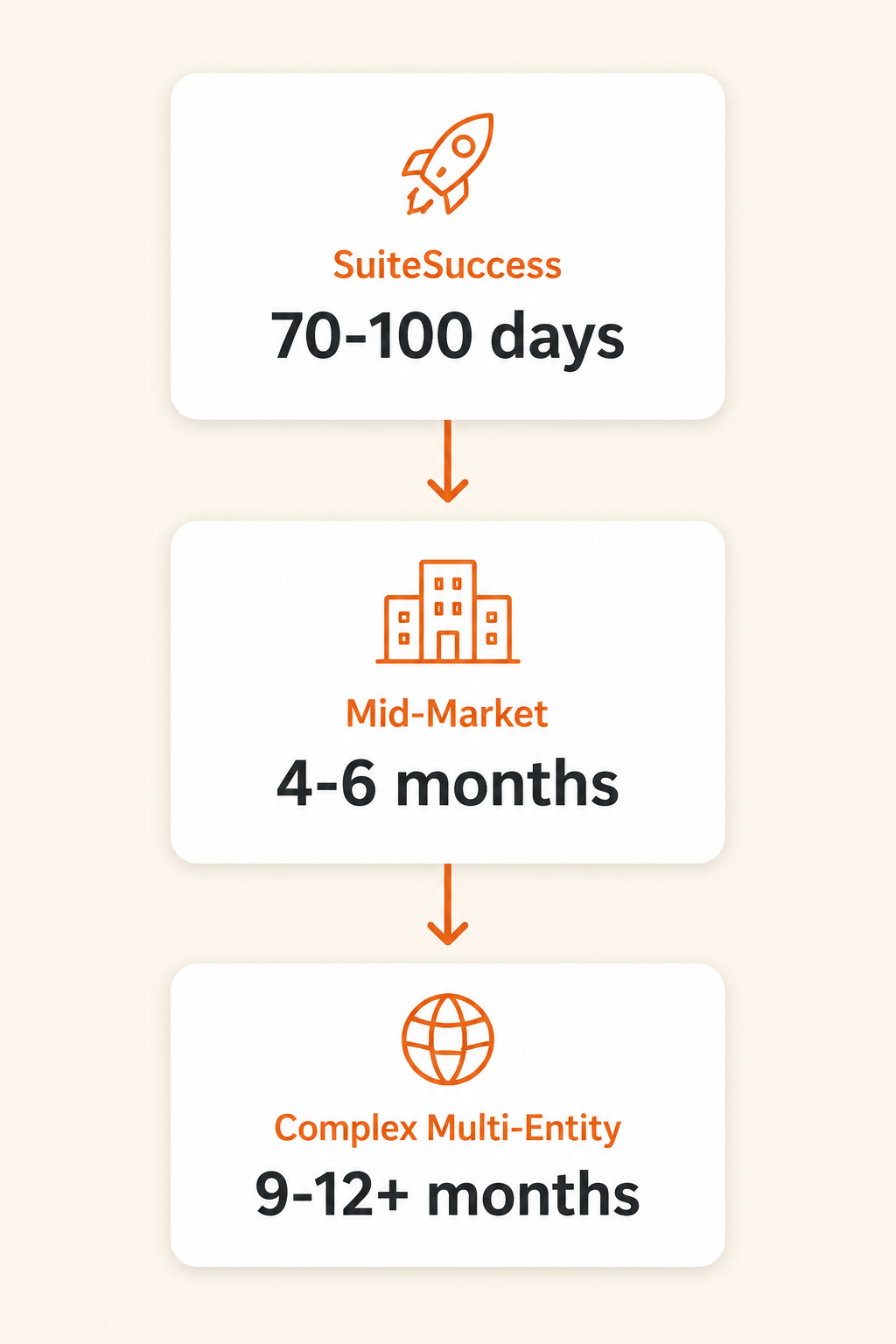
 Streamlined SuiteSuccess: 70 to 100 Days
NetSuite's SuiteSuccess methodology uses preconfigured industry templates to accelerate deployment. We have delivered SuiteSuccess implementations in as little as 70 days.
Real Softype durations:
Two-company implementation: 70 days from kickoff to go-live, with 30-day post-go-live support
Single-country energy company: 90 days
Three-company simultaneous setup: 100 days
Single-entity agricultural producer: 100 days
Health technology company: 100 days
Realty firm: 90 days
Group of companies (3 entities): 120 days
What enables this speed: stakeholder commitment to adopt NetSuite leading practices rather than force the system to mirror legacy workflows, limited customization, fewer integration points, and dedicated internal resources.
What this approach is not: it is not for organizations requiring extensive custom workflows, complex approval routing, or deeply integrated legacy systems.
Standard Mid-Market: 4 to 6 Months (16 to 26 Weeks)Most mid-market NetSuite implementations fall into the 4 to 6 month range. This timeline assumes a single subsidiary or limited multi-entity scope, moderate process complexity, basic inventory, one or two integrations, and dedicated internal resources.
Real Softype durations:
Wholesale distribution manufacturer: 18 weeks (Engage 3 weeks, Drive 7 weeks, Enable 4 weeks, Convert 4 weeks)
Multi-location food services group: 22 weeks (Engage 4 weeks, Drive 8 weeks, Enable 6 weeks, Convert 4 weeks), go-live in week 21
4-entity OneWorld deployment: 14 to 18 weeks (518 to 605 hours)
Multi-clinic healthcare provider Phase 1: 10 weeks
Standard CAS implementation: 20 to 24 weeks
What drives this timeline: item master cleanup, integration testing, approval workflow design, and cross-team coordination across finance, operations, and IT.
Complex Multi-Entity: 6 to 12+ MonthsOrganizations with multiple subsidiaries, intercompany transactions, multi-country operations, or complex supply chain requirements should plan for 6 to 12 months or longer.
Real Softype durations:
Renewable energy company with multiple project models: 24 weeks
Holding company with 20+ subsidiaries: 24 to 26 weeks
Retail operations replacing SAP, with parallel SAP integration: 24 to 28 weeks
International NGO with multiple entities: 9 months contract-to-go-live, 12.5 months total including hypercare
Logistics group replacing a legacy ERP: phased rollout starting with a subset of entities
What extends these timelines: intercompany reconciliation logic, multi-currency and tax configurations, data migration across multiple entities, statutory reporting requirements, and phased rollouts.
Different modules carry different complexity. Understanding this helps you build a realistic project plan.
Module | Typical Duration | Key Drivers |
|---|---|---|
Core financials (GL, AP, AR, banking) | 8 to 12 weeks | Chart of accounts design, approval workflows |
Inventory and order management | 10 to 14 weeks | Item master cleanup, multi-warehouse setup |
CRM (added) | 2 to 4 weeks | Pipeline design, lead routing rules |
Manufacturing (work orders, BOMs, routings) | 3 to 6 months | BOM extraction, routing design, cost roll-up |
Warehouse Management (WMS) | 3 to 6 months | Bin structure, mobile device config, integrations |
Multi-entity / OneWorld | Adds 2 to 6+ months | Intercompany rules, currency translation, eliminations |
Planning and Budgeting (NSPB) | 12 to 18 weeks | Driver-based models, integration to actuals |
Softype uses NetSuite's SuiteSuccess methodology with four phases. Here is what actually happens in each phase and how long it typically takes.
Engage (1 to 4 weeks)Project initiation, requirements validation, solution design, and data migration planning. Includes the kick-off meeting, getting started session, and Joint Design Document (JDD).
Typical duration: 1 to 4 weeks. Mid-market implementations tend toward 3 to 4 weeks.
Why it varies: complex multi-entity discoveries take longer because more stakeholders need to align on entity hierarchy, chart of accounts, and reporting requirements.
Drive (4 to 10 weeks)System configuration, custom development, integrations, and process walkthroughs. The bulk of the build work happens here.
Typical duration: 4 to 10 weeks. This is the longest phase in most implementations.
What controls the duration: number of integrations, depth of customization, and whether the team has clean source data ready for trial loads.
Enable (3 to 6 weeks)UAT, training, finalized data migration, and process sign-off. This is where defects surface and get resolved before go-live.
Typical duration: 3 to 6 weeks. Skipping or rushing this phase is the most common cause of post-go-live problems.
Convert (1 to 4 weeks plus hypercare)Final cutover from legacy systems to NetSuite production. Includes opening balance posting, user access activation, validation of first production transactions, and hypercare support.
Typical duration: 1 to 4 weeks for the cutover, plus 30 to 90 days of hypercare.
Hypercare (the post-go-live stabilization period) is when the implementation team remains on standby to address production issues and optimize processes based on real usage. Most engagements include a 30-day hypercare window with extended support available.
Poor legacy data quality is the biggest timeline risk. Item records lacking accurate costs, customer records with duplicates, opening balances that do not reconcile.
Mitigation: start data cleanup during discovery (Engage phase), assign dedicated data owners, run mock migrations before UAT.
Integrations with CRM, ecommerce, WMS, banking, and payroll require defined ownership, error handling, and retry logic. Defects discovered late delay go-live.
Mitigation: define integration specifications during the Drive phase, assign technical owners per integration, begin integration testing early.
Adding requirements after the project starts is the number one cause of timeline overruns.
Mitigation: maintain a formal scope register, require executive sponsor approval for changes, document timeline and cost impact before proceeding.
NetSuite implementations require significant time from internal subject matter experts for requirements, validation, testing, and training.
Mitigation: secure dedicated resource commitments before kickoff, build availability assumptions into the project plan, escalate availability issues immediately.
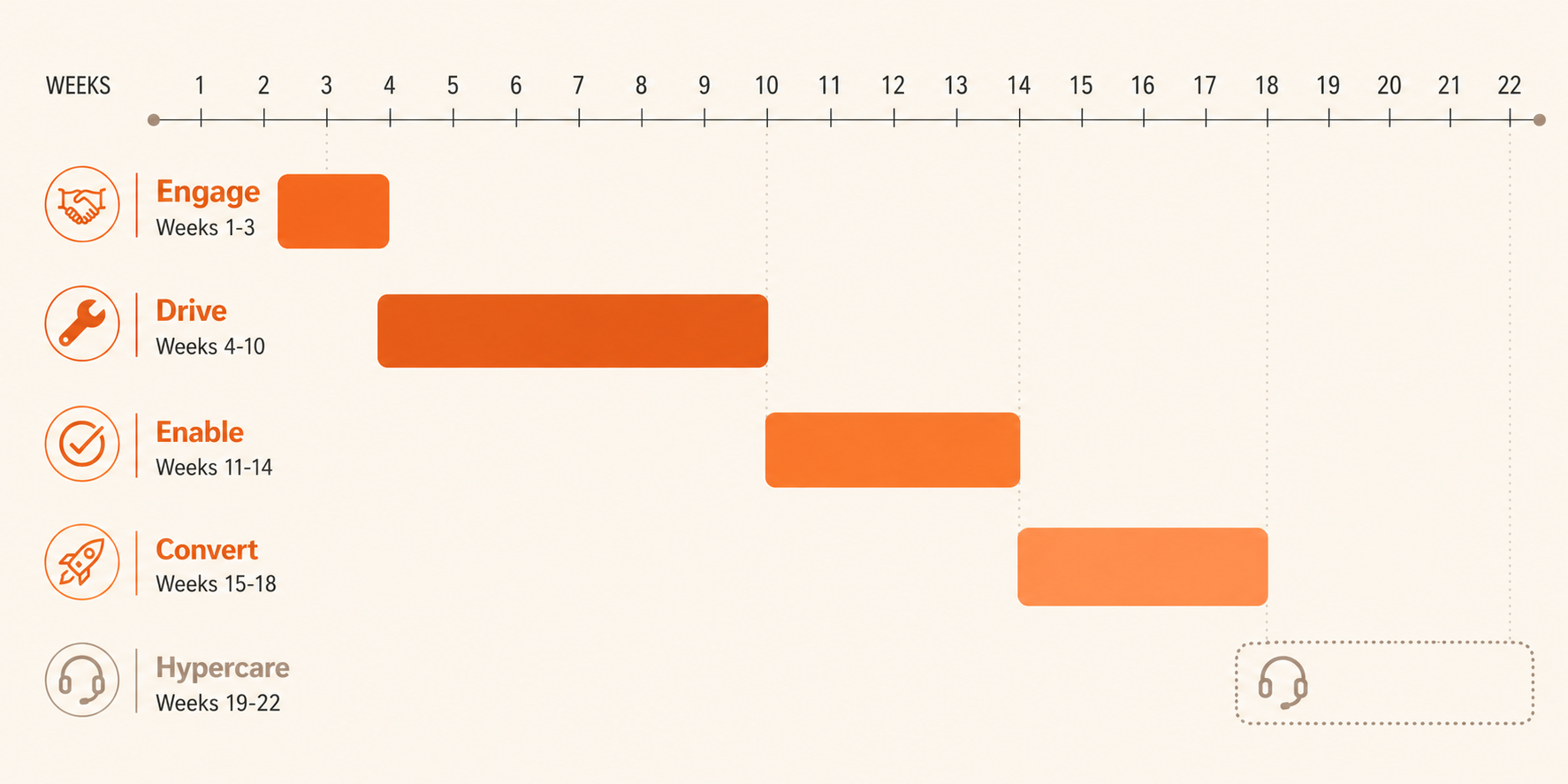
A phase-by-phase walkthrough:
Weeks 1 to 3 (Engage). Discovery, requirements, design sign-off, data migration plan.
Weeks 4 to 10 (Drive). Configuration, customization, integrations, process walkthroughs, trial data loads.
Weeks 11 to 14 (Enable). UAT, training, defect remediation, final data migration.
Weeks 15 to 18 (Convert). Cutover, go-live, hypercare begins.
Weeks 19 to 22 (Hypercare). Issue resolution, process optimization, transition to ongoing support.
This is a typical 18-week mid-market implementation. SuiteSuccess deployments compress this to 10 to 14 weeks. Complex multi-entity deployments extend it to 24 to 50+ weeks.
We commit to fixed-bid project plans with clear phase milestones. Our typical Statement of Work (SOW) boilerplate includes:
Project team engages with the client within 10 business days of SOW signing
Engage phase culminates in a finalized work plan with milestones, dependencies, and dates
Standard 30-day hypercare, with options to extend to 60 or 90 days for complex environments
60-day post-go-live review to identify follow-on work
Transition to NetSuite Global Support after hypercare ends
Where we commit to a specific go-live date depends on the depth of discovery completed. For SuiteSuccess engagements with limited customization, we can commit early. For complex multi-entity programs, we phase the commitment by milestone rather than locking a single go-live date upfront.
Talk to Softype about scoping a realistic timeline for your NetSuite implementation.

Most mid-market NetSuite implementations take 4 to 6 months from kickoff through go-live. SuiteSuccess deployments can go live in 70 to 120 days. Complex multi-entity or heavily customized projects extend to 9 to 12+ months.
The fastest deployments use SuiteSuccess methodology and complete in 70 to 100 days. This requires stakeholder commitment to NetSuite leading practices, limited customization, dedicated internal resources, and clean source data.
Manufacturing implementations typically take 3 to 5 months for small discrete manufacturers and 5 to 9 months for mid-market companies with multi-level BOMs. Timeline is driven by BOM extraction (4 to 12 weeks), routing design (2 to 6 weeks), and cost roll-up validation (2 to 4 weeks).
Multi-entity deployments typically take 6 to 12+ months. A 4-entity OneWorld deployment can complete in 14 to 18 weeks if scope is contained. A 20+ subsidiary holding company implementation typically runs 6 months or more, depending on intercompany complexity and reporting requirements.
The four primary drivers are: data quality (legacy cleanup), integration complexity, customization depth, and internal team availability. Poor data is the single biggest extender across all implementation types.
Hypercare is the post-go-live stabilization period when the implementation team remains on standby to resolve production issues and optimize processes. Standard hypercare is 30 days. Complex implementations extend to 60 or 90 days. Some engagements include a 60-day post-go-live review for follow-on work.
Yes. Many organizations phase implementations by entity, geography, or module. A typical phased approach: financials and inventory go live first, then operations and manufacturing, then warehouse management. Phasing reduces risk but extends the overall timeline.
NetSuite implementations using SuiteSuccess complete in 70 to 140 days. Traditional on-premise ERPs typically run 12 to 18 months. Cloud architecture, prebuilt industry templates, and a mature partner ecosystem are why NetSuite consistently deploys faster than legacy alternatives.


Helping businesses thrive with integrated ERP solutions.
NetSuite
Service
Company
Contact Us
Copyright © 2026


