


NetSuite and QuickBooks are not competing on quality. QuickBooks is accounting software built for a single entity. NetSuite is a business system built for several. The divide shows up in four places: structure, financial control, operational visibility, and how much planning the move takes.
Ten years ago, a plant nursery had one greenhouse, five employees, and one legal entity. Bank reconciliations were clean. The question isn’t whether QuickBooks is “good.” The question is whether it was designed for the level of operational complexity you now carry.
Ten years ago, a plant nursery had one greenhouse, five employees, and one legal entity. QuickBooks was perfect.
Invoicing worked. Bank reconciliations were clean. Month-end was manageable.
Then growth happened, not dramatically, but steadily. A second location. Imports. Seasonal retail contracts. A distribution arm operating as a separate entity.Nothing broke overnight. But complexity crept in.
Month-end now meant consolidating spreadsheets. Inventory adjustments across locations. Revenue timing mattered. Multiple legal entities required coordination.
QuickBooks was still functioning. The business model, however, had changed.
With 25+ years of experience and 600+ implementations, we help businesses get most value from ERP Implementation. Talk to us.
The question is not whether QuickBooks is good software. It is whether QuickBooks was built for the operational complexity you now carry.
The question isn’t whether QuickBooks is “good.” The question is whether it was designed for the level of operational complexity you now carry.
QuickBooks is accounting software. NetSuite is an ERP platform.
That architectural difference matters more than feature lists.
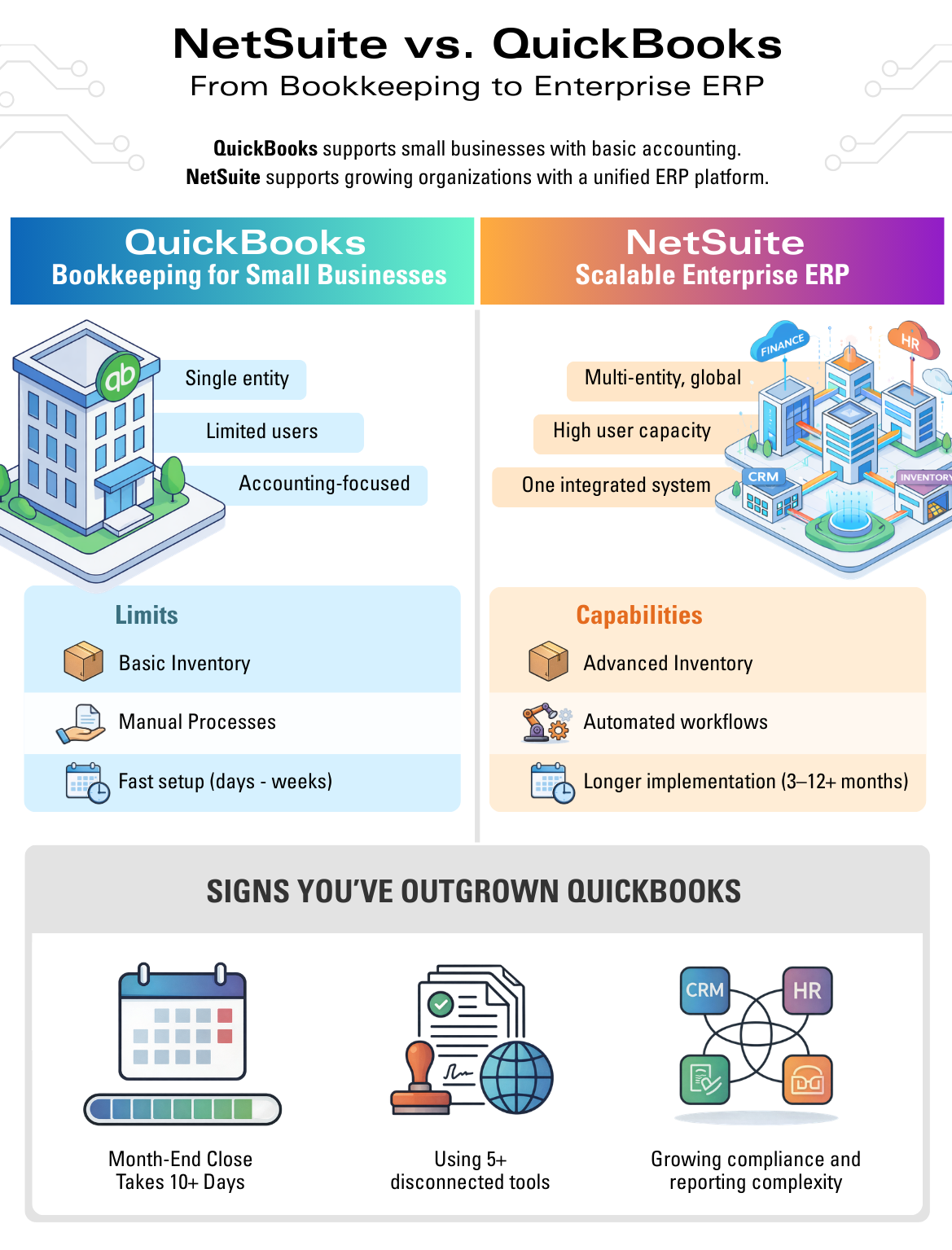
QuickBooks handles single-entity accounting. Multiple entities usually mean separate files and manual consolidation.
QuickBooks: Designed primarily for single-entity accounting. Multiple entities typically mean separate files and manual consolidation.
NetSuite: Multi-entity, multi-currency operations inside one system with consolidated reporting by design.
If consolidation happens outside the system, you’re carrying risk.
QuickBooks offers basic billing and a traditional chart of accounts, where NetSuite adds structured revenue recognition and multidimensional reporting.
Basic billing vs structured revenue recognition
Traditional chart of accounts vs multidimensional reporting
Limited permissions vs role-based controls and audit trails
As contracts become more structured, governance requirements increase. Systems either support that — or they strain under it.
QuickBooks gives you basic inventory and data exports. NetSuite gives multi-location traceability and dashboards that update in real time.
Basic inventory vs multi-location traceability
Exporting data for analysis vs real-time dashboards
Assistive automation vs embedded forecasting and anomaly detection
At scale, inventory accuracy and timing aren’t accounting concerns, they’re operational survival.
Feature | QuickBooks | NetSuite |
Primary Use | Small business accounting | Full ERP platform |
Multi-Entity | Separate files / manual consolidation | Native consolidation in one system |
Users | Capped (Advanced tier limits) | Scalable across teams and geographies |
Inventory | Basic tracking | Multi-location, traceable inventory |
Revenue Recognition | Basic billing models | Structured, automated recognition |
Reporting | Standard financial reports | Multidimensional, real-time reporting |
Implementation | Days to weeks | Structured implementation (3–12+ months) |
A structured comparison like this clarifies the architectural divide, not just feature differences.
QuickBooks deploys quickly. NetSuite needs planning, sequencing and change management, and that difference belongs in your decision.
QuickBooks can be deployed quickly. NetSuite requires planning, sequencing, and change management.
Practitioner note: in live migrations the sequencing matters more than the software. The projects that go badly are almost always the ones that tried to move every entity and every process in a single cutover.
That’s not a drawback. It reflects scope. ERP is not an accounting upgrade. It is a structural shift in how the business runs.
If the nursery had remained one greenhouse, QuickBooks would still be right.
But once you are
Managing multiple entities
Reconciling across locations
Handling structured contracts
Needing consolidated visibility
You are no longer solving an accounting problem. You are managing operational complexity.
And that requires a system designed for it.
The decision isn’t which product is “better.” It’s whether your business has evolved beyond what accounting software was built to support. That’s a strategic conversation, not a software comparison.
Typically when managing multiple entities, locations, structured contracts, or when financial consolidation becomes manual and time-consuming.
They serve different purposes. QuickBooks is accounting software for simpler operations. NetSuite is a full ERP platform designed to manage operational complexity.
It can, but usually through separate files and manual consolidation. Native multi-entity consolidation is where ERP systems like NetSuite differentiate.
Not always. But once operational complexity increases beyond bookkeeping, ERP becomes a structural requirement, not a luxury.
 RELATED POST: NetSuite vs QuickBooks Enterprise: When to Upgrade Your Accounting
RELATED POST: 5 Signs Your Business Has Outgrown QuickBooks and Needs NetSuite
The question isn’t whether QuickBooks is “good.” The question is whether it was designed for the level of operational complexity you now carry.
QuickBooks: Designed primarily for single-entity accounting.
Basic billing vs structured revenue recognition.
Basic inventory vs multi-location traceability.
If the nursery had remained one greenhouse, QuickBooks would still be right.
When should a company move from QuickBooks to NetSuite?
These published sources cover the detail behind the points above:
7 reasons NetSuite is World’s # 1 Cloud Financial Accounting Software
NetSuite for Nonprofits: Fund Accounting, Grant Management & Donor Tracking
5 Signs Your Business Has Outgrown QuickBooks and Needs NetSuite
Softype is an Oracle NetSuite solution provider with more than 25 years of experience and over 600 implementations. Our team sets NetSuite up around how your business already runs, then stays on to tune it as you grow. To see what that looks like for your own numbers, book a meeting with our team.
NetSuite runs as one system across entities rather than one file per company. Oracle documents the ERP feature set behind that, covering the ledger, receivables, payables and reporting in a single record model.
The practical difference is consolidation. Where QuickBooks asks you to export and combine, NetSuite reports across entities natively, so month-end does not depend on someone rebuilding a spreadsheet.
Softype implements this move regularly, and the trigger is almost always the same: the finance team is spending more time assembling numbers than interpreting them.
The trigger is rarely dissatisfaction with QuickBooks. It is the month-end that keeps getting longer, the consolidation that lives in a spreadsheet, and the inventory question nobody can answer without an export.
If those three things describe your close, the cost of staying is already being paid in staff time. That is the comparison worth making, rather than a feature-by-feature list.


Helping businesses thrive with integrated ERP solutions.
NetSuite
Service
Company
Contact Us
Copyright © 2026


