

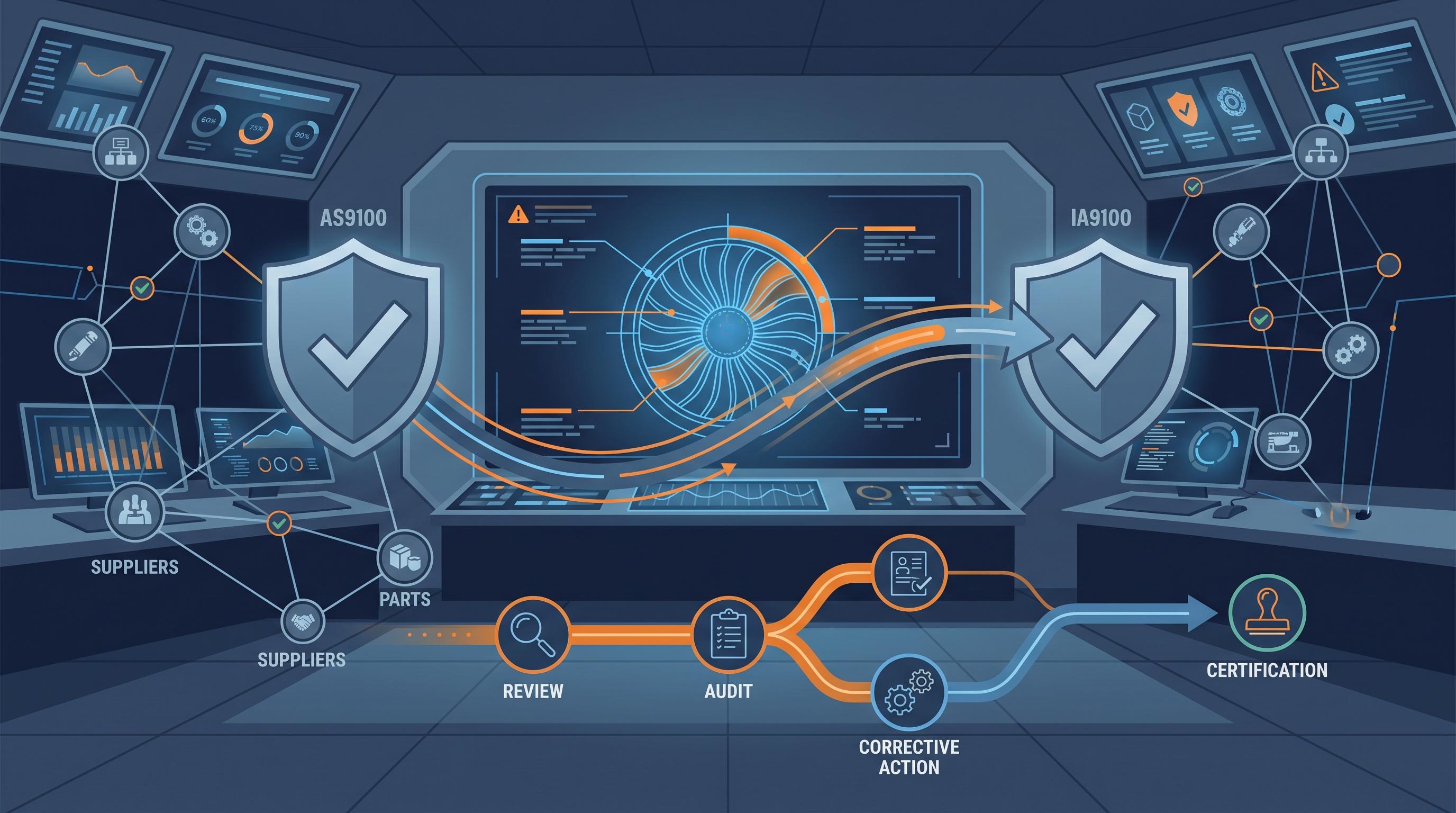
The AS9100 to IA9100 changes raise one practical question for aerospace suppliers: what is the best ERP for manufacturing when an auditor asks for proof? It is the system that can show a clean trail across risk, supplier controls, approvals, and quality records. Under the next revision cycle, your ERP and QMS stack must do more than process jobs. It must prove who changed what, when they changed it, and how the business controlled the risk.
TL;DR: The AS9100 to IA9100 changes are not just a label update. Aerospace suppliers should tighten cyber-risk handling, supplier oversight, and audit evidence now so quality teams can retrieve one defensible operating story fast. Start with your risk model, your supplier records, and the links between work orders, approvals, and nonconformance data.
Take Softype’s 15-minute NetSuite Readiness Assessment for a fast view of where your current operating stack may fall short before IA9100 transition work starts in earnest.
The phrase AS9100 to IA9100 changes can sound like a naming update. That misses the real issue. Quality leaders should prepare for a higher proof burden around risk control, supplier governance, document integrity, and audit evidence.
In its October 2024 update, the ISO committee said the revised ISO 9001 is planned for September 2026. The final 9100-series text is still not published. That means teams should separate confirmed source material from likely implementation themes.
For a QA Director, Quality Manager, or COO, the practical issue is simple. Can your quality system, ERP workflows, and cyber controls show a clear chain of evidence when an auditor asks how risk was identified, applied, and closed?
The safest way to think about IA9100 is this: expect the familiar clause backbone to stay, but expect tighter proof around higher-risk operating conditions. Industry discussion points to stronger attention on information security, supplier visibility, product safety, measurement evidence, and risk-based auditing. Until the final text lands, teams should treat these as preparation themes, not settled clause language.
One likely shift matters more than the rest. If a cyber event can affect product conformity, traceability, or release decisions, quality teams will need to treat it as a quality issue, not only an IT issue.
Area | AS9100D baseline | IA9100 direction of change |
|---|---|---|
Standard identity | Regional naming under AS9100, EN9100, JIS Q 9100 | More globally aligned publication and change control |
Quality risk planning | Risk-based thinking is required, but many teams keep cyber risk outside the quality plan | Tighter expectation that cyber events affecting conformity, records, or delivery sit inside the operating risk model |
Documented information | Control is required, but many sites still rely on mixed manual and shared-folder governance | Greater emphasis on access control, integrity, retention, approval history, and electronic evidence |
Supplier oversight | Approved supplier control often centers on direct suppliers | More scrutiny on sub-tier visibility, counterfeit exposure, distributor chain, and supplier risk signals |
Audit evidence | Evidence can be spread across ERP, spreadsheets, folders, and email | Higher expectation for fast, consistent retrieval of linked operational evidence |
Cyber-control alignment | Often handled in a separate IT or contract-compliance stream | Stronger link to DFARS, NIST, and CMMC-style control discipline where cyber events affect quality execution |

Cyber risk now touches quality execution. A compromised drawing, an altered work instruction, an inaccessible traveler, or a corrupted inspection record can create the same real-world damage as a bad lot.
That is why quality teams should treat cyber risk as an operating input. DFARS 252.204-7012 still requires cyber incidents to be reported within 72 hours. NIST SP 800-171 Rev. 2 was withdrawn in May 2024 and superseded by Rev. 3, even though many defense suppliers still map their programs against Rev. 2. If your ERP may sit inside that boundary, this DFARS 7012 and CMMC checklist gives the compliance context.
In practical terms, your quality risk plan should answer questions like these:
Which cyber events could compromise revision-controlled production data?
Which roles can alter inspection, nonconformance, or release records?
How is supplier cyber exposure considered when that supplier handles sensitive drawings, test data, or customer requirements?
What is the escalation path if system integrity affects product disposition or delivery?
For the standards side, monitor IAQG for 9100-series governance updates, the ISO 9001 revision timeline for the current 2026 schedule, and NIST guidance for the cyber-control context. That source trail helps you separate confirmed updates from market interpretation.
An aerospace quality management ERP setup that worked under AS9100D may still process transactions well. That is no longer enough. The real question is whether your system can show how risk, supplier control, quality events, and cyber exposure connect at the record level.
The best ERP for manufacturing in this context is not the one with the longest feature list. It is the one that lets quality teams retrieve evidence fast, enforce role-based control, and connect live operations to the risk model. For a wider operating view, see this guide to NetSuite manufacturing implementation.
Most nonconformance processes classify issues by material, dimensions, supplier, process, or documentation. Quality teams now also need a way to tag events with a cyber trigger or cyber impact.
That includes unauthorized document changes, access failures tied to inspection records, corrupted work instructions, unavailable systems, or supplier incidents that affect required data. The point is not to turn quality staff into security staff. The point is to make these events visible, searchable, and auditable.
A strong quality plan for aerospace in 2026 cannot sit in a static folder. If the risk plan says a process, part family, or customer program has elevated exposure, the live operating record should show it.
At minimum, teams should connect risk classification to work orders, inspection checkpoints, engineering changes, release approvals, and affected supplier records. When an auditor asks how a known risk changed the process, the answer should be in the execution record.
AS9100D supplier control often centers on approvals, certifications, delivery performance, and part quality. IA9100 pressure is likely to push further. Aerospace suppliers need a practical view of whether a vendor adds risk through weak information handling, unmanaged subcontracting, or poor access discipline.
Not every vendor needs a full cyber audit. But the supplier record should support a risk tier, review date, evidence reference, and escalation path. If a supplier touches controlled information or critical process knowledge, that supplier changes your quality exposure.
Two related resources fit this section better than generic regional pages. This post on assembly manufacturing ERP controls shows how mature operating stacks connect production, planning, and traceability. This CUI boundary checklist shows where supplier and system controls start to affect compliance scope.
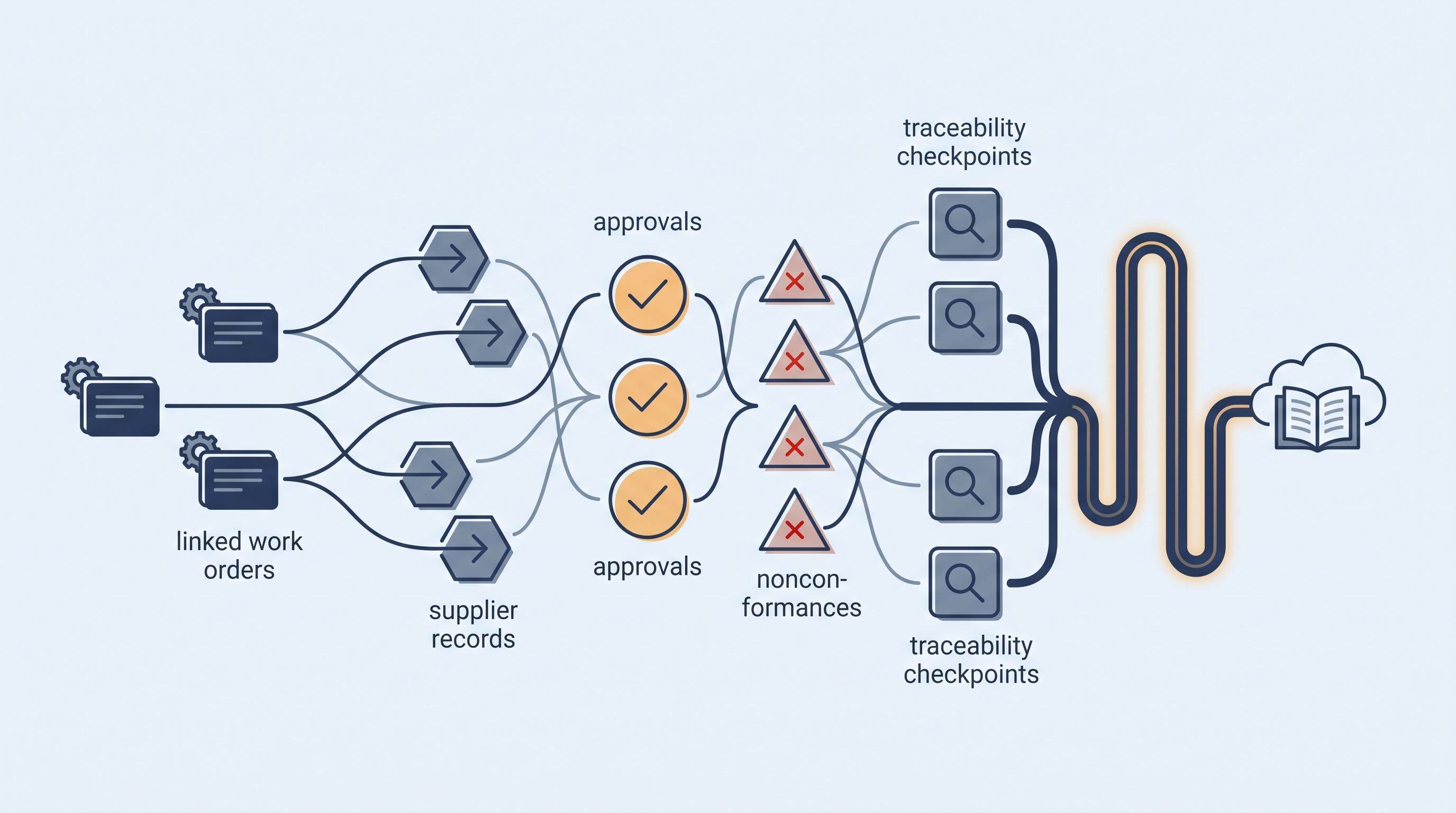
Audit retrieval speed matters. Many mixed-tool environments still split part history, risk plans, approvals, nonconformances, and supplier evidence across separate systems and folders.
That setup works until an auditor asks for one time-bound, evidence-specific story. Then teams spend days rebuilding what should have been traceable in minutes. The IA9100 direction favors systems that can retrieve one coherent record of the part, revision, supplier, risk rating, quality event, approval path, and final disposition.
Your reader is not shopping for ERP from scratch. The narrower question is this: which architecture is more likely to support the AS9100 to IA9100 changes without forcing manual evidence assembly?
Operating area | NetSuite Advanced Manufacturing + Softype configuration | Quality tool + QuickBooks stack |
|---|---|---|
Work-order-linked risk controls | Connects work orders, routing steps, approvals, item records, and custom risk fields in one operating flow | Often split between a finance tool, spreadsheets, and a standalone quality layer with weaker operational context |
Cyber-risk-tagged nonconformance | Configured with structured classifications, escalation logic, and linked operational evidence | Often managed as a separate ticket or note outside the main transaction trail |
Supplier cyber-risk scoring | Lives on the supplier record with review dates, tiers, and downstream reporting | Often tracked in a side spreadsheet or folder, disconnected from receiving and purchasing history |
Audit retrieval speed | Stronger potential for one-path retrieval when configuration is disciplined | Higher dependence on manual evidence gathering across disconnected tools |
Change governance | Better fit for role-based approvals and linked record history | More likely to rely on informal workarounds outside the main operating system |
The real comparison is not ERP versus accounting software. It is unified operating evidence versus stitched-together evidence. For more background, see Softype’s comparison of NetSuite vs QuickBooks Enterprise and its guide to when businesses outgrow QuickBooks.
The best response is not a large software project on day one. It is a focused 90-day readiness sprint that shows where your current control model breaks.
Document where the risk plan, supplier reviews, nonconformances, engineering changes, inspection evidence, access approvals, and customer flow-downs are stored today. Document the real process, not the intended one.
Review the current risk plan and ask whether it covers data integrity, access compromise, document tampering, system outage, or supplier cyber incidents that could affect conformity or on-time delivery. If not, the model already lags the operating reality.
Before launching a larger systems project, add the minimum fields needed to make risk visible now: cyber-risk classification on nonconformances, supplier cyber tier, review date, linked risk-plan reference, and a flag that ties elevated-risk jobs to approval control.
Pick one job, one supplier, one engineering change, and one elevated-risk event. Then see how quickly your team can produce the full story. If the answer still depends on inboxes and side files, your evidence model is not strong enough.
If your customers already invoke DFARS or expect NIST and CMMC maturity, do not build the quality transition plan in isolation. The cyber-control conversation and the quality-evidence conversation are already converging.
Download the Assembly Manufacturing ERP Checklist for a practical starting point while a dedicated IA9100 checklist is still being built.
IAQG for official 9100-series governance and publication updates
ISO 9001 revision updates for current 2026 timing and development status
NIST SP 800-171 Rev. 2 as the withdrawn baseline many suppliers still reference while moving to Rev. 3
DFARS 252.204-7012 for contract language that shapes how many defense suppliers frame cyber controls and incident response
These sources do not remove every uncertainty around the final IA9100 release language. They do make the direction clear enough to start remediation planning now. This article separates confirmed source material from anticipated implementation themes.
The exact mandatory date still depends on final publication timing and transition rules. Most aerospace teams should expect a formal transition window after release rather than an immediate cutover.
The market expectation is a transition to the new IA-labeled standard rather than a parallel long-term track. Certified organizations should watch official transition rules before making audit-timing assumptions.
The biggest change is the proof burden. ERP must support stronger evidence links across risk plans, suppliers, approvals, nonconformances, and document control.
Not always. But many organizations will need to expand the current one so cyber events, supplier data exposure, and document-integrity failures sit inside the active risk model.
They are different frameworks, but they touch the same operating reality. If cyber controls affect access, data integrity, supplier trust, or audit evidence, the quality and compliance teams can no longer work in separate lanes.
Current certificates should remain valid until formal transition rules take effect. The safer assumption is that waiting until the last minute will create unnecessary audit pressure.
No. But if your evidence trail still depends on a finance tool, a separate quality app, spreadsheets, and shared folders, expect more friction as the proof burden rises.
Start with a control-gap review. Map where your risk plan, supplier review process, approval records, and nonconformance evidence live today, then rank the biggest traceability breaks.
The AS9100 to IA9100 changes shift the conversation from procedures to proof. Aerospace suppliers should tighten the link between quality risk, cyber risk, supplier governance, and live operating evidence before the next audit cycle forces the issue.
If your current stack still depends on a quality tool, QuickBooks, and manual reconciliation, now is the right time to expose those gaps. If your team already runs on NetSuite, the next question is how to configure manufacturing and quality workflows so the evidence trail is visible, role-controlled, and easy to retrieve.
Book a 30-minute IA9100 readiness call for a focused review of where your current operating model is likely to break under the next 9100-series transition.


Helping businesses thrive with integrated ERP solutions.
NetSuite
Service
Company
Contact Us
Copyright © 2026


