


If you run a distribution or trading business in the Philippines, the question is not "which ERP is best." It is "which platform, configured by which partner, handles my multi-branch reality, my BIR obligations, my POS and e-commerce channels, and my growth plans without falling apart in year three?" That is a more useful frame.
This guide gives you the evaluation framework. We cover what Philippine wholesalers actually need, the platform archetypes worth considering, the BIR compliance layer that determines whether the system survives audit time, and a feature checklist you can use during demos.
For broader context, see our companion guides: NetSuite Implementation Partners in the Philippines: How to Choose, How to Implement NetSuite: Step-by-Step Guide for First-Time Buyers, and How Much Does NetSuite Really Cost? A Transparent Guide for Businesses. A dedicated industry page on ERP for distributors and a deeper dive on trading ERP are also available on the Softype site.
Distribution in the Philippines combines several pressures at once. Most wholesale businesses are not running one warehouse and one branch. They are running a head office, regional branches, multiple warehouses, sometimes a retail front, and increasingly an online channel. The result is constant pressure on inventory accuracy, transfer documentation, branch-level financial visibility, and consolidated reporting.
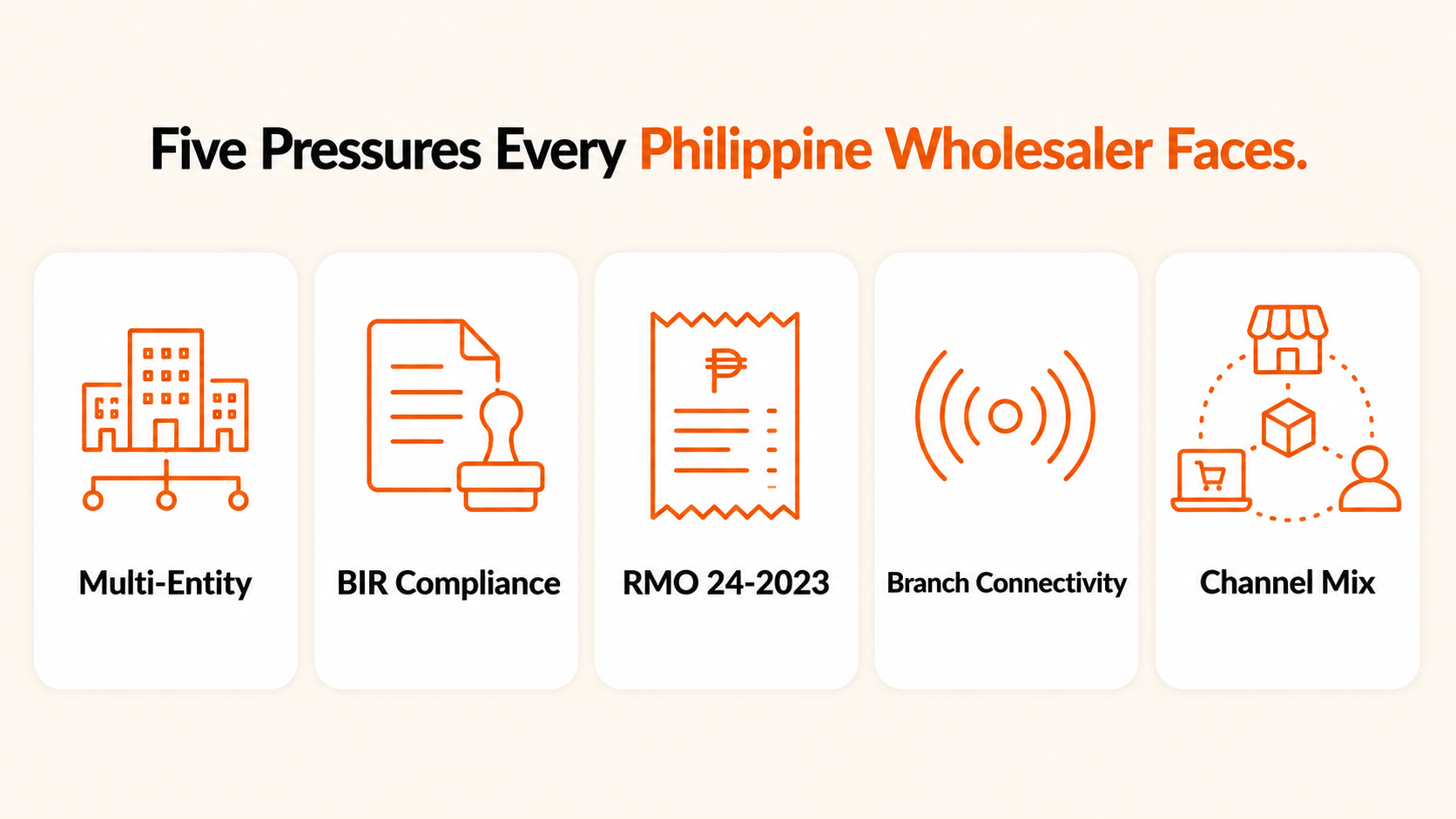
Layer onto that the local compliance and operational realities:
Multi-entity structures. Many Philippine distributors operate as several legal entities under a holding structure, often for BIR compliance reasons. Consolidation across entities is non-trivial and needs to be designed in, not bolted on.
BIR compliance. Value Added Tax (VAT), expanded withholding tax (EWT), and creditable withholding tax (CWT) are part of the daily workflow, not a year-end exercise. Reports for BIR Form 2307, BIR Form 1601-EQ, the Summary Alphalist of Withholding Tax (SAWT), the Quarterly Alphalist of Payees (QAP), and the Summary List of Sales/Purchases (SLS/SLP) must come out clean.
BIR RMO 24-2023. Computerized Accounting System (CAS) and POS receipting requirements have tightened. Any retail or wholesale-with-counter operation needs RMO 24-2023 compliant receipting, which is rarely native and depends on partner configuration.
Branch connectivity. Provincial and island branches still face unreliable internet. Offline-capable POS and asynchronous syncing are real requirements for many distributors, not nice-to-haves.
Channel mix. Counter sales, B2B sales orders, field reps with route lists, marketplaces (Lazada, Shopee, Zalora, TikTok Shop), and own-brand e-commerce often coexist within the same business.
A platform that handles two of those well and three of them badly will create exactly the kind of manual workarounds the system was supposed to remove. The evaluation has to test against all of them.
Stock by branch, warehouse, bin, and lot. Transfers between locations with proper documentation. Centralized item master and pricing managed at head office, with branch-level access controls so store users cannot see cost prices but can transact normally. Real-time visibility on stock positions across the entire network.
A pattern we see often in Philippine distribution: a head office in Manila or Cebu, regional branches handling local sales and credit, and warehouses sitting separately to optimize freight and inbound logistics. The system has to model that without forcing the business to flatten the structure.
This is the single biggest differentiator between platforms that work in the Philippines and platforms that almost work. The practical question for any vendor is whether VAT, EWT, CWT, official document flows, and reporting outputs can be configured cleanly enough that the accounting team uses them every month and quarter without offline workarounds.
Specifically, ask the vendor or partner to show you:
BIR Form 2307 generation, by vendor, with the right tax codes and amounts.
Quarterly outputs feeding 1601-EQ.
SAWT, QAP, SLS, and SLP exports in the formats BIR accepts.
Customer and vendor tax tagging that flows automatically into transactions.
For retail or counter operations, BIR RMO 24-2023 compliant receipting with the right serialization, journal entries, and CAS audit trails.
Many global ERPs can support all of this. The difference is how much configuration and ongoing maintenance the local layer requires. A pattern we see: even excellent international platforms become cumbersome if the Philippine layer depends on heavy manual journals or offline reconciliations. The localization quality lives at the partner level.
Distribution is inventory work. Beyond quantity on hand, look for:
Units of measure with conversion (cases to pieces, sacks to kilograms, bulk to retail packs).
Reorder rules and replenishment automation.
Lot or serial tracking, with expiry support for FMCG, food, and pharmaceutical distributors.
First-Expiry-First-Out (FEFO) and First-In-First-Out (FIFO) allocation logic.
Available-to-promise versus already-committed visibility.
Landed cost handling for imported goods, including duties, freight, and brokerage.
Branch-to-branch transfer workflows with proper inventory movement and accounting.
A pattern from a 62-branch Philippine distributor we worked with: UOM repacking from a 25 kilogram sack into per-kilo retail units was a daily operation. Without native repacking and FIFO enforcement, the team would have run on spreadsheets indefinitely, with predictable error rates.
Philippine distributors increasingly run multiple channels at once. The system has to either provide native capabilities or integrate cleanly. The integrations that actually matter:
POS for counter sales and showroom operations, including offline-capable POS for branches with unreliable connectivity.
Marketplace connectors for Lazada, Shopee, Zalora, TikTok Shop, and increasingly proprietary D2C apps.
Field sales tools for route-based reps with order capture, customer credit visibility, and inventory awareness.
Consignment partner workflows where stock sits with third parties and sells through over time, with automated reconciliation.
A pattern we see in mid-sized Philippine distributors: a single business running 30+ owned retail stores plus 80+ consignment partner doors plus four to five e-commerce channels. The integration architecture is more important than the core ERP at that point.
Many Philippine distributors operate multiple legal entities for BIR or operational reasons. Look for:
Native multi-company architecture with intercompany transaction rules.
Consolidated reporting at the group level with subsidiary roll-up.
Per-entity profit and loss with consolidated views.
Intercompany elimination entries handled automatically, not via month-end manual journal entries.
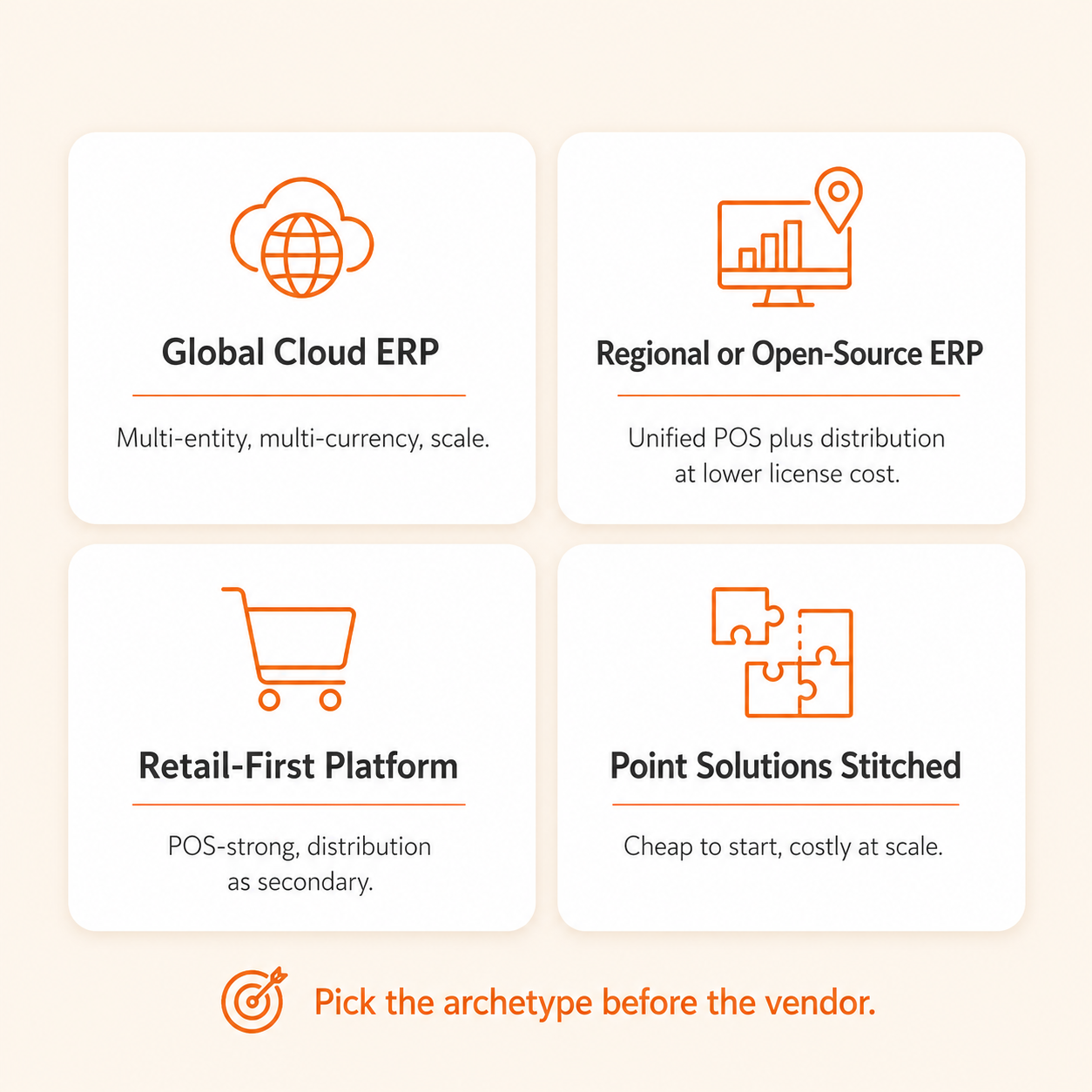
Rather than a vendor leaderboard, here are the four archetypes that show up in most Philippine distribution evaluations. Each has trade-offs.
Examples: Oracle NetSuite, SAP Business One, Microsoft Dynamics 365 Business Central.
Best for: mid-sized to larger distributors with multi-entity, multi-warehouse, multi-currency complexity, and a real need for consolidated financial control. Strong inventory and order management depth. Mature partner ecosystems in the Philippines, including local BIR compliance configuration.
Trade-offs: higher license cost than regional or open-source alternatives. Implementation complexity is real, and the quality of the Philippine localization depends almost entirely on the partner. Native POS is usually not included, so retail-heavy operations need a POS layer alongside.
Examples: Odoo, HashMicro, Zoho.
Best for: distributors that want a unified platform spanning POS, inventory, sales, purchase, and accounting in a single system, often at lower licensing cost. Particularly strong when retail and distribution sit in the same business and a native POS matters. Some platforms (Odoo specifically) ship with offline-capable POS, which matters for provincial and island branches.
Trade-offs: customization-heavy when scope grows. Regional vendors vary widely in BIR depth, so verification during demo is critical. Less proven at enterprise multi-entity scale than NetSuite or SAP, though Odoo in particular has matured significantly.
Examples: Lightspeed, Shopify Plus paired with an ERP layer.
Best for: businesses where retail is the dominant channel and wholesale distribution is secondary. Strong POS, e-commerce, and customer experience features. Less depth on multi-entity finance and procurement.
Trade-offs: need to be paired with a real accounting and ERP layer for serious multi-branch distribution. Often the right call for a smaller retail-led operation, less so for a wholesaler with primarily B2B revenue.
Examples: standalone inventory tools plus standalone POS plus QuickBooks plus marketplace connectors.
Best for: smaller distributors below roughly 20 users, with a single warehouse, a single legal entity, and limited integration needs. Cheap to start.
Trade-offs: every integration is a potential failure point. Reconciliation work compounds as the business grows. Most distributors who go this route end up replacing it within three to five years. The total cost of ownership over time is usually higher than picking a unified platform from the start.
Score each row against the platforms you are evaluating. Anything in the "Must Have" column scoring below adequate is a deal-breaker, not a roadmap item.
Capability Area | Specific Requirement | Must Have or Nice |
|---|---|---|
Multi-Branch Inventory | Stock by branch, warehouse, bin, and lot in real time | Must |
Multi-Branch Inventory | Branch-to-branch transfer workflows with full audit trail | Must |
Multi-Branch Inventory | Centralized item master with branch-level access controls | Must |
BIR Compliance | VAT, EWT, and CWT tagging that flows from master records into transactions | Must |
BIR Compliance | BIR Form 2307 generation per vendor with correct tax codes | Must |
BIR Compliance | 1601-EQ, SAWT, QAP, SLS, and SLP exports | Must |
BIR Compliance | RMO 24-2023 compliant POS receipting (if retail or counter sales apply) | Must (if applicable) |
Multi-Entity | Native multi-company architecture with intercompany rules | Must (if multiple legal entities) |
Multi-Entity | Consolidated reporting with per-entity P&L and group roll-up | Must (if multiple legal entities) |
Inventory Depth | Units of measure with conversion (sacks to kilos, cases to pieces) | Must |
Inventory Depth | Lot, serial, and expiry tracking with FEFO and FIFO logic | Must (if perishables or pharma) |
Inventory Depth | Available-to-promise versus committed visibility | Must |
Inventory Depth | Landed cost handling for imports | Must (if importer) |
POS and Channels | Native or cleanly integrated POS for counter sales | Must (if retail) |
POS and Channels | Offline-capable POS for low-connectivity branches | Must (if provincial branches) |
POS and Channels | Marketplace integration (Lazada, Shopee, Zalora, TikTok Shop) | Must (if e-commerce) |
POS and Channels | Consignment partner workflow with sell-through reconciliation | Must (if consignment) |
POS and Channels | Field sales tool for route reps with order capture and credit visibility | Nice to Must, depending on model |
Procurement | Three-way matching (PO, GR, invoice) | Must |
Procurement | Multi-currency and import handling | Must (if importer) |
Reporting | Real-time dashboards by branch, entity, and channel | Must |
Reporting | Standard BIR-required reports without manual rework | Must |
Platform | Mobile-friendly access for branch and field users | Must |
Platform | Configurable without heavy custom code | Must |
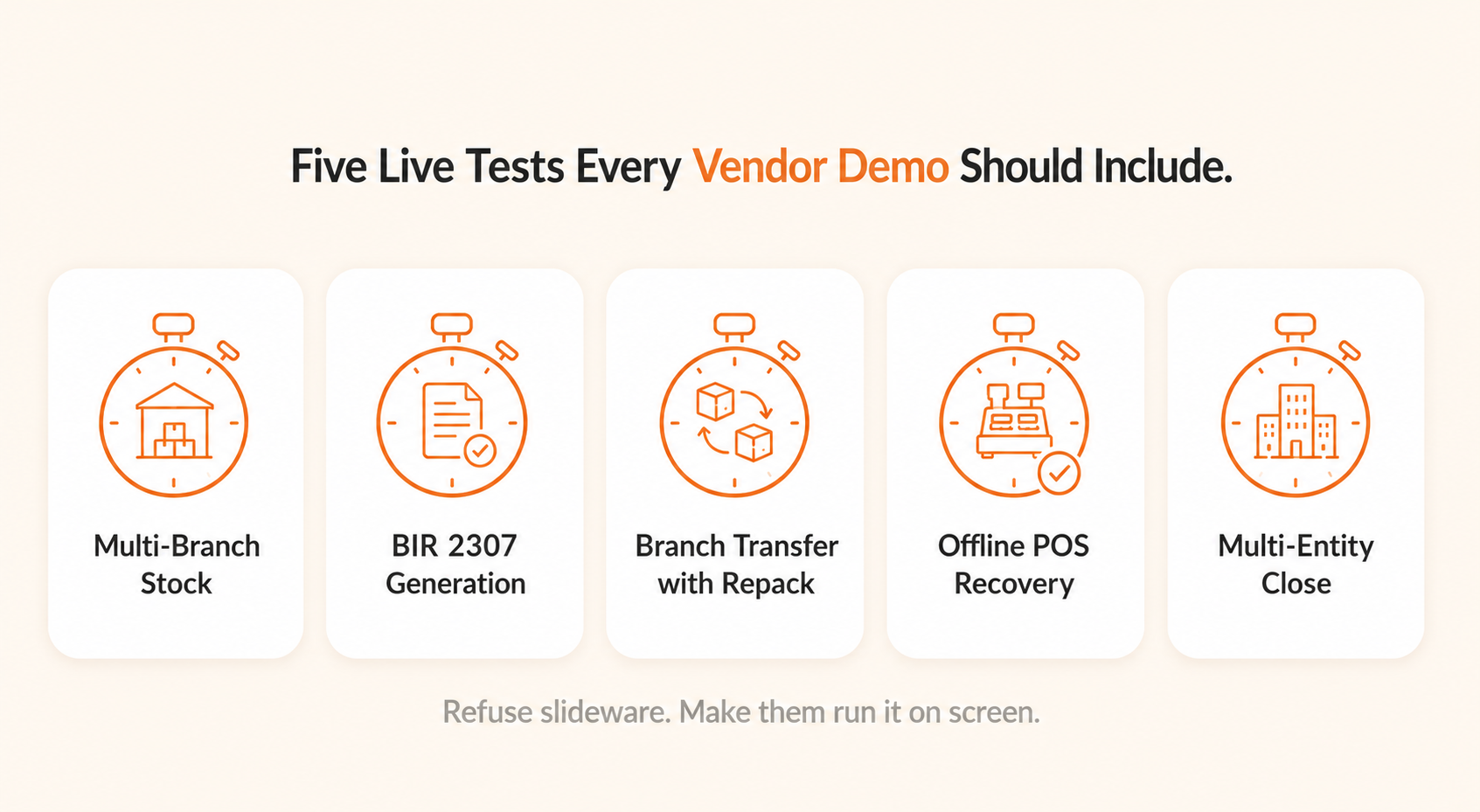
A polished demo can hide a lot. Build these scenarios into every vendor evaluation and require live execution.
 The Multi-Branch Stock Picture
"Show me current stock by item across all our branches and warehouses, with reorder points highlighted, in under 30 seconds."
What you are testing: real-time inventory visibility, search and filter performance, and whether dashboards actually pull live data versus a refresh-every-hour snapshot.
The BIR 2307 Generation"Generate a BIR Form 2307 for one of our vendors for last quarter, with all the right tax codes and amounts. Show me where that data comes from and what happens when a new vendor is onboarded."
What you are testing: localization depth, automatic tax tagging on master records, and whether the report comes out clean or needs manual touch-up.
The Branch Transfer with Repack"Move 10 sacks of 25 kilogram stock from the warehouse to a retail branch, repack into 1 kilogram retail units, and reflect the inventory and accounting impact across both locations."
What you are testing: UOM conversion, inventory movement integrity, and whether the system handles repacking natively or through workarounds.
The Offline POS Recovery"Disconnect the branch POS from the network. Process five transactions. Reconnect. Show me what happens."
What you are testing: offline-capable POS, transaction queuing, sync reliability. Critical for provincial and island branches.
The Multi-Entity Close"Show me the consolidated month-end close across our three legal entities, including intercompany eliminations."
What you are testing: native multi-company architecture, consolidation depth, and whether the team is doing this in the system or in Excel.
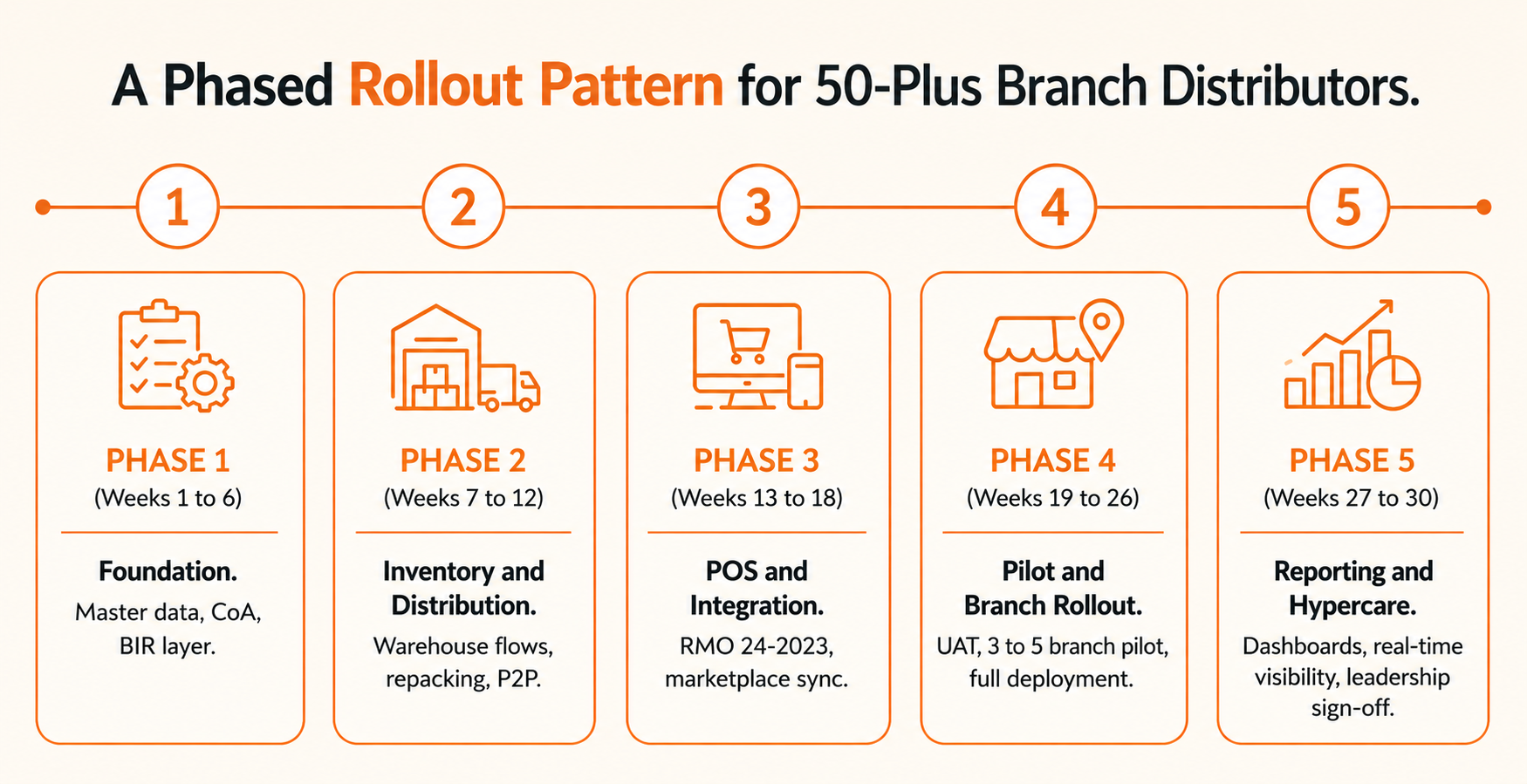
A few patterns we see consistently in Philippine distribution implementations that go well:
Phase the Rollout, Pilot the POSDistribution implementations that try to do everything at once often slip.
The patterns that work: phase finance and inventory first, then layer the operational and POS rollout, then add e-commerce and demand planning. For multi-branch businesses, pilot the POS at three to five branches before deploying to all locations. We have seen 30-week delivery plans for 60-plus branch deployments executed cleanly using this structure.
Get the BIR Layer Right Before Anything ElseLocalization is not a Phase 3 item. It belongs in the foundation phase. The accounting team needs to be running clean VAT and withholding workflows before the rest of the business goes live, because everything else flows through that layer.
Decide Where Manufacturing LivesIf your distribution business also manufactures or does light assembly, the cleanest pattern is sometimes to keep manufacturing on a specialized system (SAP Business One or a manufacturing-specific tool) and run distribution on a unified ERP, with a single integration point at head office. Trying to do both natively in the same platform sometimes works and sometimes does not, depending on the platform.
Plan for Connectivity, Not Around ItProvincial and island branches are part of the architecture, not edge cases. Offline-capable POS, asynchronous sync, and conservative bandwidth assumptions need to be designed in from day one.
The best wholesale distribution software for a Philippine business is the one that handles your branches, your BIR obligations, your channel mix, and your growth plans without manual workarounds. The platform name matters less than the partner who configures it for the local reality. A great platform implemented poorly will frustrate you for years. A merely good platform implemented by a partner who understands BIR compliance, multi-branch operations, and Philippine connectivity realities will outperform.
The matrix above and the live demo scenarios are designed to surface the difference before contracts are signed. The systems that look slickest in slides are often the ones that buckle hardest in production. The systems that survive are the ones that get the local layer right.
Talk to Softype about your Philippine distribution platform. We have implemented NetSuite, NetSuite paired with Branchline, and Odoo for wholesalers, importers, multi-brand retail groups, and food service distributors across the Philippines.
There is no single best system. The right answer depends on scale, channel mix, multi-entity complexity, and budget. Mid-sized to larger distributors with multi-entity complexity often land on Oracle NetSuite or SAP Business One. Retail-heavy operations or those needing native POS often land on Odoo. The deciding factor is usually the partner who handles the BIR compliance and multi-branch configuration.
Partially. Most global ERPs support VAT, withholding tax, and multi-entity consolidation, but the specific BIR forms and report formats (2307, 1601-EQ, SAWT, QAP, SLS, SLP, RMO 24-2023 receipting) almost always require partner configuration on top of the base platform. The depth of that localization layer varies widely between partners.
For a single-entity, single-warehouse distributor, plan on 12 to 16 weeks. For a multi-branch, multi-entity operation with POS and e-commerce integration, plan on six to nine months for a phased rollout. Multi-branch retail and wholesale combinations with 50-plus locations typically run as 30-week deployments using a pilot-first structure.
Each platform has a sweet spot. NetSuite suits distributors with serious multi-entity, multi-currency, multi-channel complexity who need consolidated reporting at scale. SAP Business One has a mature Philippine partner network and is well-proven at the mid-market. Odoo is strong when retail and POS are core to the business and offline-capable branch operations matter. The right answer is usually the platform plus partner combination that matches your actual operating model, not the platform with the strongest brand.
Regional platforms can be a good fit for businesses that want a more Philippines-focused interface and a vendor that speaks directly to local distribution pain points. The key questions during evaluation are BIR localization depth, multi-entity capability if you need it, scale references in your segment, and the implementation partner ecosystem. Validate these in demos rather than relying on website claims.
Implementation costs range from around PHP 1.5 million for a small single-entity rollout to PHP 5 million or more for a multi-branch, multi-entity deployment with POS and e-commerce integration. Annual licensing varies widely by platform: regional and open-source platforms start lower, global cloud ERPs start higher but include more functionality. Total cost of ownership over three years is the right comparison, not year-one license cost.
RMO 24-2023 is the Bureau of Internal Revenue's regulation on Computerized Accounting Systems and POS receipting requirements. If your business issues receipts to customers (retail, counter wholesale, or any cash transaction), it applies. Compliance requires specific receipt formats, journal entry handling, and audit trails. Most platforms do not ship with RMO 24-2023 compliance natively. It is a partner configuration item.
Yes. Most modern ERPs support marketplace integration through middleware (Celigo, FarApp, or platform-specific connectors). The integration handles order import, inventory sync, fulfillment status, and reconciliation back to the ERP. The configuration effort scales with the number of channels and the complexity of the product catalog.


Helping businesses thrive with integrated ERP solutions.
NetSuite
Service
Company
Contact Us
Copyright © 2026


