


If you run a Philippine trading business and your team is still consolidating sales data from branch spreadsheets every Monday morning, you are not alone. The same patterns repeat across distributors, wholesalers, importers, and trading companies of every size in this market. The honest test for whether you are ready for ERP is not your headcount or your revenue.
If you run a Philippine trading business and your team is still consolidating sales data from branch spreadsheets every Monday morning, you are not alone. The same patterns repeat across distributors, wholesalers, importers, and trading companies of every size in this market. Manual stock counts. End-of-month reconciliation marathons. Customer service teams who cannot tell a buyer whether the SKU is in stock at the Cebu warehouse without making three phone calls.
This guide is the operational case for ERP in a Philippine trading business. It covers the signs that you have outgrown your current setup, what actually changes operationally when you move to ERP, realistic cost ranges in pesos, and a practical view of when to act now versus when to wait.
If you are already past the "why ERP" question and ready to evaluate platforms, see our companion guide, Best Wholesale Distribution Software for Philippine Businesses, which covers platform archetypes, the feature evaluation matrix, and demo scenarios designed for distributors. For broader Philippine mid-market context across all industries, see Best ERP System in the Philippines: 2026 Mid-Market Buyer's Guide.
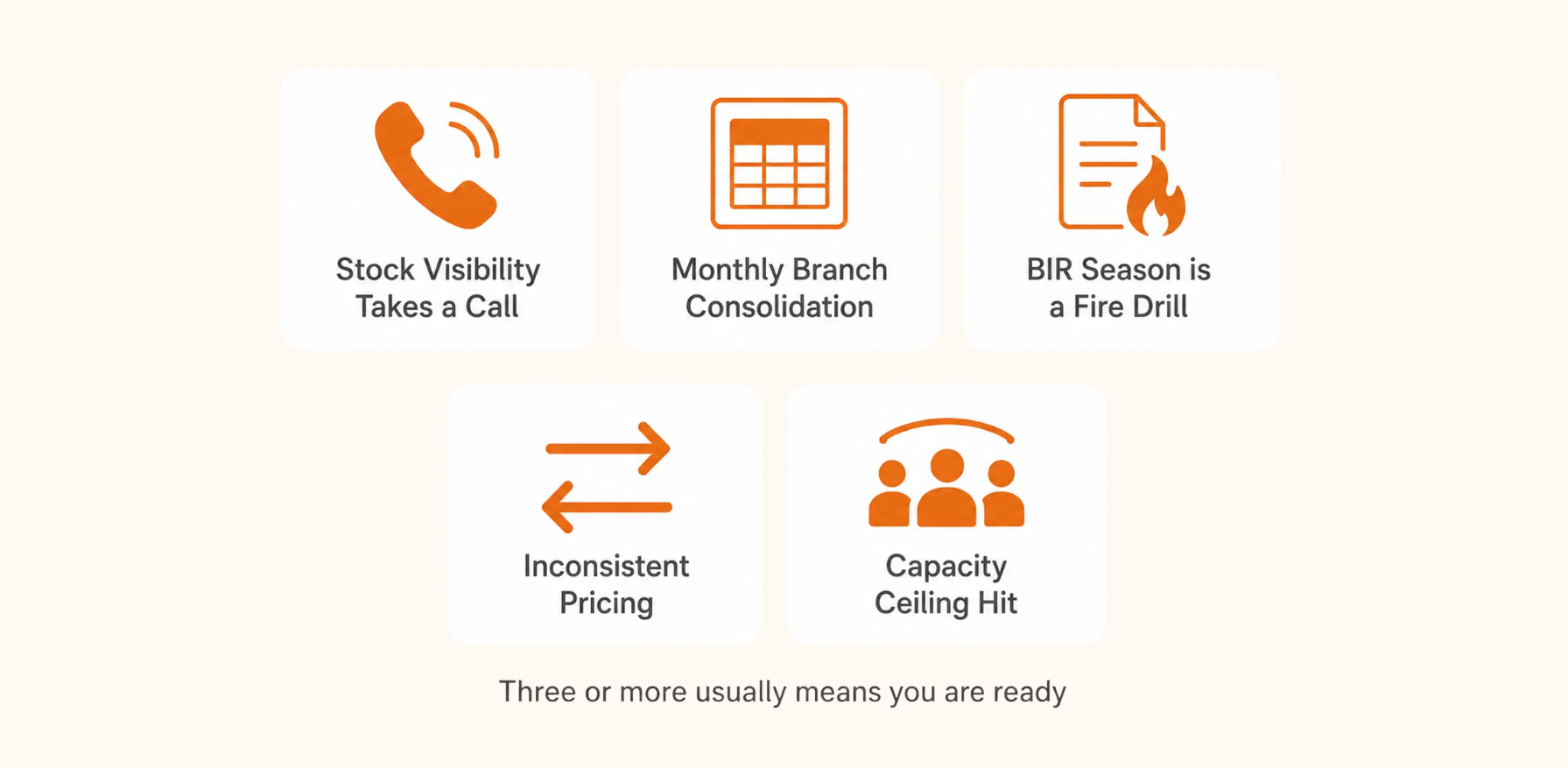
The honest test for whether you are ready for ERP is not your headcount or your revenue. It is the operational friction you are absorbing every week. Three of these signs is usually enough.
1. Stock visibility takes a phone call. Your customer service team cannot answer a basic stock availability question without contacting the branch or warehouse directly. Sales orders are held up because nobody is sure what is actually on hand. Stock-outs at branches happen even when central warehouse has the item, because there is no consolidated view.
2. Branch consolidation happens once a month. Sales, inventory, and accounts receivable from branches roll up to head office on a monthly cycle, often via Excel uploads or manual data entry. Real-time consolidation does not exist. Decisions get made on data that is weeks old.
3. BIR season is a fire drill. Preparing for Bureau of Internal Revenue (BIR) reporting at quarter-end or year-end consumes the finance team for days. Forms like 2307, 1601-EQ, the Summary Alphalist of Withholding Tax (SAWT), and the Quarterly Alphalist of Payees (QAP) are assembled manually from disconnected systems. Audit preparation is stressful and reactive.
4. Pricing is inconsistent across customers and branches. Different customers get different prices because pricing lives in a spreadsheet that branches update on their own. Discount discipline is hard to enforce. Margin analysis by customer or by product is approximate at best.
5. The team has hit its capacity ceiling. Adding more sales or another branch would require hiring more administrative staff just to keep up with the manual work. Growth is constrained by operations, not by demand.
If three or more of these resonate, your business has crossed the threshold where ERP starts paying for itself.
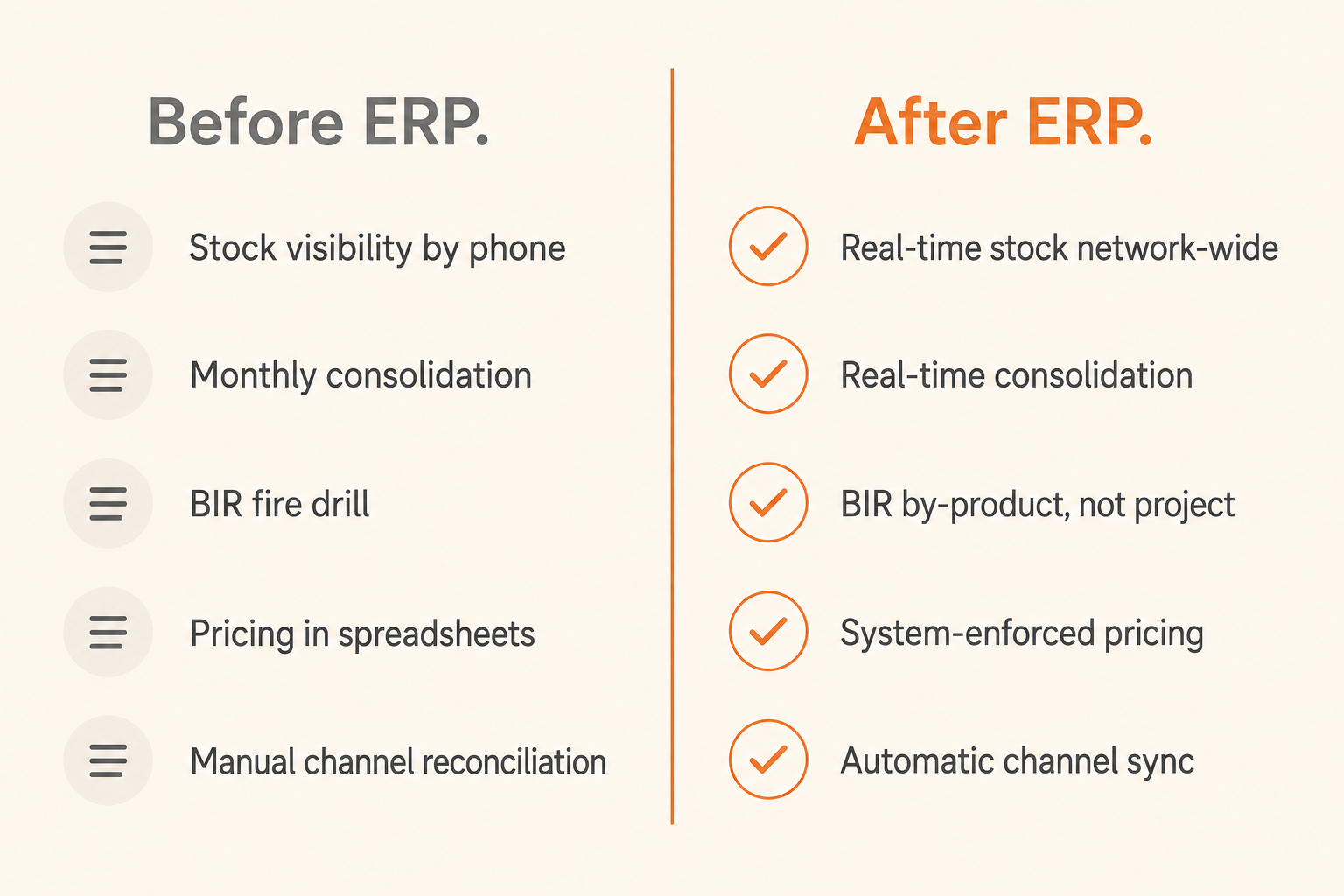
The marketing version of ERP focuses on features. The operational reality is more concrete. Here is what changes in a typical Philippine trading business after a successful ERP implementation, based on patterns we see across real deployments.
 Real-Time Stock Across the Network
Before: stock counts vary by branch, customer service guesses, and stock-outs happen with inventory sitting in another location.
After: every branch and warehouse shows current stock in real time. A customer service representative can confirm availability across the entire network without calling anyone. Stock transfers between branches are documented and costed automatically. Reserved quantities for open sales orders are visible.
 A pattern we see across implementations: businesses that move from spreadsheet-tracked stock to ERP-tracked stock typically eliminate 80 percent or more of their stock visibility phone calls in the first month after go-live. The operational gain is immediate.
Daily Consolidation Instead of MonthlyBefore: branches export sales and inventory data to spreadsheets weekly or monthly. Head office consolidates manually. Reporting lag is one to four weeks.
After: branch transactions post to head office in real time. Consolidated reporting (sales by branch, inventory by location, accounts receivable aging, gross profit by product or customer) is available on demand. Month-end close moves from a week-long exercise to a one or two-day exercise.
For Philippine multi-entity businesses (holding structures with multiple legal entities), this includes intercompany consolidation with automatic eliminations rather than manual journal entries.
BIR Compliance as a By-Product, Not a ProjectBefore: BIR reporting is a quarterly fire drill. The finance team rebuilds reports from scratch from disconnected systems.
After: VAT, expanded withholding tax (EWT), and creditable withholding tax (CWT) are tagged automatically on transactions. BIR Form 2307, 1601-EQ, SAWT, QAP, and the Summary List of Sales and Purchases (SLS and SLP) exports come out of the system rather than being rebuilt. Audit readiness becomes ongoing rather than reactive.
A nuance worth noting: native BIR support varies by platform, and most global ERPs require partner-built localization to fully cover Philippine requirements. The depth of that localization layer depends on the partner more than on the platform. For the detailed Philippine compliance picture (including BIR Revenue Memorandum Order (RMO) 24-2023 for retail and counter-sales operations), see our companion guide on Philippine wholesale distribution software.
Pricing and Margin ControlBefore: pricing lives in spreadsheets. Different customers get different prices because nobody is enforcing discipline. Margin analysis is approximate.
After: pricing rules live in the system, applied automatically based on customer, product, contract terms, or branch. Discount approval routes through workflow when thresholds are crossed. Margin reports by customer, product, channel, and salesperson are accurate and available in real time.
POS, E-Commerce, and Marketplace IntegrationPhilippine trading businesses increasingly operate across multiple channels: retail counter sales, business-to-business (B2B) sales orders, marketplace channels (Lazada, Shopee, Zalora, TikTok Shop), and proprietary e-commerce.
Before: each channel runs in its own silo. Reconciliation across channels is manual and lags by days or weeks.
After: orders, inventory, and customer balances synchronize across channels through native connectors or middleware (Celigo, Boomi, or platform-specific tools). Stock commitments are visible across channels. Reconciliation is automatic.
A pattern we see in Philippine implementations: a single trading business often runs 30+ retail or branch locations, 50 to 100 consignment partners, and four or five e-commerce channels concurrently. The integration architecture matters more than the core ERP at that complexity level.
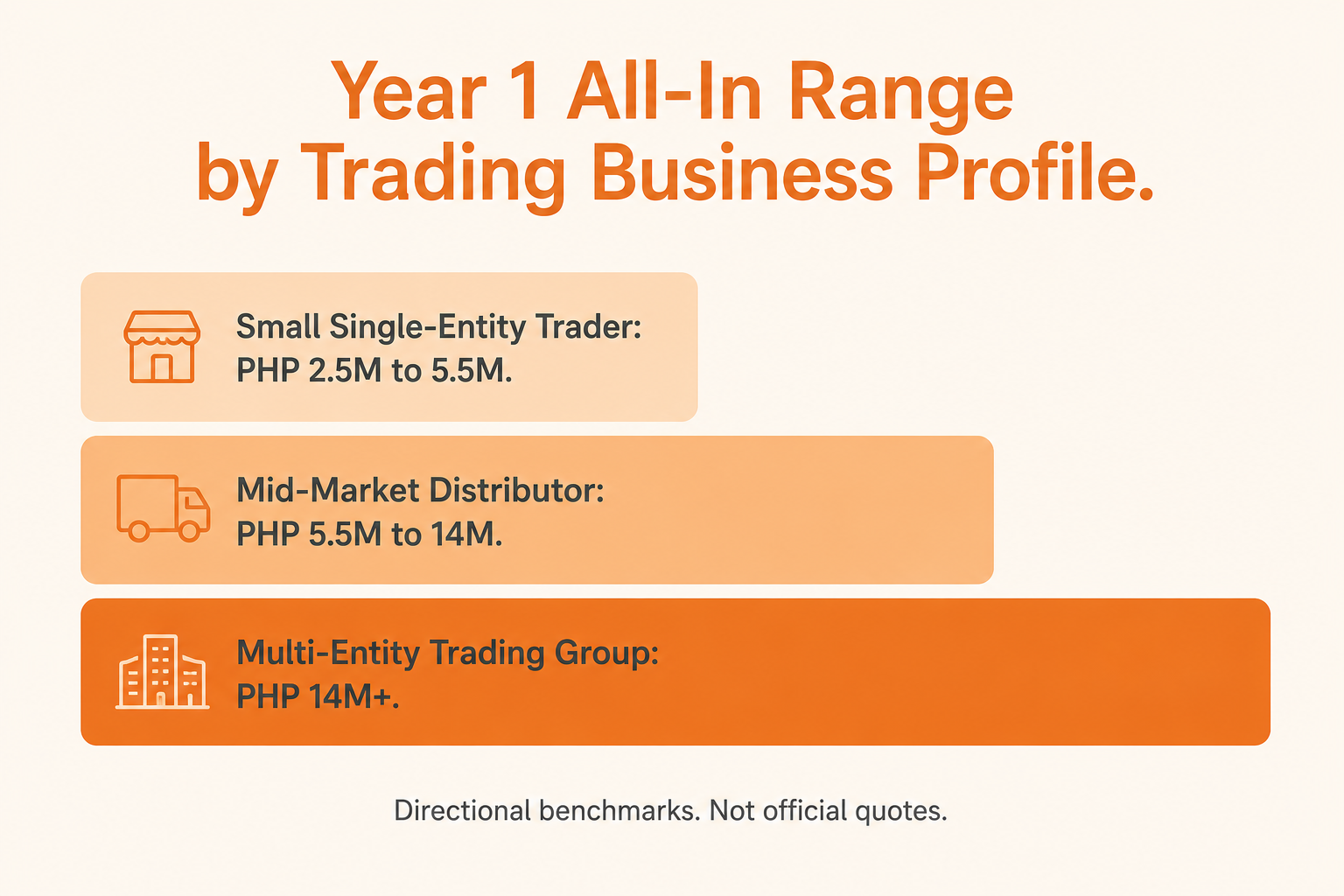
Cost depends on scale, scope, and platform. Here are directional ranges based on publicly available partner guidance and industry benchmarks. These are planning numbers, not official quotes.
Trading Business Profile | Annual Subscription (Year 1) | Implementation Services (One-Time) | Year 1 All-In Estimate |
|---|---|---|---|
Small single-entity trader (under 20 users, single warehouse, 1 to 2 branches) | PHP 1.0M to PHP 2.5M | PHP 1.5M to PHP 3M | PHP 2.5M to PHP 5.5M |
Mid-market distributor (20 to 80 users, 3 to 5 warehouses, multi-branch) | PHP 2.5M to PHP 6M | PHP 3M to PHP 8M | PHP 5.5M to PHP 14M |
Multi-entity trading group (80+ users, multi-subsidiary, multi-channel) | PHP 6M to PHP 15M+ | PHP 8M to PHP 20M+ | PHP 14M+ |
Directional benchmarks based on publicly available partner data, not official Oracle or vendor quotes. Your actual costs will depend on your specific configuration, modules, user count, and partner. For your accurate quote, the next step is a scoping conversation.
Year 1 cost is typically 1.5 to 3 times your annual subscription, with the multiplier driven by scope complexity, data migration difficulty, customization density, integration count, and partner selection. For the detailed implementation budget framework, see our companion guide on NetSuite Implementation Cost: How to Plan Your Year 1 Budget. For the broader NetSuite cost picture, see How Much Does NetSuite Really Cost? A Transparent Guide for Businesses.
ERP is a significant investment in money, time, and organizational change. Not every business needs to act today. The honest framing:
Act now if:
Three or more of the readiness signals above apply to your business
You are planning growth (new branches, new channels, new entities) in the next 12 months that your current systems cannot support
Compliance or audit risk has become a recurring concern
Your finance or operations team has hit its capacity ceiling and the cost of more headcount exceeds the cost of automation
You have an upcoming inflection point (e-commerce expansion, marketplace onboarding, business partner integration) that requires real-time data
Consider waiting if:
Your operations are stable and manual processes are still keeping up
You are in the middle of another major organizational change (acquisition integration, leadership transition)
Your team does not have the bandwidth to engage with an implementation properly
Your business has fewer than 10 users and a single entity with simple processes (the cost-benefit usually favors a lighter accounting platform plus targeted tools in this case)
The trap to avoid: implementing ERP because a competitor did, rather than because the operational case is real for your business. ERP done at the wrong time produces frustration and write-offs, not transformation.
If the operational case is real for your business, the next two decisions are which platform and which partner.
On platform. The Philippine market has multiple credible options. Oracle NetSuite is strong for multi-entity, multi-channel mid-market and upper mid-market businesses. SAP Business One has deep roots in Philippine manufacturing and distribution. Odoo is competitive when retail and Point-of-Sale (POS) are central. For the full evaluation framework with platform archetypes, feature matrix, and demo scenarios, see Best Wholesale Distribution Software for Philippine Businesses.
On partner. Implementation success in the Philippines depends heavily on the local partner: their industry experience in your segment, certified consultant headcount, depth of BIR localization, and references from comparable Philippine clients. The platform is half the decision. The partner is the other half. For the partner evaluation framework, see NetSuite Implementation Partners in Philippines: How to Choose.
If you have outgrown spreadsheets and accounting-only tools but are not yet at full ERP scale, our companion piece on 5 Signs Your Business Has Outgrown QuickBooks and Needs NetSuite covers the transition point in more detail.
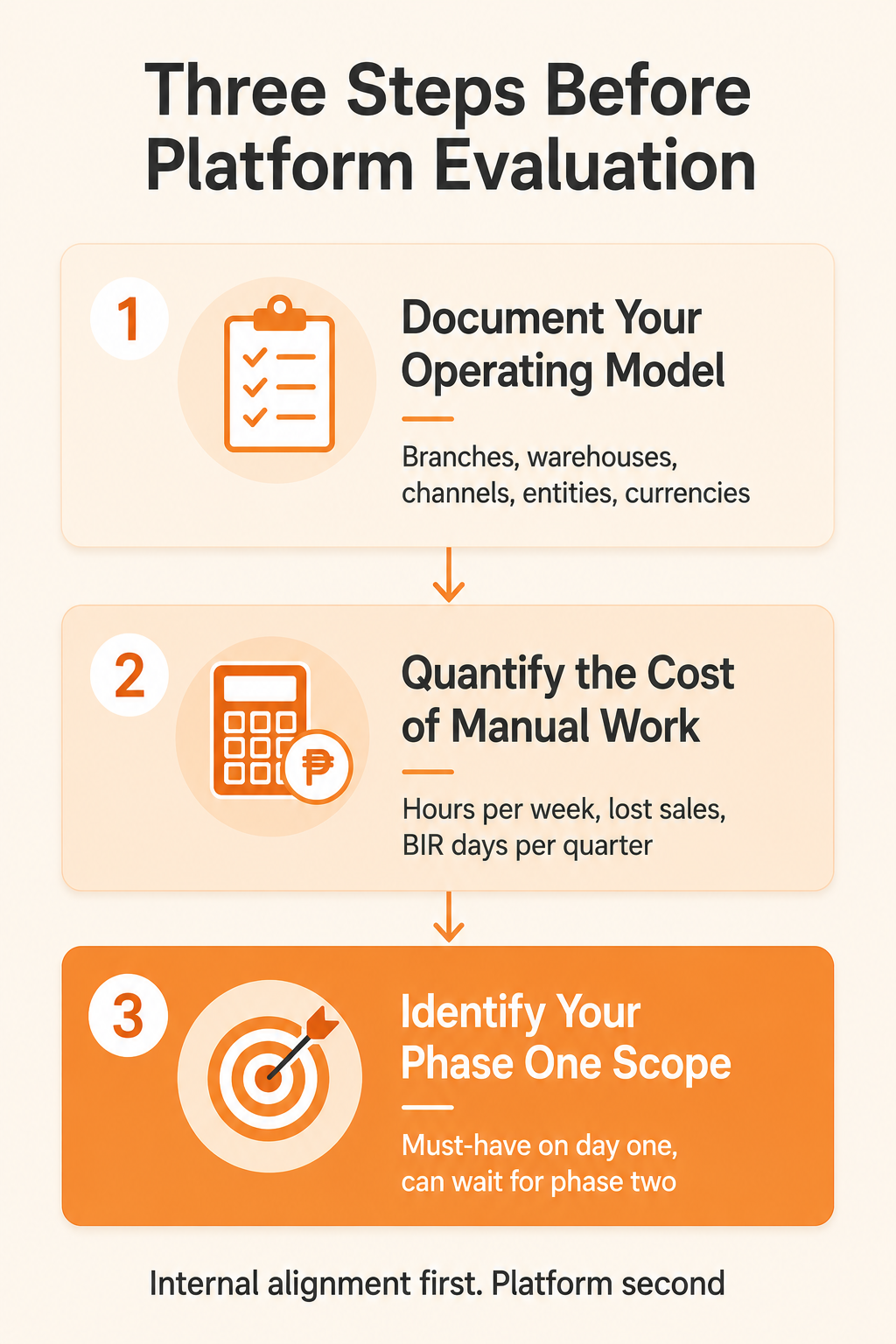
If the readiness signals resonate and the operational case is real for your business, the practical first step is not platform selection. It is internal alignment.
The three steps that move a Philippine trading business from "we should do this" to "we are ready to evaluate":
Document your operating model. Branches, warehouses, channels, entities, currencies. The clearer the operating model picture, the better the platform evaluation will go.
Quantify the current cost of manual work. Hours per week consolidating spreadsheets. Lost sales from stock-out errors. Days per quarter spent on BIR reporting. These numbers anchor the business case.
Identify your phase one scope. What must be live on day one (finance, inventory, core operations) versus what can wait for phase two (advanced reporting, e-commerce integration, demand planning).
With these three in hand, the platform evaluation becomes much sharper. You arrive at partner conversations knowing what your business needs rather than letting vendors anchor your expectations.
Talk to Softype about your Philippine trading business. We have implemented ERP for multi-branch distributors, multi-entity trading groups, and importers across the Philippines. We will help you decide whether the operational case justifies the investment now, and if it does, scope the right configuration for your phase one.
ERP for a trading business is integrated software that manages sales, purchasing, inventory, finance, BIR compliance, and reporting in a single system. For Philippine traders, that typically means connecting branches, warehouses, delivery teams, and online sales channels in one real-time platform. Unlike generic accounting software, trading-focused ERP includes features such as multi-warehouse inventory, landed cost tracking for imports, customer-specific pricing, and automated replenishment.
Three or more of these signs is usually enough: stock visibility takes a phone call, branch consolidation happens monthly, BIR season is a fire drill, pricing is inconsistent across customers and branches, and the team has hit its capacity ceiling. Below that threshold, lighter accounting platforms plus targeted tools are usually sufficient.
Year 1 all-in cost ranges from roughly PHP 2.5M to PHP 5.5M for small single-entity traders, PHP 5.5M to PHP 14M for mid-market distributors, and PHP 14M or more for multi-entity trading groups. These are directional planning numbers, not official quotes. For your accurate number, scope a conversation with a partner.
There is no single best ERP for every trading business. The right answer depends on scale, channel mix, multi-entity complexity, and budget. Oracle NetSuite, SAP Business One, and Odoo are all credible options for different profiles. The deciding factor is usually the platform plus partner combination that matches your operating model. See our companion guide on Philippine wholesale distribution software for the full evaluation framework.
For a single-entity, single-warehouse trader, plan 12 to 16 weeks. For a multi-branch, multi-channel operation, plan 6 to 9 months for a phased rollout. Multi-entity trading groups with 50-plus branches typically run as 30-week phased deployments using a pilot-first structure.
Most modern Philippine trading businesses need at least one of these integrations on day one, and several more by phase two. The integration architecture is often more complex than the core ERP, especially for businesses running concurrent retail, B2B, consignment, and marketplace channels. Modern ERPs support these integrations through native connectors or middleware (Celigo, Boomi, or platform-specific tools).
Most global ERPs support VAT, EWT, and CWT through partner-configured localization. BIR Form 2307, 1601-EQ, SAWT, QAP, and SLS and SLP exports require setup but are achievable. For retail or counter-sales operations, BIR RMO 24-2023 compliant receipting is a partner configuration item, not a native feature on any platform. Validate localization depth during vendor demos, not after signing.
This guide covers the operational case for ERP in a Philippine trading business: the readiness signals, what changes operationally, the cost ranges, and when to act. It is written for buyers who are still asking "do we need ERP?" The wholesale distribution guide is the platform evaluation framework with archetypes, the feature matrix, and demo scenarios. Use this guide first to build the internal case, then use the distribution guide to evaluate platforms.
The honest test for whether you are ready for ERP is not your headcount or your revenue.
The marketing version of ERP focuses on features.
Before : stock counts vary by branch, customer service guesses, and stock-outs happen with inventory sitting in another location.
Before : branches export sales and inventory data to spreadsheets weekly or monthly.
Before : BIR reporting is a quarterly fire drill.
Philippine trading businesses increasingly operate across multiple channels: retail counter sales, business-to-business (B2B) sales orders, marketplace channels (Lazada, Shopee, Zalora, TikTok Shop), and proprietary e-commerce.
For the vendor-published detail behind the capabilities described above, Oracle maintains official documentation:


Helping businesses thrive with integrated ERP solutions.
NetSuite
Service
Company
Contact Us
Copyright © 2026


