


If you run finance or operations at a Philippine mid-market company (about 200 to 2,000 staff, often a holding structure with many operating subsidiaries), you have probably been told that NetSuite is the answer. Or that SAP Business One is the answer. The single most consequential filter on PH mid-market ERP selection is your regulatory profile, because it finds the localization layer your ERP needs.
If you run finance or operations at a Philippine mid-market company (about 200 to 2,000 staff, often a holding structure with many operating subsidiaries), you have probably been told that NetSuite is the answer. Or that SAP Business One is the answer. Or that Odoo is the answer.
The honest answer is more nuanced. Each of those platforms wins for certain profiles and loses for others. The deciding factor is almost never the platform alone. It is the combination of the platform, the local partner who sets up BIR, PEZA, and BOI compliance for your specific situation. How well the architecture matches your actual operating model.
This guide is the horizontal evaluation framework. We cover the regulatory profile every PH mid-market buyer needs to clarify first, the seven dimensions that matter in selection, an goal head-to-head comparison of six platforms, and a phased buying process designed for the local market.
For broader context, see our companion guides: NetSuite Implementation Partners in the Philippines: How to Choose, How to Set up NetSuite: Step-by-Step Guide for First-Time Buyers, and How Much Does NetSuite Really Cost? A Transparent Guide for Firms. If your business is specifically wholesale, distribution, or trading, see Best Wholesale Distribution Software for Philippine Firms for the distribution-specific deep dive. The Softype SuiteSuccess page on our site covers our specific NetSuite implementation methodology in more detail.
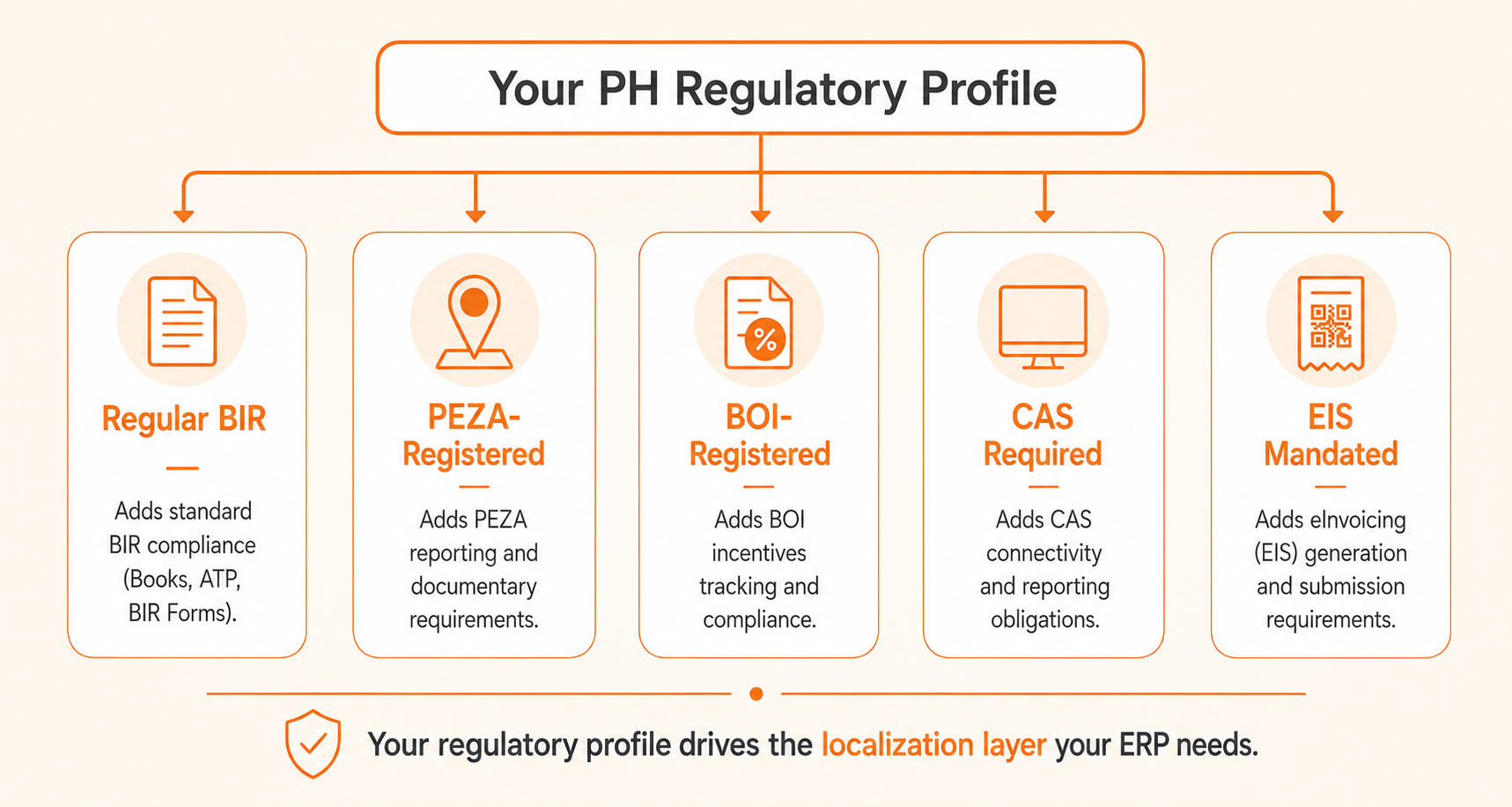
The single most consequential filter on PH mid-market ERP selection is your regulatory profile, because it finds the localization layer your ERP needs. Get this clear before you start evaluating platforms.
Are you a regular BIR taxpayer, PEZA-registered, BOI-registered, or some combination?
Regular BIR. Standard Value Added Tax (VAT), expanded withholding tax (EWT), and creditable withholding tax (CWT) needs. BIR Form 2307, 1601-EQ, the Summary Alphalist of Withholding Tax (SAWT), the Quarterly Alphalist of Payees (QAP). The Summary List of Sales/Buys (SLS/SLP) all apply.
PEZA-registered. Add PEZA reportorial needs: annual reports, import and export tracking, inventory movements, and submission via the PEZA Annual Compliance Management System (ACMS). PEZA enterprises also need careful tax incentive tracking for the Income Tax Holiday (ITH) period and the subsequent Special Corporate Income Tax or Enhanced Deductions regime.
BOI-registered. Similar incentive tracking needs via the Board of Investments, with reporting cadence and audit obligations to match.
Computerized Accounting System (CAS). If your books are kept electronically (which is true for any ERP-running mid-market company), BIR CAS needs apply, including approval, audit trails, and books of accounts.
Electronic Invoicing System (EIS). The BIR's national platform for electronic invoice and receipt reporting. Mandatory for certain taxpayer categories under the e-invoicing rollout, with the scope expanding.
This regulatory profile drives a lot of downstream choices: which platforms have credible localization, which partners can give the reporting layer cleanly. How much of the implementation budget needs to be earmarked for compliance configuration versus core process work.
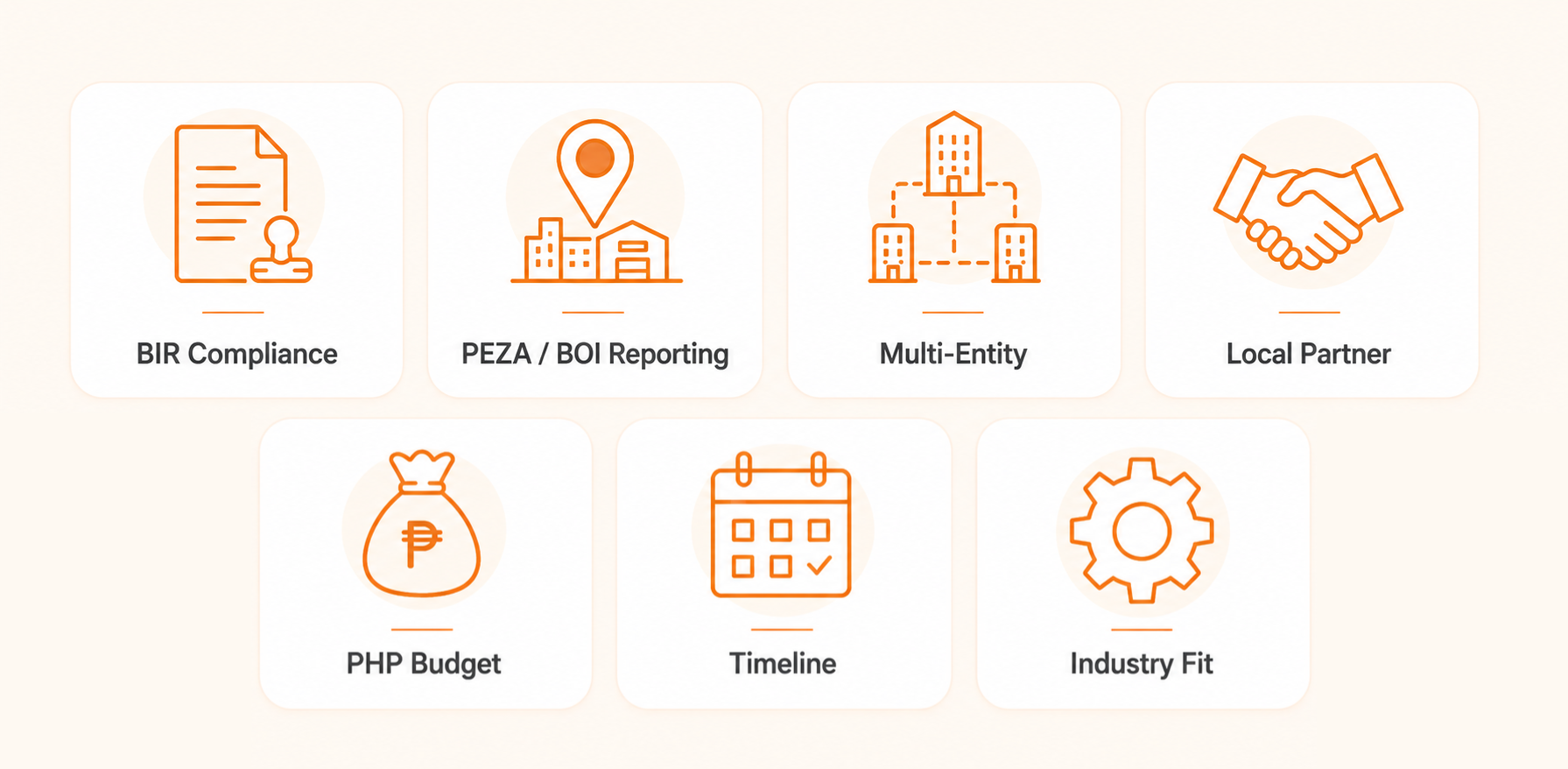
The practical question is whether the ERP plus partner combination handles VAT, EWT, CWT, official document flows. The full suite of BIR reports without offline workarounds. Most global ERPs can support this, but the depth and ongoing maintenance of the localization layer varies widely between partners. For the deeper distribution-specific BIR coverage, including BIR Revenue Memorandum Order (RMO) 24-2023 receipting and the full forms set, see our companion piece on Philippine wholesale distribution software.
If you are PEZA or BOI registered, reporting is not optional, and most platforms do not handle it natively. Expect partner-built templates aligned to PEZA ACMS data structures and BOI reporting needs. During evaluation, ask the partner to show sample PEZA reports built on their template, ideally for a buyer in your industry segment.
Many PH mid-market firms are holding structures with several operating subsidiaries, often for BIR compliance reasons. The system needs to handle intercompany transactions, multi-entity consolidation, automatic intercompany elimination, and per-subsidiary profit and loss with group roll-up. NetSuite, Acumatica, and some Infor solutions are stronger here natively. SAP Business One and Odoo can do it, but configuration is heavier.
Implementation success in the Philippines depends heavily on the local partner. The variables that matter: industry experience in your segment, certified consultant headcount, support service-level agreements (SLAs), PEZA and BOI track record if applicable. Willingness to provide references from comparable Philippine clients. A great platform set up by a thin partner will frustrate you. A capable platform plus a strong partner will outperform.
ERP costs vary by deployment model (cloud subscription versus on-premise perpetual), license type, user count, modules, and customization depth. For PH mid-market firms, first-year totals (license plus implementation) often run from the low seven figures to the upper seven figures in pesos, depending on platform and scope. Always model total cost of ownership over three years, not year-one license cost. The cheapest year-one license sometimes carries the highest three-year cost when customization piles up.
For PH mid-market groups, full ERP implementations often run 6 to 12 months. Simpler, phased projects can go live in 3 to 6 months. Multi-site, multi-entity projects can stretch to 9 to 12 months for the full rollout. The dominant risk factor is rarely the platform itself. It is data migration quality and change management discipline. See our companion guide on data migration for the technical detail there.
Some platforms have stronger manufacturing features out of the box. Others are stronger in distribution, services, or project-based work. Open-source and highly configurable platforms (Odoo) support deep local customization, but heavy customization also creates long-term maintenance burden. Industry fit narrows the field fast once you have the regulatory profile clear.
 Oracle NetSuite
Cloud-only, true multi-tenant Software-as-a-Service. Strong multi-subsidiary, multi-currency, and consolidation features. Mature partner ecosystem in the Philippines, with several partners offering BIR localization, EIS-ready configurations, and PEZA reporting templates.
Best fit: mid-market and upper mid-market PH firms with multi-entity complexity, regional or international growth plans, or a strategic preference for cloud-first architecture. Common patterns include holding firms with shared finance teams, fast-growing technology and services firms, multi-brand groups, and distributors with strong financial control needs.
Trade-offs: often one of the higher-priced options as user count and modules grow. Native point-of-sale (POS) is not included. Localization quality lives at the partner level, so partner due diligence is key.
Indicative PH cost band: mid to upper seven-figure pesos for first-year total (license plus implementation), depending on user count and modules.
Typical implementation timeline: 6 to 9 months for finance, distribution, and basic Buyer Relationship Management (CRM); 9 to 12 months for complex multi-entity rollouts.
OdooModular, open-source platform with both Odoo Enterprise (commercial) and Odoo Community (free) editions. Wide module coverage, strong native POS, offline-capable POS, and a large partner and developer ecosystem. Many PH-specific localizations available through partners and community modules for BIR tax, e-invoicing, payroll, and reporting.
Best fit: PH mid-market firms that want a unified platform spanning POS, inventory, sales, buy, and accounting in a single system, often at lower licensing cost. Mainly strong when retail and distribution sit in the same business and a native POS matters, or when offline-capable POS is needed for provincial and island branches.
Trade-offs: implementation quality varies widely between partners. Heavy customization is tempting but can create maintenance debt. Less proven at enterprise multi-entity scale than NetSuite or SAP, though it has matured greatly.
Indicative PH cost band: high six-figure to mid seven-figure pesos for first-year total. License costs are often lower per user than global Tier-2 ERPs.
Typical implementation timeline: 3 to 9 months depending on scope and customization depth.
SAP Business OneLong-established mid-market ERP with deep roots in Philippine manufacturing, distribution, and trading. Cloud, hosted, and on-premise deployment options. Mature local partner network with PH tax packs, BIR-compliant reports, and steady localization updates.
Best fit: PH manufacturing and distribution firms that want a stable, proven platform with strong partner support. Firms that prefer an on-premise or hosted deployment for IT control reasons. Mid-market firms without serious multi-entity complexity.
Trade-offs: advanced multi-entity consolidation often needs configuration or separate instances rather than native handling. The user interface and underlying technology stack feel less modern than newer cloud platforms. Mobile and browser-based usage often relies on add-ons.
Indicative PH cost band: mid six-figure to mid seven-figure pesos for first-year total, depending on deployment mode and user count.
Typical implementation timeline: 2 to 6 months for straightforward small and medium-sized enterprise rollouts; 6 to 9 months for mid-market with many sites.
AcumaticaCloud-first ERP with strong financials, distribution, and project accounting. Resource-based commercial model rather than per-user pricing, which can be attractive for firms with seasonal user counts. Built-in multi-entity and multi-currency support. Modern role-based user interface (UI) with strong mobile access.
Best fit: PH mid-market multi-entity distributors and project-based firms (engineering, construction support, professional services) that need integrated project accounting and finance. Holding firms that want cloud gains but not a strict per-user license model.
Trade-offs: smaller local partner ecosystem than SAP B1 or Odoo, so partner due diligence is key. BIR and PEZA support is partner-delivered rather than native, so localization templates and processes need careful review.
Indicative PH cost band: similar range to NetSuite, with major variability based on transaction volumes and modules.
Typical implementation timeline: about 6 to 9 months for broad rollouts.
Infor (CloudSuite Industrial / SyteLine, Infor LN)Enterprise-grade manufacturing and supply chain ERP. Strong industry-specific flavors for industrial manufacturing, distribution, automotive, and similar verticals. Used in the Philippines mainly by export-oriented manufacturers and groups standardizing on Infor regionally.
Best fit: PEZA-registered or export-oriented manufacturers with complex production processes. Upper mid-market and large enterprises with regional or global operations. Firms that need industry-specific manufacturing depth out of the box.
Trade-offs: often heavier than smaller mid-market firms need. Local partner coverage is narrower than SAP B1 or Odoo. PEZA support tends to come from partner-built templates rather than native modules.
Indicative PH cost band: upper seven-figure pesos and above. Reflects the targeting of more complex operations.
Typical implementation timeline: 9 to 12 months for multi-site manufacturing rollouts.
FocusSoftnetRegional ERP vendor with growing presence in Southeast Asia, including the Philippines. Integrated suite covering finance, inventory, human resources, and other core modules. Cloud and on-premise deployment options.
Best fit: growing PH small and medium-sized enterprises that have outgrown entry-level accounting (QuickBooks, Xero, basic Sage) but are not yet ready for the higher-priced global cloud ERPs. Firms looking for a more regional vendor with localized features.
Trade-offs: smaller global and local ecosystem compared to SAP, Oracle NetSuite, or Odoo. Fewer third-party integrations and community add-ons. Reference base in your specific industry segment may be thinner.
Indicative PH cost band: lower to middle end of mid-market budgets, depending on modules and users.
Typical implementation timeline: 3 to 6 months for focused deployments.
The table below summarizes the seven dimensions for each platform. Values are general patterns from Philippine mid-market deployments, not quotes, and will vary by partner and deal.
Dimension | NetSuite | Odoo | SAP Business One | Acumatica | Infor (CloudSuite/LN) | FocusSoftnet |
|---|---|---|---|---|---|---|
Deployment | Cloud only | Cloud or on-premise | On-premise, hosted, or cloud-hosted | Cloud-first | Mainly cloud or hosted | Cloud or on-premise |
BIR localization | Partner tax packs, CAS and EIS support | Localizations and partner modules | Mature PH tax packs by partners | Partner-driven PH localization | Partner-driven PH localization | PH-focused modules in some offerings |
PEZA support | Template-based via partners | Configuration plus partner reports | Often offered by PH partners | Template-based via partners | Used in export manufacturing; partner-built | More limited; often custom reports |
Multi-entity strength | Very strong native | Configurable with add-ons | Possible but more complex setups | Strong native multi-company | Strong for larger groups | Designed mainly for single to few entities |
Typical PH first-year budget (license plus implementation) | Mid to upper seven-figure PHP | High six to mid seven-figure PHP | Mid six to mid seven-figure PHP | Similar to NetSuite (resource-based) | Upper seven-figure PHP and above | Low to mid seven-figure PHP |
Typical PH implementation time | 6 to 9 months | 3 to 9 months | 2 to 6 months SME, 6 to 9 months mid-market | 6 to 9 months | 9 to 12 months for complex manufacturing | 3 to 6 months |
Best-fit PH profiles | High-growth, multi-entity, regional expansion | Cost-sensitive, retail-with-distribution, configurable | Manufacturing or distribution with strong local partner | Multi-entity distributors and project-based groups | Complex manufacturers and exporters | Growing SMEs and lower mid-market |
A polished demo can hide a lot. Build these scenarios into every vendor evaluation and need live execution against your data, not their canned demo.
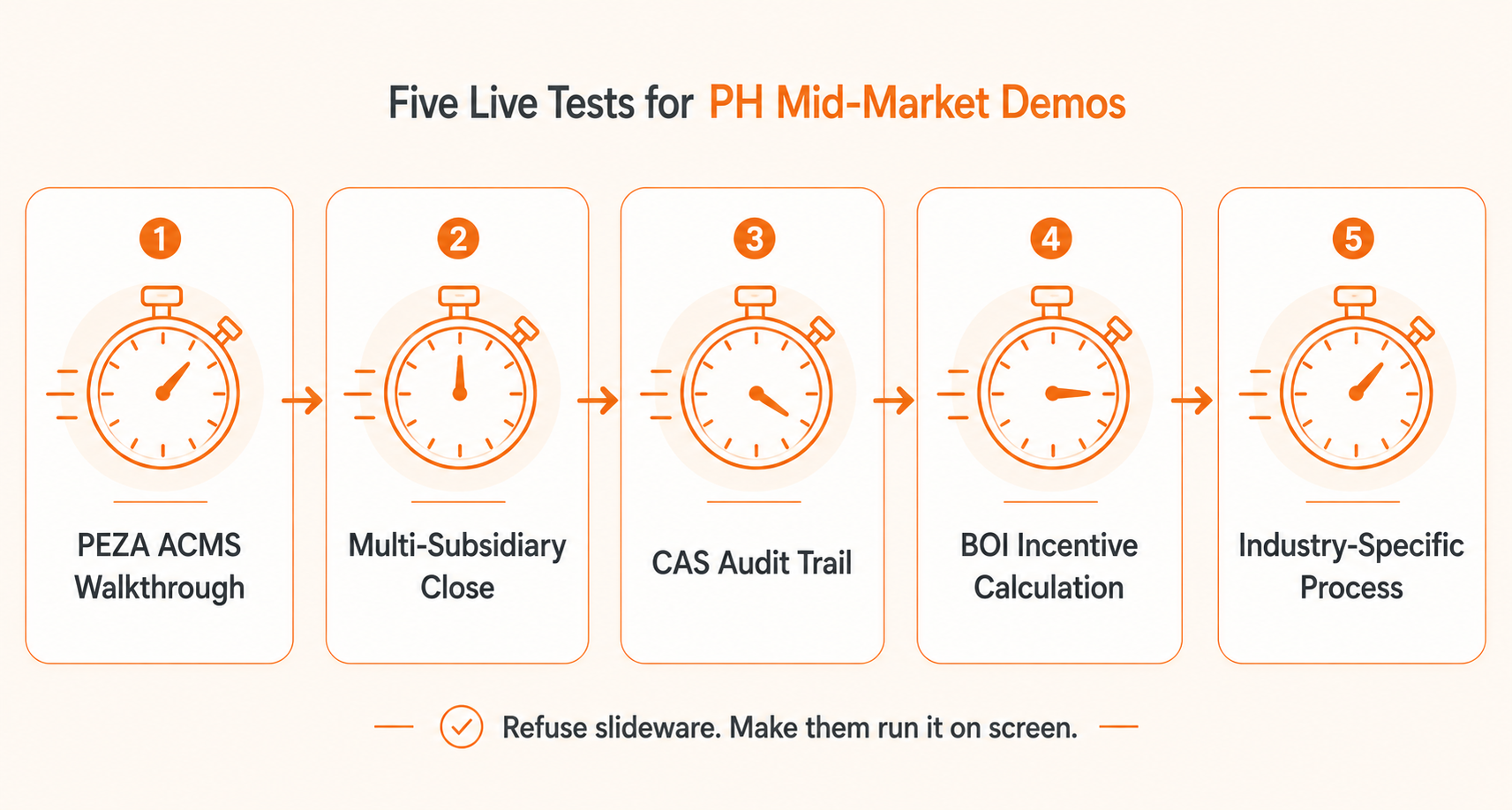 The PEZA ACMS Walkthrough
"Walk me through how this system produces the data we would submit to PEZA Annual Compliance Management System for one of our PEZA-registered subsidiaries. Show me the actual reports, not the data structure."
What you are testing: localization depth for PEZA, partner-built template quality, and whether the team has done this for a real PEZA-registered buyer before.
The Multi-Subsidiary Month-End Close"Show me the combined month-end close across three legal entities, with intercompany eliminations handled automatically. How long does this take in production at a real buyer?"
What you are testing: native multi-company architecture, consolidation depth, and whether the team is doing this in the system or in Excel after the fact.
The CAS Audit Trail"I am a BIR auditor. Show me the audit trail for a specific journal entry: who created it, who approved it, what supporting documents are attached. What the underlying source transactions were."
What you are testing: BIR Computerized Accounting System compliance, audit trail depth, and whether the system would survive an actual BIR examination cleanly.
The BOI Incentive Calculation"Show me how this system tracks BOI-incentivized revenue separately from non-incentivized revenue, and how it handles the reporting for our incentive period."
What you are testing: ability to separate incentive-eligible and non-eligible activities, partner experience with BOI buyers, and reporting flexibility.
The Industry-Specific ProcessReplace this with a scenario specific to your industry: a manufacturing work order from raw material to finished good, a construction project from contract to retention release, a services engagement from quote to revenue recognition. Make it the most operationally complex thing your business does.
What you are testing: whether the platform handles your industry naturally or needs configuration that gets brittle at scale.
A few patterns in how PH mid-market firms actually deploy ERP, drawn from Softype's implementation experience across the region.
Multi-Entity Holding CompaniesHolding structures with three to ten operating subsidiaries are common in the Philippines, often for BIR compliance reasons. The pattern that works: NetSuite OneWorld or Acumatica multi-company, with one consolidation logic and one localization layer covering all entities. Per-entity profit and loss with group roll-up. Automated intercompany elimination at month-end rather than manual journal entries.
Manufacturing with Multi-Branch DistributionManufacturing firms that also distribute through their own retail branches or wholesale channels often run a hybrid architecture. SAP Business One or Infor for manufacturing, paired with a distribution-focused front-end (sometimes Odoo, sometimes a NetSuite distribution layer) at the branches, with a single integration point at head office. We have seen this pattern executed cleanly in food service, hardware, and consumer products.
Services and Project-Based BusinessesEngineering firms, construction services, and professional services in the Philippines gain from project accounting depth. Acumatica and NetSuite SuiteProjects (where regionally available) are the common landing places. The differentiating feature is often project-based revenue recognition tied to milestones or percentage-of-completion accounting.
PEZA Manufacturers and ExportersPEZA-registered manufacturers often need both manufacturing depth and incentive-aware reporting. SAP Business One and Infor are common in the upper mid-market here. The key evaluation question is the partner's PEZA reporting track record, because the reporting layer is invariably partner-built rather than native.
Distribution and Trading SpecificallyFor wholesale distribution and trading firms in the Philippines, the evaluation is similar but adds multi-branch inventory, point-of-sale integration, and BIR RMO 24-2023 receipting as key dimensions. See our companion guide on Best Wholesale Distribution Software for Philippine Firms for the distribution-specific buyer's framework, including the feature matrix and demo scenarios tuned for distributors.
A phased approach keeps the evaluation goal and reduces the risk of being talked into the wrong system.
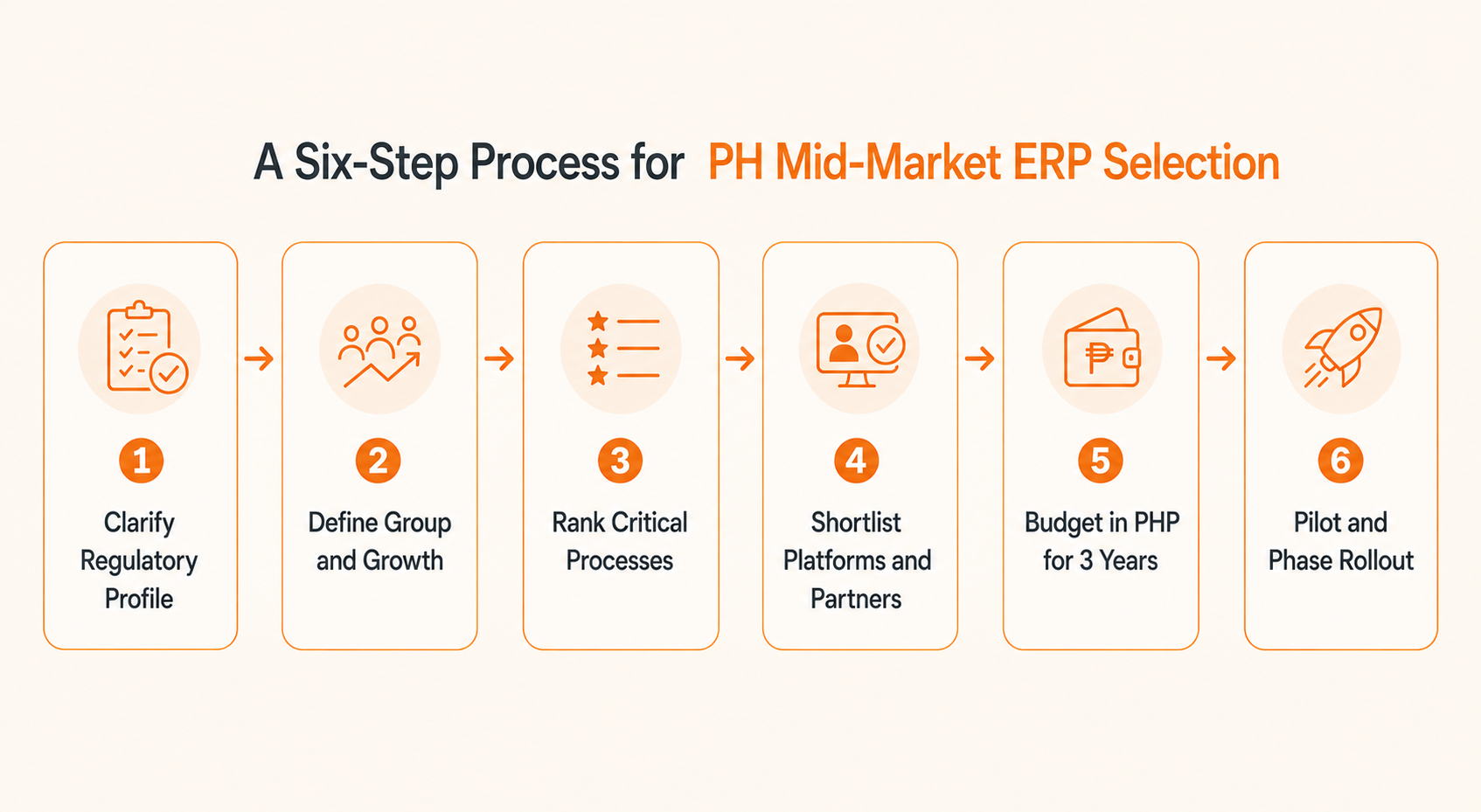
Step 1. Clarify your regulatory profile. PEZA, BOI, regular BIR, or some combination. Confirm CAS approval status and EIS applicability. Get this in writing internally before any vendor conversations begin.
Step 2. Define your group and growth profile. Single entity or holding structure. Number of entities now and projected over three to five years. Multi-currency needs. International expansion plans.
Step 3. Rank the three to five most key processes. Order to cash, procure to pay, production planning, project accounting, warehouse management. Use these to structure demos and proofs of concept.
Step 4. Shortlist three to four platforms and two to three partners. Aim to see at least two different platforms with strong PH track records in your industry segment. Request references from local buyers of similar size and complexity.
Step 5. Budget realistically in pesos. Plan for both upfront project costs and ongoing annual costs (licenses, support, internal ERP team). Include internal time for process owners, not just vendor fees. Model total cost over three years.
Step 6. Pilot and phase the rollout. Start with core finance and one or two key processes. Go live, stabilize, then expand to operations, then add advanced reporting and integrations. This reduces risk and spreads cost over time.
The brand of ERP matters less than three other things: your regulatory profile clarity, your partner's depth in your industry segment, and your willingness to phase the rollout rather than chase a big-bang go-live.
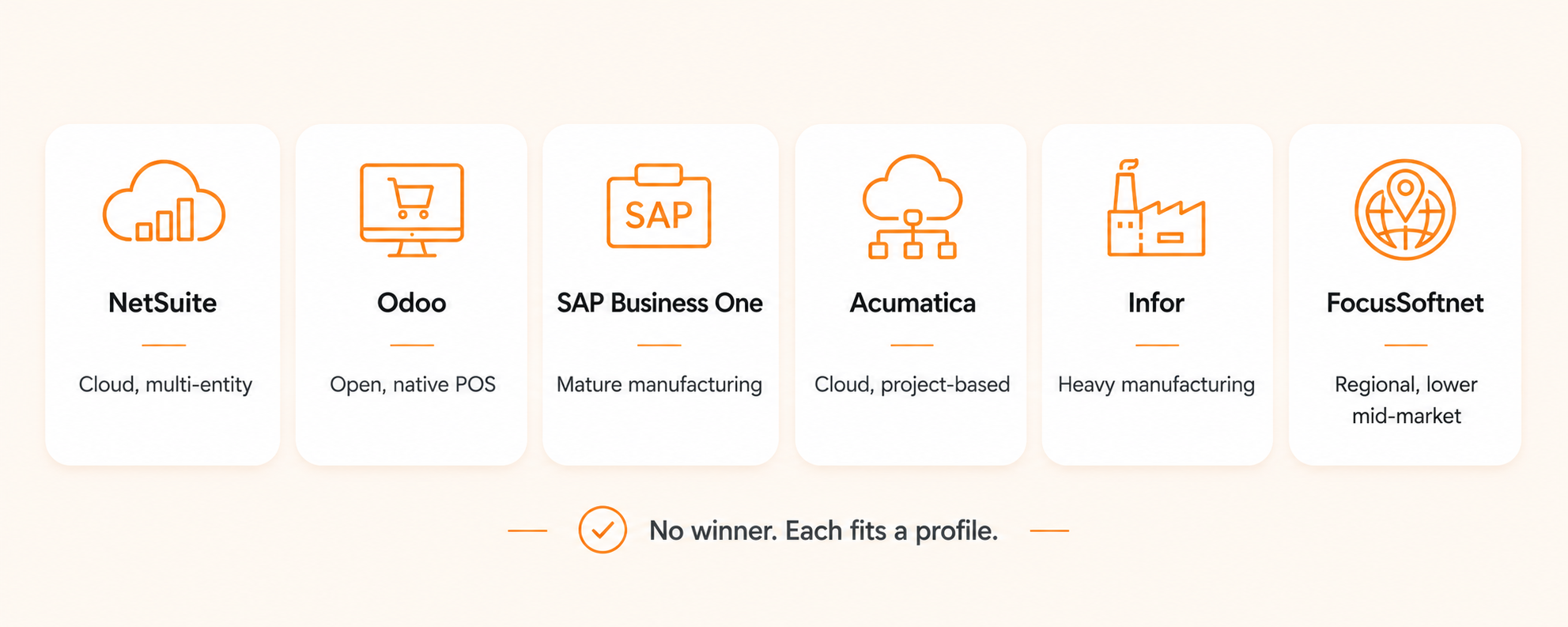
The platforms in this guide are all viable for Philippine mid-market firms. NetSuite, Odoo, SAP Business One, Acumatica, Infor, and FocusSoftnet have all given successful implementations in the Philippines under the right conditions. The right answer for your business is the one that matches your operating model, your regulatory profile. The partner team you are committing to work with for the next three to five years.
The systems that look slickest in slides are sometimes the ones that buckle in production. The systems that survive are the ones whose partner got the BIR layer right, whose consolidation logic matches the actual entity structure. Whose rollout was phased honestly rather than oversold.
Talk to Softype about your Philippine ERP selection. We have set up NetSuite, Odoo, and integrated platforms across manufacturing, services, distribution, and multi-entity holding structures in the Philippines.

There is no single best ERP for all PH mid-market firms. The optimal choice depends on regulatory profile (regular BIR, PEZA, BOI), industry, multi-entity complexity, and budget. NetSuite suits multi-entity high-growth firms. SAP Business One suits set up manufacturing and distribution. Odoo suits cost-sensitive firms with retail or POS needs. Acumatica suits multi-entity project-based firms. Infor suits complex manufacturing. FocusSoftnet suits growing SMEs in the lower mid-market.
Key. Improper books, reports, or e-invoicing can lead to penalties. Mid-market firms should rank platforms with proven PH tax packs kept by active partners. Validate VAT, EWT, CWT, BIR Form 2307, 1601-EQ, SAWT, QAP, and SLS/SLP outputs during the demo, not after signing.
Most mid-market ERPs support PEZA needs through configuration and partner-developed reports, especially for inventory and import/export tracking aligned with PEZA ACMS. Native PEZA modules are rare. The reporting layer is almost always partner-built. Ask for a demo of an actual PEZA report from a real buyer engagement before committing.
Similar to PEZA. Most platforms can support BOI incentive tracking through configuration, but the reporting layer is partner-built. The key evaluation question is whether the partner has BOI buyer references in your industry segment.
For a typical mid-market organization, a full ERP implementation often takes 6 to 12 months. Simpler, phased projects can go live in 3 to 6 months. Multi-site, multi-entity projects often run 9 to 12 months for the full rollout.
Most mid-market groups invest from the high six-figure to mid seven-figure peso range in the first year, including licenses and implementation. Cloud subscriptions then continue as annual operating expenses. Always model total cost over three years, including internal team time and ongoing partner support.
Cloud reduces infrastructure management and supports remote work, which has become more common since 2020. On-premise or hosted deployments can still be attractive where connectivity is constrained, where data residency matters for compliance reasons, or where the IT team has a strong preference for in-house control. The right answer depends on your IT strategy more than on the platform.
Validate the partner's experience in your industry, the number of certified consultants on staff, the depth of their PH-specific localization (BIR, PEZA, BOI), their support service-level agreements. The willingness to provide references from comparable Philippine clients of similar size and complexity. See our companion guide on NetSuite Implementation Partners in the Philippines: How to Choose for a deeper framework on partner selection.
This guide is the horizontal view: any PH mid-market company evaluating ERP across industries. The wholesale distribution guide goes deeper on multi-branch inventory, POS integration, e-commerce channels. The BIR RMO 24-2023 receipting needs specific to retail and counter-sales operations. If your business is mainly wholesale, distribution, or trading, start with the distribution guide and use this one for broader context.
The single most consequential filter on PH mid-market ERP selection is your regulatory profile, because it finds the localization layer your ERP needs.
The practical question is whether the ERP plus partner combination handles VAT, EWT, CWT, official document flows. The full suite of BIR reports without offline workarounds.
If you are PEZA or BOI registered, reporting is not optional, and most platforms do not handle it natively.
Many PH mid-market firms are holding structures with several operating subsidiaries, often for BIR compliance reasons.
Implementation success in the Philippines depends heavily on the local partner.
ERP costs vary by deployment model (cloud subscription versus on-premise perpetual), license type, user count, modules, and customization depth.
For the vendor-published detail behind the features described above, Oracle keeps official documentation:


Helping businesses thrive with integrated ERP solutions.
NetSuite
Service
Company
Contact Us
Copyright © 2026


