

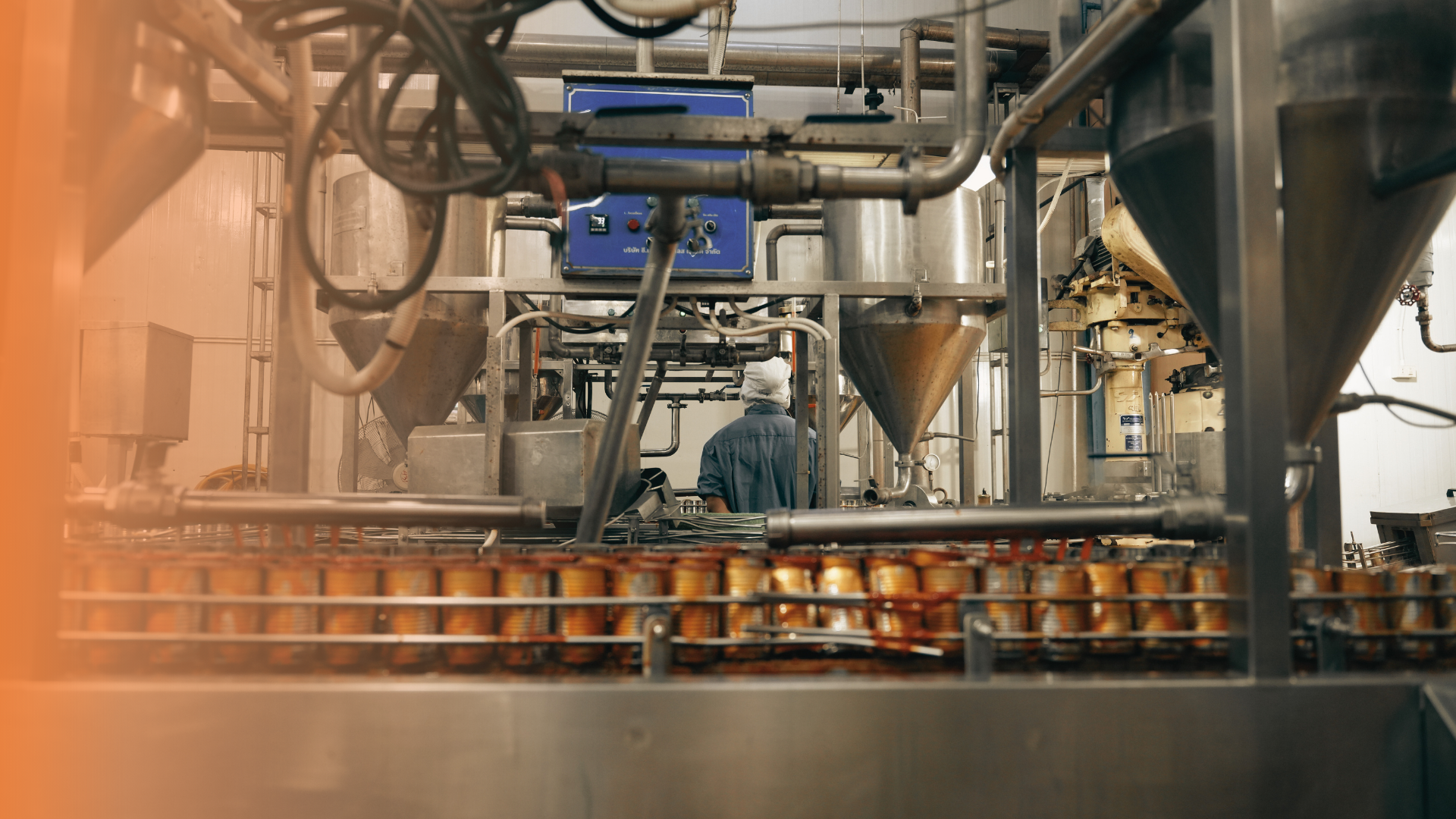
Most ERP demos look impressive. Then you go to production and discover the recipe module is a generic Bill of Materials (BOM) wearing a costume, the catch-weight items are a workaround, and the allergen logic is a checkbox someone has to remember to tick. Food production follows process manufacturing.
Most ERP demos look impressive. Lot tracking. Recipe screens. Compliance dashboards. Then you go to production and discover the recipe module is a generic Bill of Materials (BOM) wearing a costume, the catch-weight items are a workaround, and the allergen logic is a checkbox someone has to remember to tick. By that point, you've already paid for it.
The point of a buyer's checklist is to surface those gaps during evaluation, not after. This guide gives you the feature matrix, the demo scenarios that expose weak vendors, and the questions that separate purpose-built food and beverage ERP from a discrete-manufacturing system with food-flavored marketing.
For the deeper question of how an ERP actually automates Food and Drug Administration (FDA) and Food Safety Modernization Act (FSMA) compliance once you've chosen one, see our companion piece, FDA Compliance for Food Manufacturers: How ERP Automates Traceability and Lot Tracking. This blog is about the choosing..
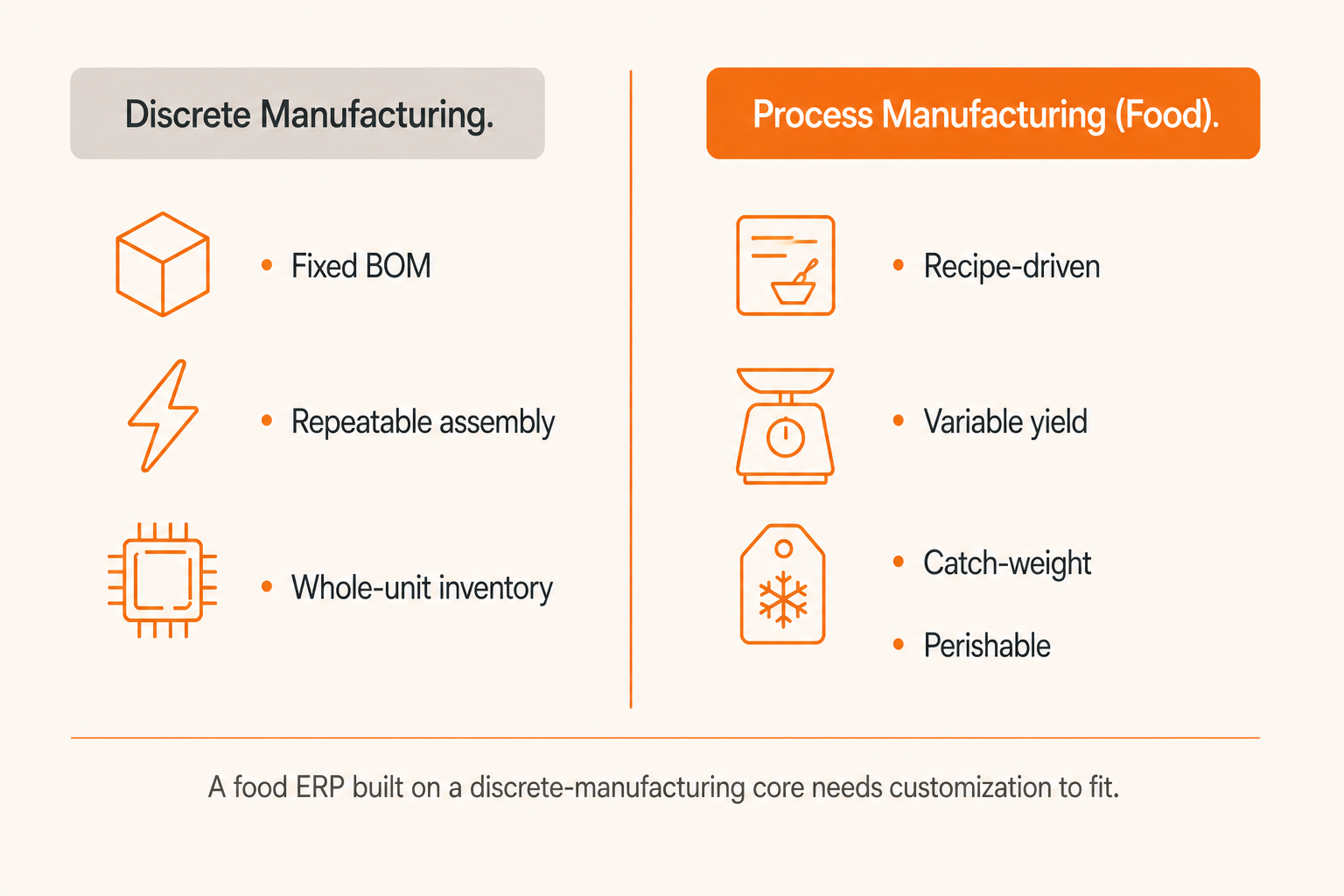
Food production follows process manufacturing. Outputs come from recipes with variable yields, sub-recipes, ingredient substitutions, and catch-weight items where the same SKU comes in different physical weights. Generic ERP and discrete-manufacturing modules are built for fixed BOMs and repeatable assemblies. They can be made to fit food, but only with heavy customization that you'll spend the next decade maintaining.
A specialized food ERP handles four pressures at once:
Perishability. Inventory has an expiration date, and the system needs to allocate accordingly.
Traceability. A recall has to be answered in hours, not days. Forward and backward.
Compliance. FDA, FSMA, Hazard Analysis and Critical Control Points (HACCP), Global Food Safety Initiative (GFSI), and retailer audits all need clean records.
Variability. Real ingredients have variable yields, variable weights, and substitutions. The recipe is the source of truth, not the BOM.
The “tell” that you're looking at a generic ERP dressed up as food software: ask the vendor whether their recipe module is a BOM. If yes, expect customization. If they hesitate on catch-weight, allergen roll-up, or yield variance, expect a bigger customization bill.
Use this section as the high-level checklist.
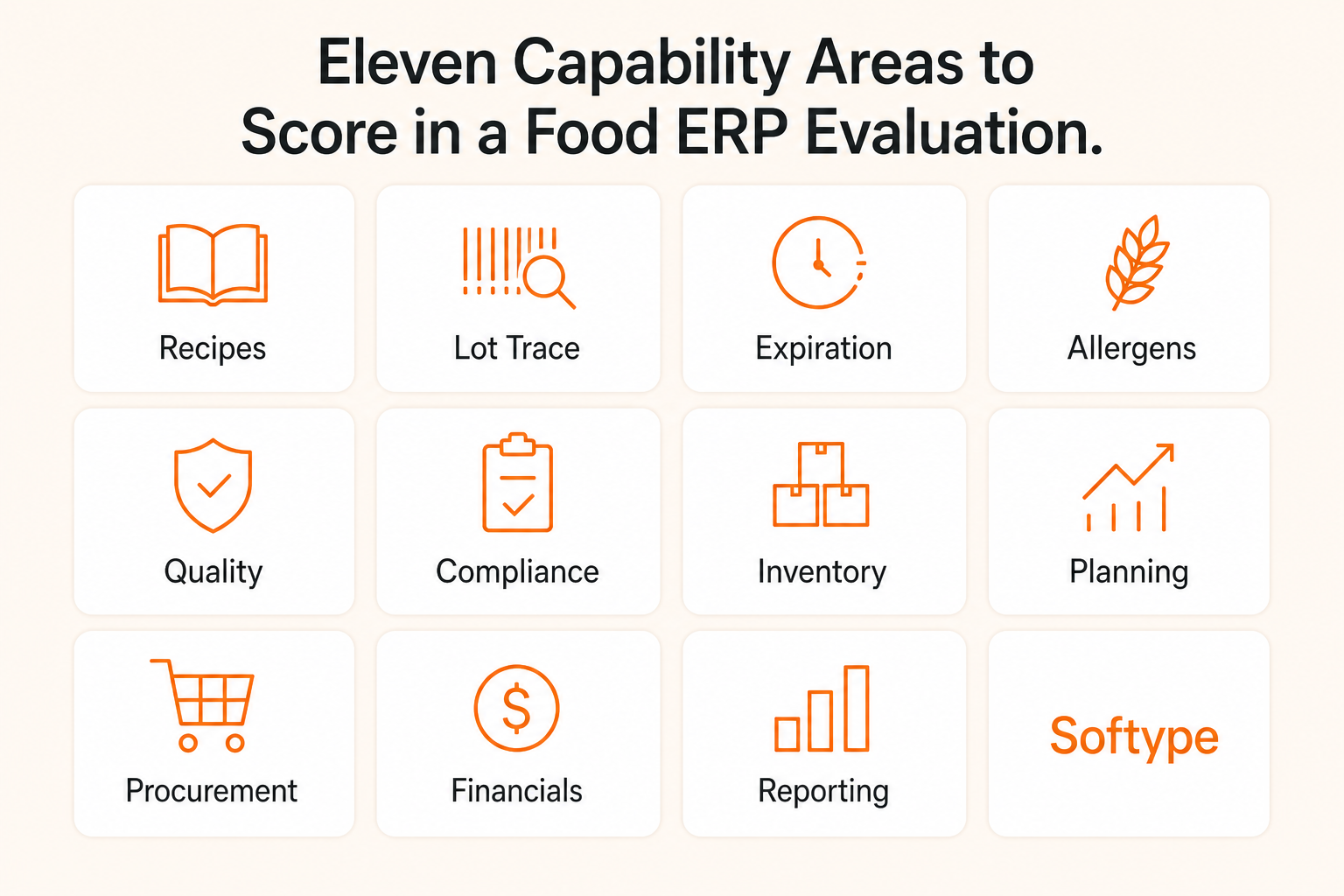
Recipes need to be a first-class concept, not a BOM with substitutions. Look for full recipe lifecycle: versioning, approval workflows, sub-recipes, effective dates, and menu cycles, plus dynamic batch scaling and the ability to link a finished lot back to the exact recipe version that produced it.
Forward and backward traceability from supplier lot to finished good to customer shipment, with lot identity captured at every transaction. Pallet or License Plate Number (LPN) tracking is critical for cold storage and third-party logistics (3PL) integrations. Our companion compliance blog covers how this maps to FSMA 204 in depth.
Expiration date captured at receiving and propagated across the supply chain. First-Expiry-First-Out (FEFO) and First-In-First-Out (FIFO) allocation rules configurable by item or customer. Shelf-life rules by customer or channel matter for retailers with strict minimum-life-on-receipt requirements.
Allergen tracking on ingredients and finished goods, with controls that prevent incompatible substitutions and enforce changeover rules. Nutrition calculation that rolls up automatically from ingredient specs. Label content (ingredients, allergens, nutrition facts, batch and expiry data) that flows directly to your label printers without manual re-keying.
Quality should live inside the ERP workflow, not in a separate spreadsheet or stand-alone Laboratory Information Management System (LIMS). Look for configurable tests at receiving, in-process, and pre-shipment checkpoints. Pass-fail logic that automatically holds inventory. Non-conformance and Corrective and Preventive Action (CAPA) workflows that close the loop.
Support for FDA, USDA, FSMA, HACCP, and GFSI schemes such as Safe Quality Food (SQF), British Retail Consortium (BRC), and Food Safety System Certification (FSSC) 22000. Digital audit trails. Electronic signatures where required. The compliance burden should be a by-product of doing the work, not a separate project at audit time.
Multi-location, multi-zone inventory with rules per zone (ambient, chilled, frozen). Catch-weight support for variable-weight items such as meat, cheese, and produce, with pricing based on actual weight. Quarantine and blocked-stock handling for QC failures or recalls. Mobile barcode scanning that captures lot, expiration, and location on every move.
Materials Requirements Planning (MRP) that accounts for yield factors and shelf life, not just lead times. Finite capacity scheduling for constrained resources (ovens, kettles, fillers, packaging lines). Allergen-aware batch sequencing to minimize changeovers and Clean-In-Place (CIP) events.
Approved supplier lists with material specifications and agreed quality parameters. Supplier performance tracking on delivery, quality incidents, and Certificate of Analysis (COA) compliance. Capture of supplier lot numbers and farm or origin data where regulations require it.
Standard and actual costing with variance analysis at the batch or production-run level. Landed cost handling for imported ingredients, including duties and freight. Profitability reporting by product, line, channel, or customer, all driven from the same database as production and inventory.
Dashboards for yield, scrap, On-Time-In-Full (OTIF), complaints, and recall readiness. Self-service reporting on production, quality, and inventory. Embedded business intelligence or warehouse integration for cross-plant analytics.
Score each row 1 to 5 against each vendor (1 = absent or workaround, 3 = supported with effort, 5 = native and configurable). Weight the categories that matter most to your operation. Anything scoring 2 or below in a "must-have" category is a deal-breaker, not a roadmap item.
Category | Capability | Must-Have or Nice-to-Have | What to Verify in the Demo |
|---|---|---|---|
Process Manufacturing | Recipe with versioning, approvals, sub-recipes | Must | Make a change, approve it, run a batch, and trace the lot back to the version |
Process Manufacturing | Dynamic batch scaling | Must | Scale a recipe from smallest to largest run size live |
Process Manufacturing | Yield variance per ingredient | Must | Show actual vs. expected yield on a completed batch |
Process Manufacturing | Co-products and by-products | Must (if relevant) | Run a recipe that produces trim or off-spec output |
Traceability | Forward and backward lot trace | Must | Run a mock recall in the demo |
Traceability | Pallet or LPN tracking | Must | Scan a pallet through receiving, putaway, and ship |
Expiration | Expiry capture and FEFO picking | Must | Pick from a SKU with three lots, three expirations |
Expiration | Customer or channel shelf-life rules | Nice | Set a 30-day minimum-life rule for one customer |
Allergens | Allergen roll-up from ingredient to finished good | Must | Add an allergenic ingredient to a sub-recipe and watch it propagate |
Allergens | Cross-contact and changeover controls | Must | Schedule allergen and non-allergen runs back to back |
Allergens | Nutrition calculation and label feed | Must | Generate a label with allergen statement and Nutrition Facts |
Quality | QC at receive, in-process, ship | Must | Fail a test and watch the inventory go on hold automatically |
Quality | COA capture linked to lot | Must | Receive a lot with a COA and retrieve it from the lot record |
Quality | Non-conformance and CAPA workflow | Must | Open an NC, assign a CAPA, close it |
Compliance | FSMA 204 traceability lot codes and Key Data Elements | Must | Show the report you'd hand the FDA in 24 hours |
Compliance | Digital audit trail and electronic signatures | Must | Edit a recipe and show the signed audit trail |
Inventory | Multi-zone (ambient, chilled, frozen) rules | Must | Move stock between zones and confirm rule enforcement |
Inventory | Catch-weight or dual unit of measure | Must (if relevant) | Receive variable-weight meat and price the invoice |
Inventory | Quarantine and blocked stock | Must | Place a lot on hold and try to ship it |
Planning | Expiry-aware MRP | Must | Run MRP with shelf-life constraints and short-coded inventory |
Planning | Allergen-aware batch sequencing | Nice | Build a production schedule that respects changeover rules |
Procurement | Approved supplier and spec management | Must | Block a PO from an unapproved supplier |
Procurement | Supplier performance and COA compliance | Nice | Show vendor scorecard with COA receipt rate |
Financials | Standard and actual cost, variance | Must | Show variance on a finished batch tied to specific ingredients |
Financials | Landed cost on imports | Must (if relevant) | Add freight and duty to an imported ingredient and reflect in COGS |
Reporting | Dashboards for yield, scrap, OTIF, recall readiness | Must | Show a real dashboard, not a static slide |
Platform | Mobile shop-floor interface designed for kitchen or plant use | Must | Hand a tablet to an operator wearing gloves |
Platform | Configurable without custom code | Must | Add a custom field to a recipe live, with no developer |
Use this matrix as a working document during demos. Make the vendor walk through each row. Watch the screens, not the slides.
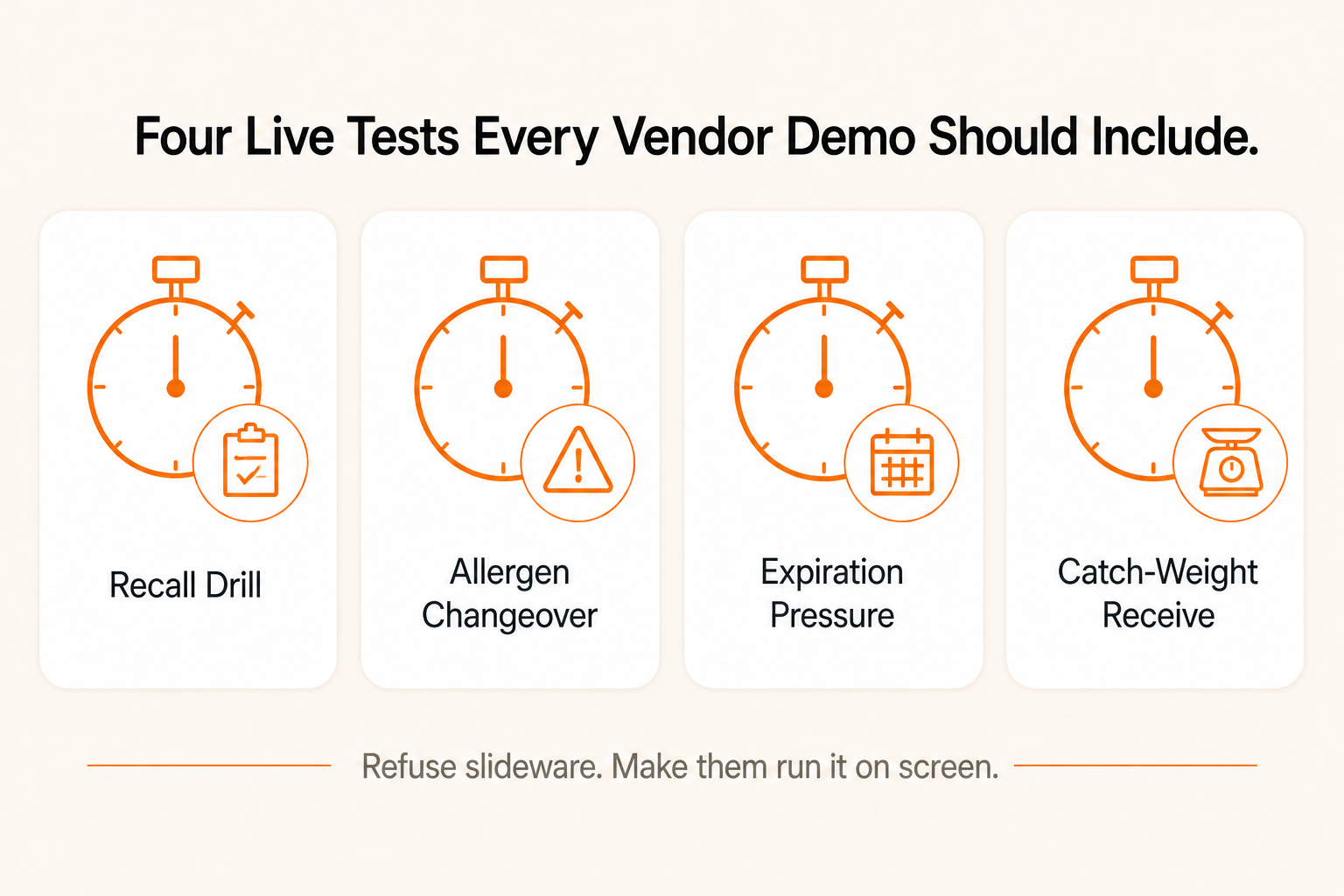
Feature lists are easy to fake. Live scenarios are not. Build three or four into every vendor demo and refuse to accept slideware for any of them.
 The Recall Drill
"A customer reports a foreign object in a finished good. Show me, end to end, how I trace the affected lot back to its supplier ingredients, identify which other finished goods used the same lot, list the customers who received them, and produce the report I'd hand the FDA. Time it."
What you're testing: forward and backward traceability, FSMA 204 readiness, and how much of this is automatic versus stitched together by a consultant during the demo.
The Allergen Changeover"We run an allergenic recipe in the morning and an allergen-free recipe in the afternoon on the same line. Demonstrate how the system enforces cleaning, prevents wrong sequencing, and updates the labels and nutrition facts when an ingredient changes."
What you're testing: allergen logic, changeover controls, label generation, and whether the system protects you when humans get tired.
The Expiration Pressure Test"We have three lots of the same SKU with different expiration dates. Customer A requires 30 days remaining shelf life on receipt. Customer B doesn't. Show how the system picks the right lots for each."
What you're testing: FEFO, customer-specific shelf-life rules, and whether expiration data actually drives allocation or is just stored on the record.
The Catch-Weight Receive"Receive 100 cases of bone-in chicken thighs. Each case has a different actual weight. Invoice the supplier on the actual weight. Sell the product per pound. Show me the GL impact."
What you're testing: dual-unit-of-measure support. Many ERPs that claim catch-weight handle it through workarounds or custom scripts. The GL has to balance.
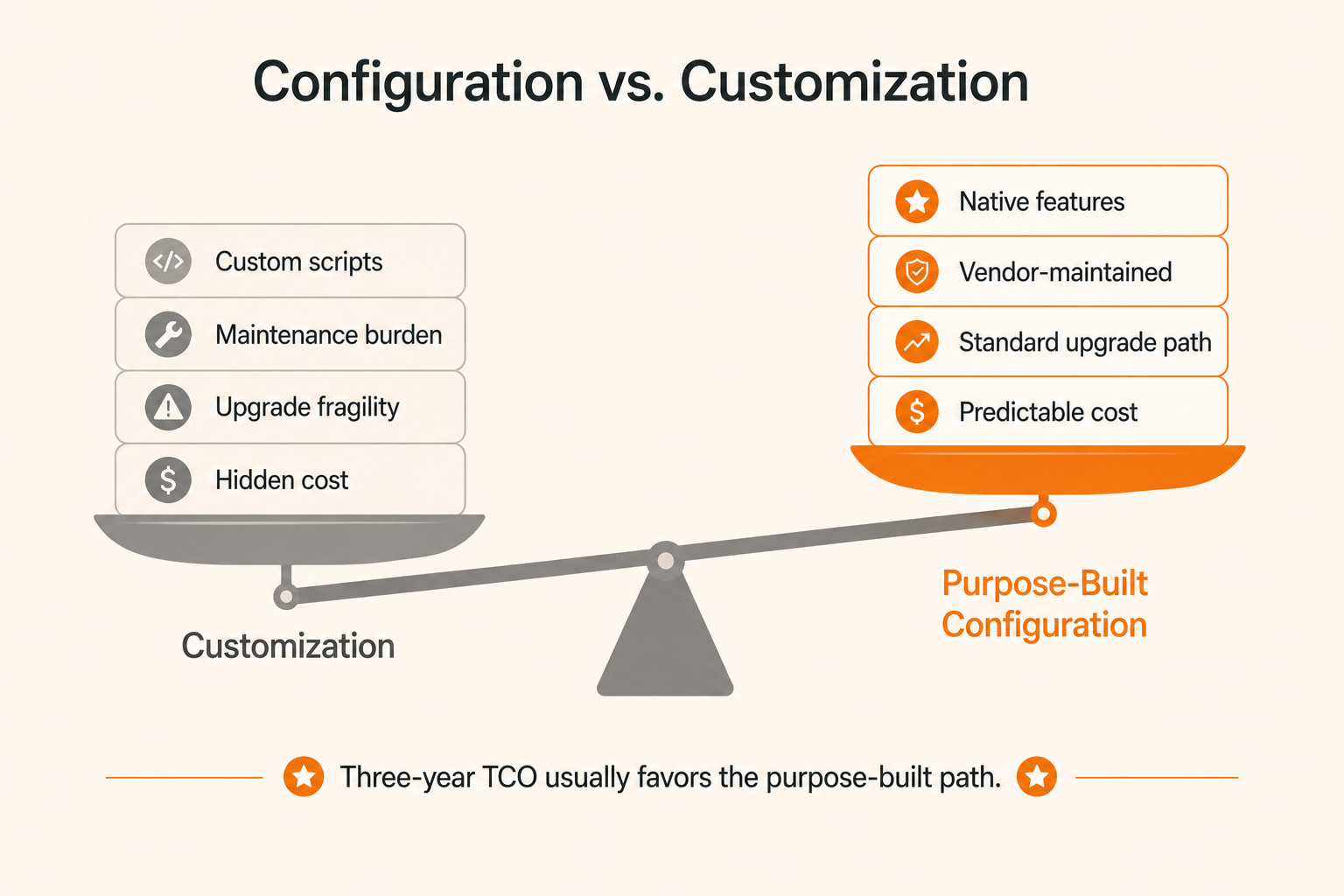
This is where most food and beverage ERP buyers get burned. A vendor demos a feature that "works." What they don't say is that the feature exists because the previous customer paid to have it built and you'll be paying to maintain that custom code for the next decade.
A pattern we see often when reviewing food and beverage ERP environments: a manufacturer chose a generic ERP because the license was cheaper, then spent more on custom scripting to approximate recipe management, catch-weight handling, yield tracking, and shelf-life-aware planning than the purpose-built food ERP would have cost in license fees over three years. In one comparison we ran for a high-volume commissary, the gap was roughly three times the total cost of ownership over three years. The custom build was also slower to deploy and harder to upgrade.
For each must-have capability, ask the vendor:
Is this standard, an add-on, or a custom development item?
How often do food and beverage customers upgrade, and what breaks during upgrades?
When FSMA, HACCP, or retailer requirements change, does your team update the rules, or does mine?
Show me a customer of similar size in my segment (dairy, bakery, meat, beverage, commissary) using this feature in production.
If the answer to "is this standard?" is "we can build it for you," that's customization risk on day one. Score it accordingly.
The platform is half the decision. The partner is the other half.
A great food and beverage ERP implemented by someone who has never run a recall drill will still get you in trouble. A merely good platform implemented by a partner who knows process manufacturing will outperform.
Ask the partner, not just the software vendor:
How many food and beverage implementations have you delivered in my sub-segment in the last three years?
How do you handle HACCP plan setup, master data cleansing, and cutover for lot and expiration data?
Can you run a mock recall with my data on day 30 of go-live?
What's your track record of pairing the core ERP with the right industry-specific module, rather than customizing the core to fit?
The right partner will recommend a purpose-built process manufacturing layer over heavy customization of a discrete manufacturing system. That recommendation alone will save you money and time on year-three audits and platform upgrades.
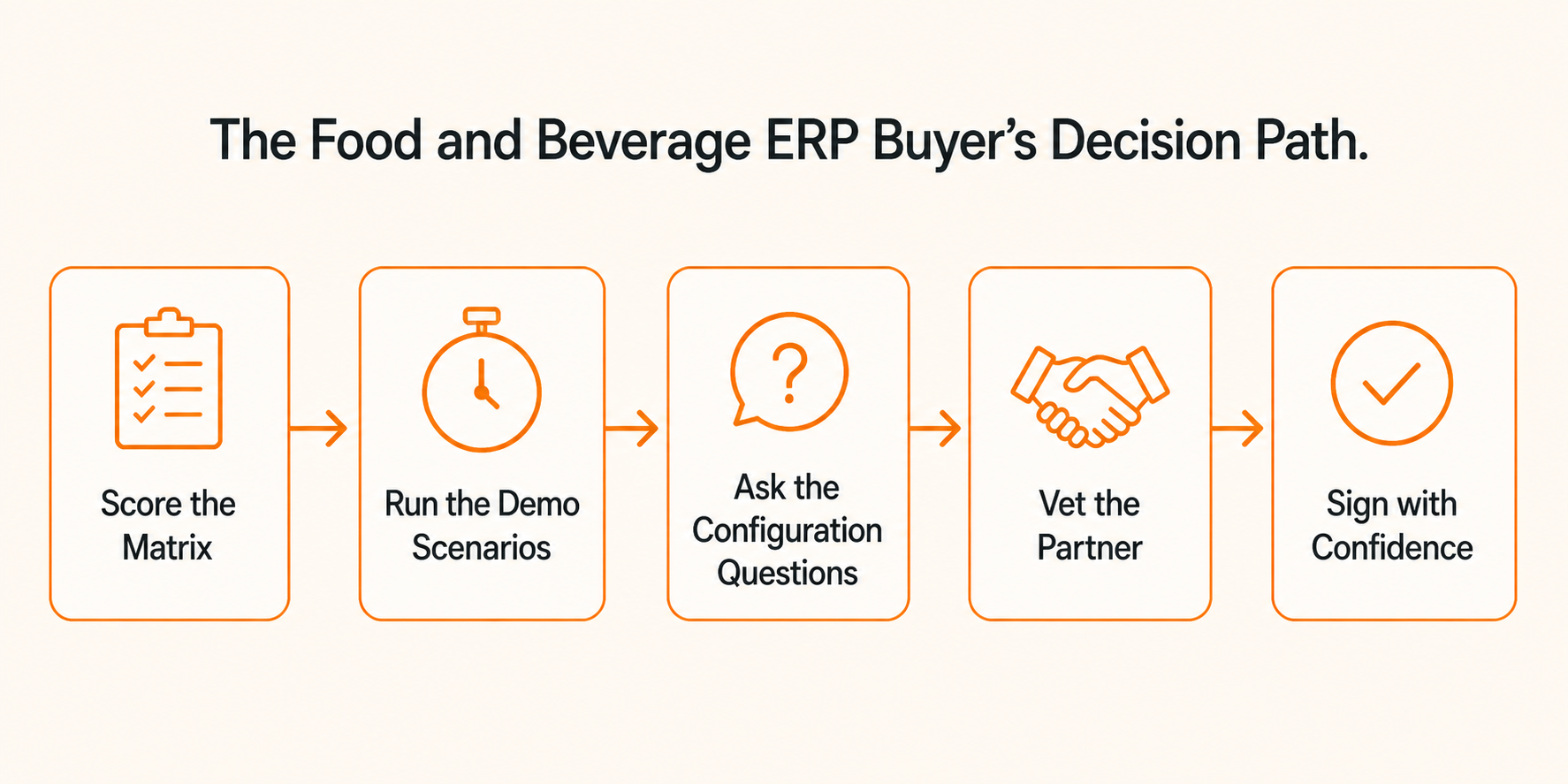
A food and beverage ERP decision is not a feature comparison. It's a question of whether the system understands how your plant actually runs. The matrix above, the demo scenarios, and the configuration-vs-customization questions are designed to surface that, before contracts are signed.
Get in touch If you'd like Softype to walk through this checklist against the specific systems you're evaluating. We have hands-on experience implementing NetSuite paired with the right process manufacturing layer for food and beverage manufacturers, including high-volume commissaries, packaged food production, and catering operations.
Recipe and formula management with version control, full lot and batch traceability, expiration and shelf-life control with FEFO, embedded quality and COA management, allergen and label automation, and FDA, FSMA, and HACCP recordkeeping. It should also offer multi-zone inventory, catch-weight support, integrated financials, and dashboards for yield, scrap, OTIF, and recall readiness.
Food ERPs are built for process manufacturing and perishable products, so they include batch recipes, lot tracking, expiration-aware inventory, allergen controls, and regulatory recordkeeping by default. Generic ERPs typically require heavy customization or third-party add-ons to reach the same level. Customization may work at small scale, but it usually breaks down as recipes, SKUs, and locations grow.
Yes, when paired with a purpose-built process manufacturing SuiteApp. NetSuite's native manufacturing modules are designed for discrete assembly, so for recipe-driven, variable-yield, catch-weight food production, the right pattern is core NetSuite for finance, inventory, and lot tracking, with a Built-for-NetSuite SuiteApp providing the process manufacturing layer.
Choosing on demo polish rather than on live scenarios. Insist that the vendor run a mock recall, an allergen changeover, and a catch-weight receive against your data, not their canned demo. The systems that look the slickest in slides are often the ones that buckle the hardest in production.
Equally important. A great food and beverage ERP delivered badly will still fail your first audit. A merely good ERP delivered by a partner who has run dozens of food implementations will outperform it. Ask for references in your specific sub-segment and run them.
For a mid-sized food manufacturer, plan on three to six months for a phased rollout: finance and core inventory first, then the process manufacturing layer, then optimization (demand planning, advanced reporting, integrations). Compressing the timeline is possible with parallel workstreams when the partner has a repeatable food and beverage methodology.
It depends on scale, but the pattern we see is that the purpose-built path is cheaper over a three-year horizon despite the additional license fee, because the custom-build path absorbs hundreds of hours of scripting, longer implementations, and ongoing maintenance every time the underlying platform releases an update. Always model total cost of ownership over three years, not just year one.
Food production follows process manufacturing.
Use this section as the high-level checklist.
Recipes need to be a first-class concept, not a BOM with substitutions.
Forward and backward traceability from supplier lot to finished good to customer shipment, with lot identity captured at every transaction.
Expiration date captured at receiving and propagated across the supply chain.
Allergen tracking on ingredients and finished goods, with controls that prevent incompatible substitutions and enforce changeover rules.
For the vendor-published detail behind the capabilities described above, Oracle maintains official documentation:


Helping businesses thrive with integrated ERP solutions.
NetSuite
Service
Company
Contact Us
Copyright © 2026


