


If you are evaluating NetSuite for the first time, you already know the subscription is not the whole picture. What catches most buyers off guard is the gap between the subscription quote and the actual Year 1 spend once implementation, data migration, training, customization, and post go-live support are included.
This blog is not about what NetSuite costs. We have two companion guides for that: NetSuite Pricing 2026: Complete Breakdown of Costs, Licenses and Hidden Fees covers every subscription component in detail, and How Much Does NetSuite Really Cost? A Transparent Guide for Businesses covers the full total cost of ownership model across five years. Start there if you need the pricing fundamentals.
This blog is about how to plan. It gives you a multiplier-based estimating method, the five decisions that swing the number, the cost-control levers available to you, and a walkthrough of what to expect in a partner Statement of Work (SOW) so you can read the proposal with confidence.
Before you model every line item, there is a directional shortcut that experienced buyers use to set expectations early.
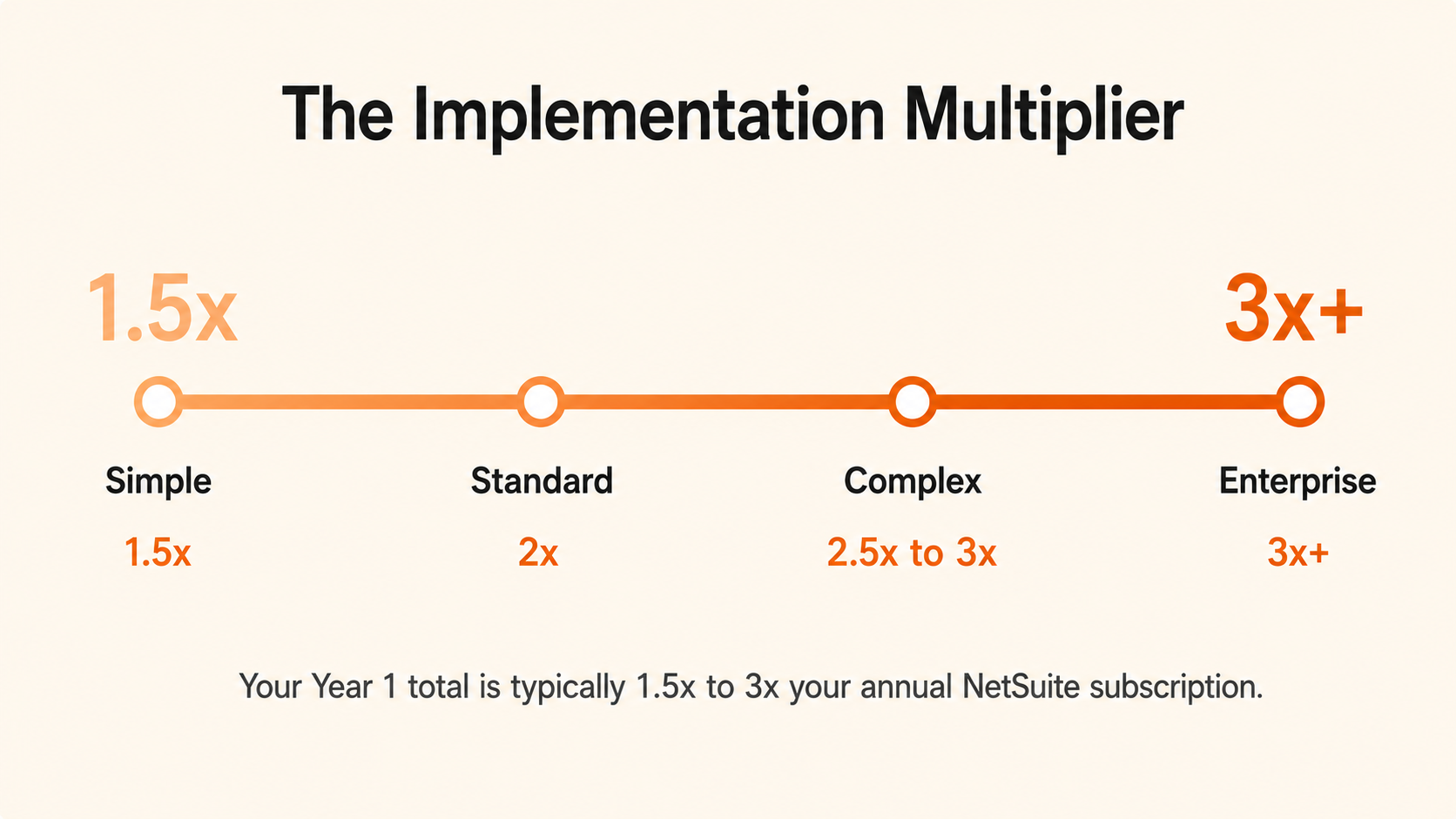
Year 1 total is typically 1.5x to 3x your annual NetSuite subscription.
This means if your quoted annual subscription (base platform plus users plus modules) comes in at $80,000 per year, plan for a Year 1 all-in spend of roughly $120,000 to $240,000, with the subscription itself as one component and the rest covering implementation services, data migration, training, customization, and early post go-live support.
Where you land on that range depends on five cost drivers.
Multiplier Range | What It Typically Means |
|---|---|
1.5x or lower | Simple scope. Core financials, single entity, clean data, minimal customization, experienced internal team. Often achievable with SuiteSuccess methodology for greenfield deployments. |
2x | Moderate scope. Multi-department, some integrations, moderate data migration, standard workflows. The most common mid-market outcome. |
2.5x to 3x | Complex scope. Multi-entity, multiple integrations, heavy data migration, significant customization, advanced modules. Common for upper mid-market and multi-subsidiary deployments. |
Above 3x | Highly complex. Global multi-subsidiary, enterprise-grade integrations, deep customization, phased multi-year rollout. Less common but real for the largest mid-market programs. |
This multiplier is not precise enough to replace a proper scoping exercise with a partner. It is precise enough to set your internal budget range before that conversation starts.
The multiplier range is wide because five decisions (most of them yours, not Oracle's) determine where you land.
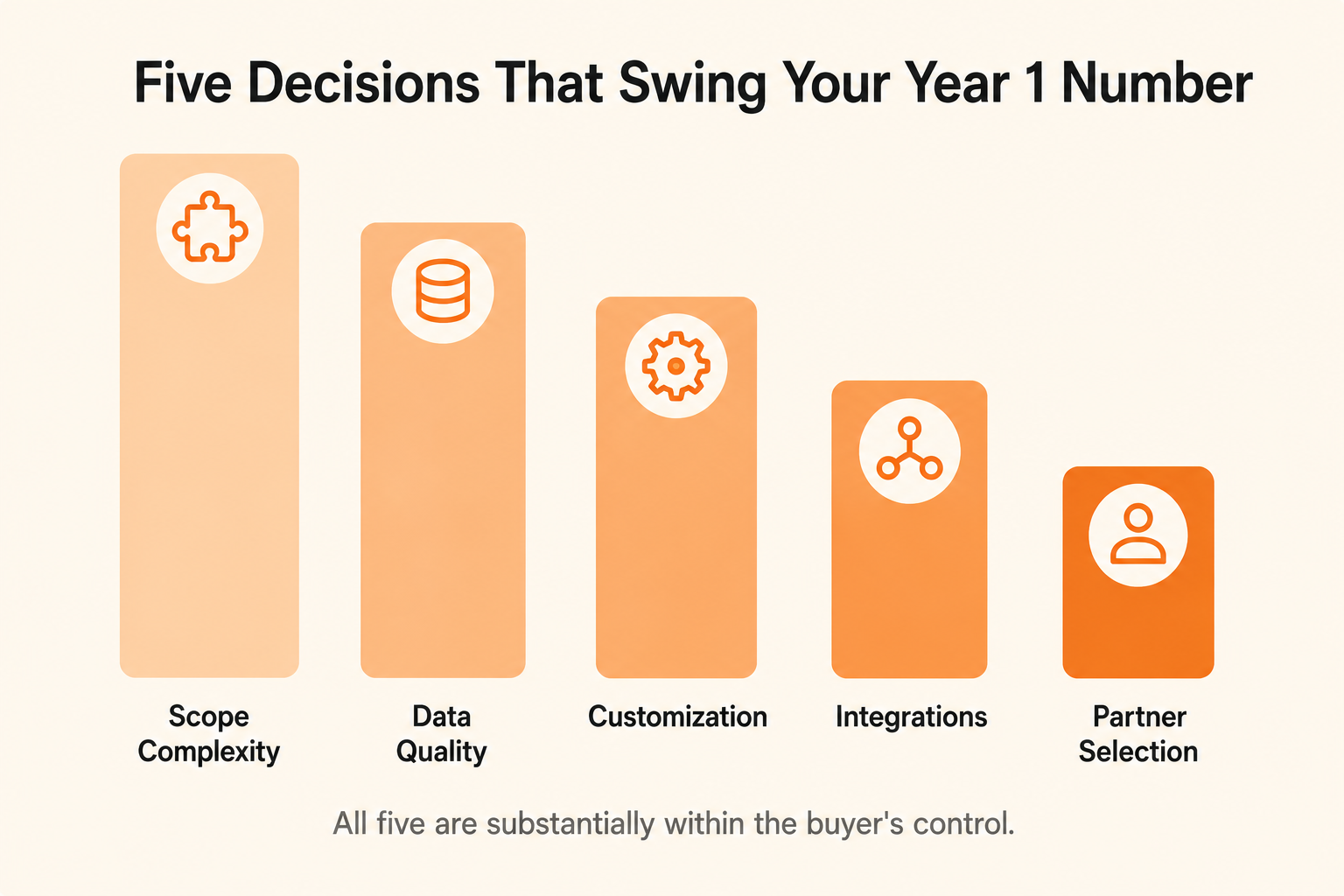
A single-entity, core-financials deployment is a fundamentally different project from a multi-entity, multi-currency rollout with advanced inventory, revenue recognition, and warehouse management. Each module, each entity, and each process adds configuration, testing, and training hours.
The cost-control lever: phase the scope. Finance first, then operations, then advanced modules. Every process you defer to phase two is money you do not spend in Year 1. This is not about cutting corners. It is about sequencing spend against business readiness.
Data migration is one of the most variable cost components because it depends on how clean your legacy data is, how many source systems you have, and how much history you bring over. A single-system migration with clean master data and opening balances only is a fraction of the cost of migrating five years of transactions from three legacy platforms.
The cost-control lever: clean your data before the migration starts, decide how much history you actually need (usually two to three years of active transactions, with the rest archived in the legacy system), and assign internal data owners who do the extraction and cleansing work. The partner provides templates and validation. You provide clean data. Underestimating the internal effort here is the most common reason migration budgets blow out.
For the technical detail on data migration, see our companion guide on NetSuite Data Migration: Complete Guide for First-Time Buyers.
Every custom workflow, custom script, custom report, and custom field adds implementation hours and creates future maintenance obligation. NetSuite's standard configuration covers a wide range of business processes out of the box, and SuiteSuccess methodology delivers pre-built industry configurations that reduce the need for custom work.
The cost-control lever: before you approve any customization in the SOW, ask whether the requirement can be met with standard configuration or a supported SuiteApp. Limit custom scripting in phase one to genuine must-haves. Everything else goes on the phase two enhancement backlog. This discipline alone can reduce Year 1 implementation cost by 20 to 30 percent on many mid-market projects.
Each integration between NetSuite and an external system (e-commerce platform, Customer Relationship Management (CRM), warehouse management, banking, payroll, marketplace) adds design, build, test, and ongoing maintenance cost. Simple integrations using pre-built connectors or middleware are materially cheaper than custom-built point-to-point integrations.
The cost-control lever: prioritize integrations that are critical for go-live (banking, core e-commerce, primary warehouse) and defer the rest to phase two. Use pre-built middleware connectors (Celigo, Boomi, or native SuiteCloud connectors) where they exist rather than building from scratch. Budget for ongoing middleware licensing as a Year 1 operating cost, not just a one-time build fee.
The partner you choose affects both the hourly rate and the total hours needed. A partner with deep experience in your industry and a proven implementation methodology (such as SuiteSuccess) will typically scope more accurately, configure faster, and produce fewer rework cycles than a generalist partner learning your industry on your project.
The cost-control lever: evaluate partners on methodology, industry references, and team composition, not just quoted rate. A lower hourly rate from a less experienced partner often results in more total hours and a higher final bill. Ask for fixed-fee or capped-fee proposals where the partner's methodology supports it, and compare proposals on total project cost rather than rate cards.
For guidance on evaluating partners, see NetSuite Implementation Partners in the Philippines: How to Choose (the evaluation framework applies globally, not just in the Philippines).
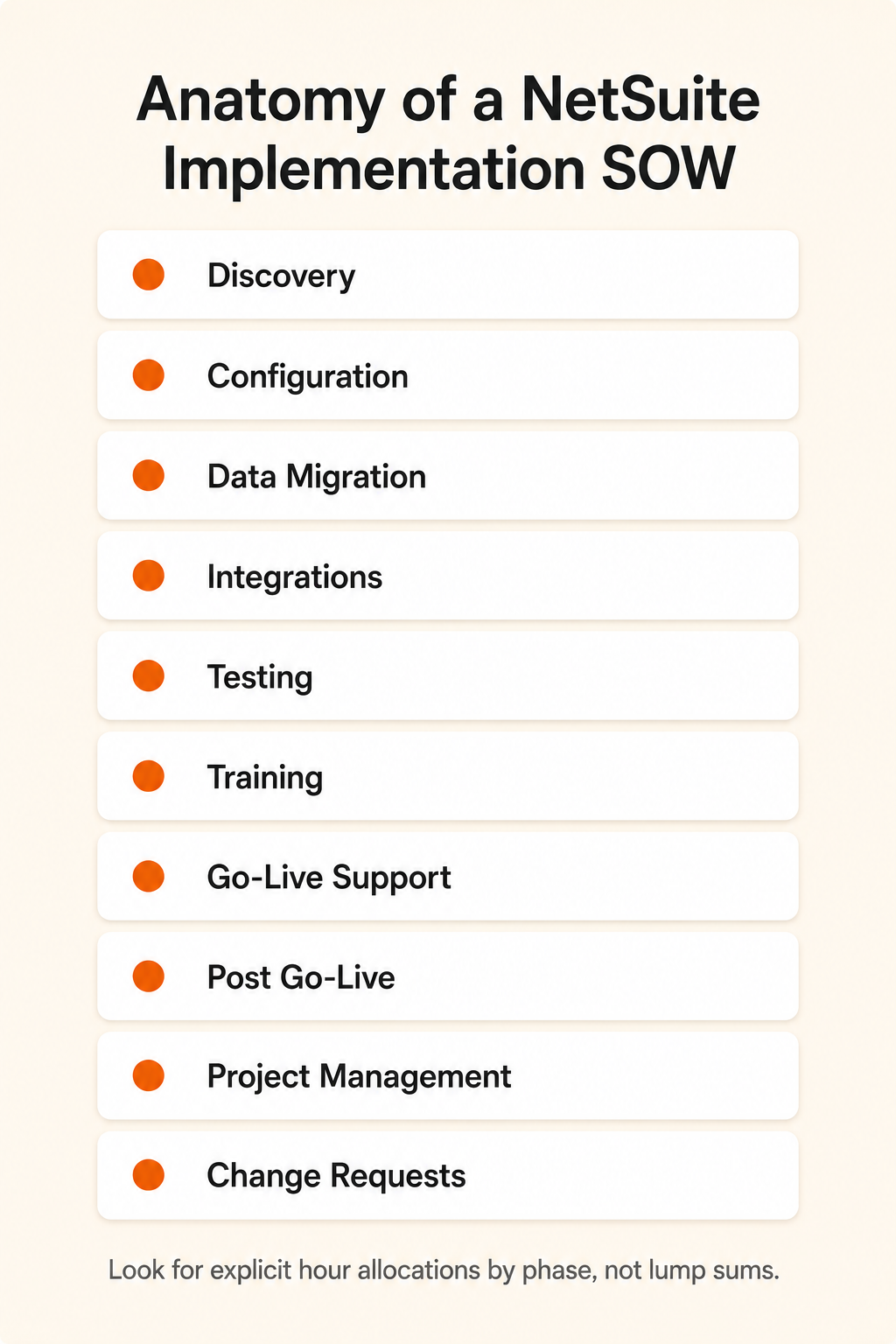
When a partner sends you a proposal, the SOW will typically contain line items across several categories. Knowing what each covers helps you compare proposals on equal terms and ask the right questions.
SOW Line Item | What It Covers | Questions to Ask |
|---|---|---|
Discovery and solution design | Process mapping, requirements workshops, configuration blueprint, data model | How many hours are allocated? What happens if we discover new requirements during workshops? |
Configuration and build | Setting up the NetSuite environment: entities, chart of accounts, roles, workflows, forms, dashboards | Is this based on SuiteSuccess pre-built configurations or custom from scratch? |
Data migration | Template preparation, field mapping, test loads, production cutover load | How many test migration cycles are included? Who is responsible for data cleansing? |
Integrations | Design, build, and test of connections to external systems | Are integrations built on pre-built connectors or custom? What is the ongoing maintenance model? |
Testing and quality assurance | System integration testing, user acceptance testing, performance testing | How many UAT cycles are included? What happens if UAT uncovers configuration gaps? |
Training | Administrator training, end-user training, training materials | Is training live, recorded, or self-paced? How many sessions per role? |
Go-live support | Cutover execution, production monitoring, immediate issue resolution | How many days of go-live support are included? What is the escalation path? |
Post go-live support | Bug fixes, minor enhancements, optimization in the first 30 to 90 days | Is this included in the project fee or billed separately? How many hours? |
Project management | Partner project manager, status reporting, risk management, change control | Is the PM a named resource throughout the project? |
Change requests | Scope changes discovered during the project | What is the change request process? Are hours pre-allocated for contingency? |
Two things to look for that distinguish a strong SOW from a weak one: explicit allocation of hours by phase (not just a lump sum), and a clear description of what is in scope and what is out of scope. If the SOW does not define what happens when scope changes, that ambiguity will cost you money.
Rather than reproducing the full cost tables from our pricing and cost guides, here is the planning-level view tied to the implementation multiplier.
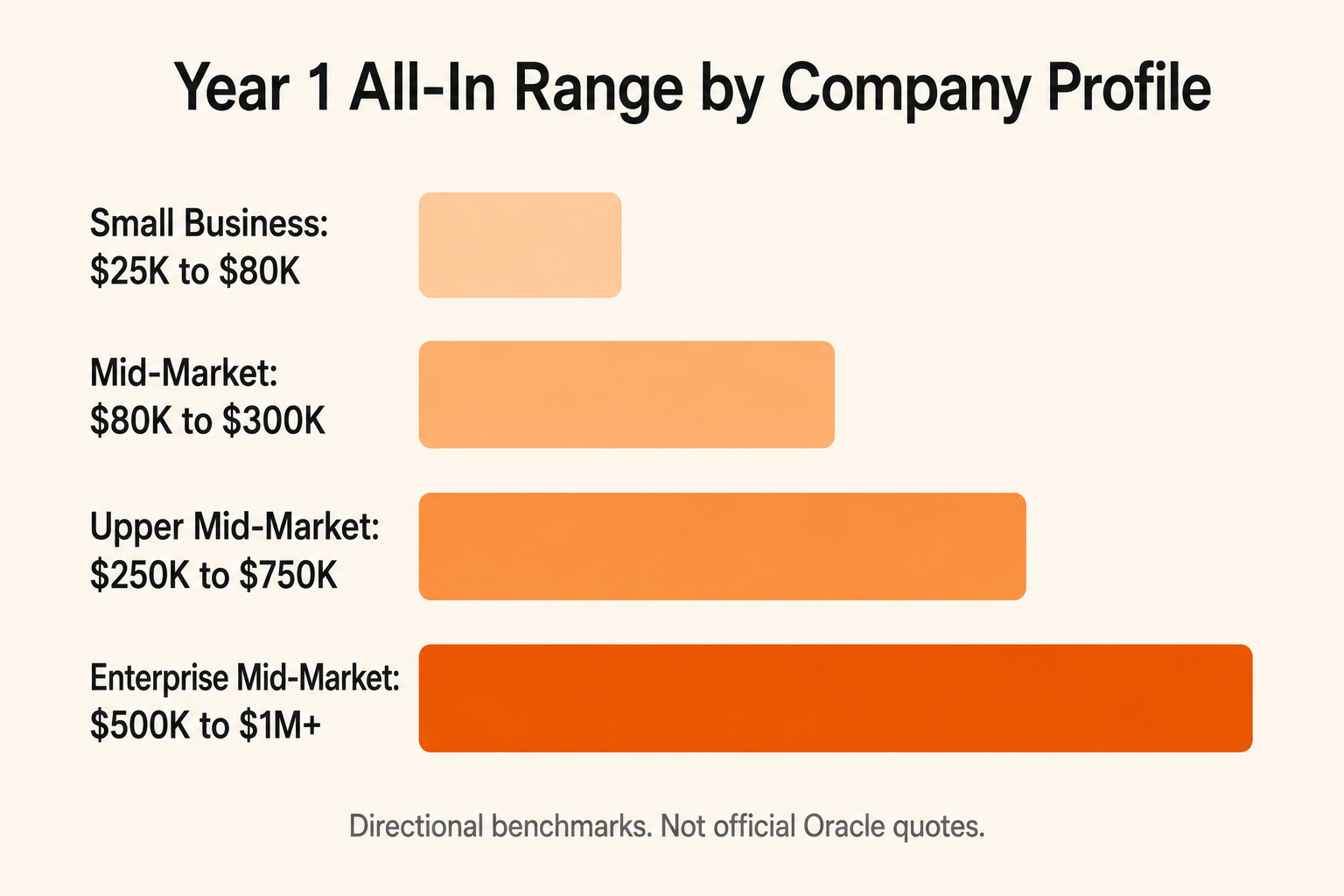
These are directional planning ranges based on publicly available partner guidance and industry benchmarks. They are not official Oracle quotes. Your actual costs will depend on your specific configuration, user count, modules, and partner.
Company Profile | Typical Annual Subscription Range | Multiplier to Apply | Estimated Year 1 All-In Range |
|---|---|---|---|
Small business (under 25 users, single entity, core financials) | $15,000 to $40,000 per year | 1.5x to 2x | $25,000 to $80,000 |
Mid-market (25 to 80 users, multi-department, some integrations) | $40,000 to $120,000 per year | 2x to 2.5x | $80,000 to $300,000 |
Upper mid-market (80 to 200 users, multi-entity, advanced modules) | $100,000 to $250,000 per year | 2.5x to 3x | $250,000 to $750,000 |
Enterprise mid-market (200+ users, multi-subsidiary, global) | $200,000+ per year | 2.5x to 3.5x | $500,000 to $1,000,000+ |
For the detailed breakdown of subscription components (base platform, user licenses, module add-ons), see NetSuite Pricing 2026: Complete Breakdown of Costs, Licenses and Hidden Fees. For the five-year total cost of ownership model including hidden costs, see How Much Does NetSuite Really Cost? A Transparent Guide for Businesses.
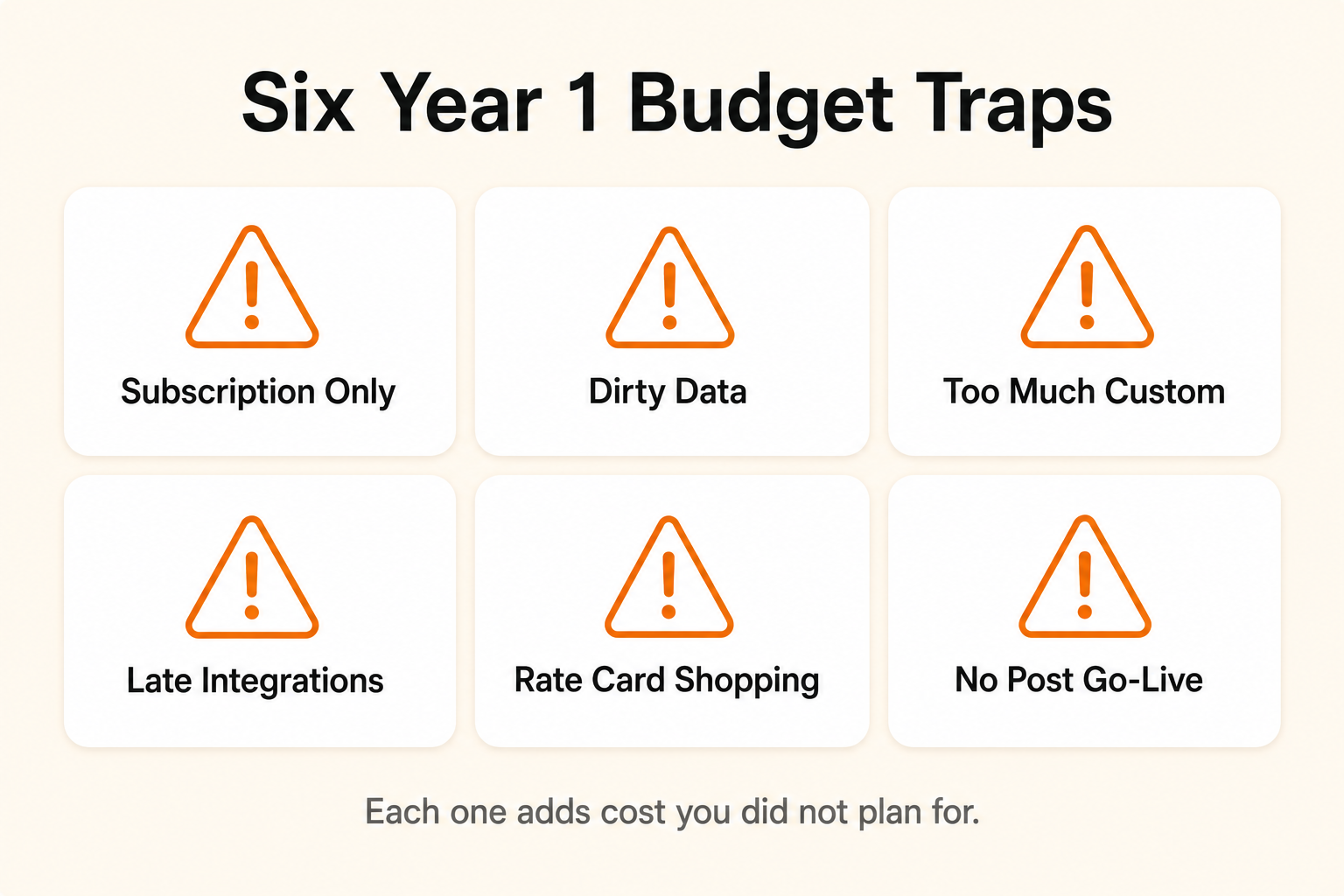
Trap | Why It Happens | How to Avoid It |
|---|---|---|
Budgeting only for the subscription | The quote looks like the whole cost | Apply the 1.5x to 3x multiplier before presenting the business case internally |
Underestimating data migration | Assumes legacy data is clean and minimal | Audit your data early. Budget 30 to 40 percent of migration time for cleansing. See our data migration guide. |
Approving too much customization in phase one | Every stakeholder wants their workflow on day one | Limit custom scripting to must-haves. Standard configuration and SuiteApps first. Everything else is phase two. |
Deferring integration planning until late in the project | Assumes integrations are simple | Scope integrations during discovery, not after configuration is done. Late-discovered integrations are the most expensive. |
Comparing proposals on hourly rate, not total project cost | A low rate feels like a good deal | Ask for total cost by phase. A cheaper rate with more hours costs more than a higher rate with fewer hours. |
Forgetting post go-live support | Assumes the project ends at go-live | Budget 30 to 90 days of post go-live support hours. The first month after go-live always surfaces issues. |
Softype scopes Year 1 budgets using a phased methodology: finance and core operations first, then expansion modules and integrations in subsequent phases. This keeps Year 1 spend focused on what matters for go-live and defers enhancement spend to when the team is ready.
Our proposals break cost into explicit phases with hour allocations per workstream, clear scope boundaries, and a defined change-request process. We use the SuiteSuccess methodology where it fits the buyer profile and a tailored approach where it does not. Both paths produce a scoped, defensible Year 1 budget.
For the broader implementation lifecycle, see How to Implement NetSuite: Step-by-Step Guide for First-Time Buyers. Before your first partner conversation, use our NetSuite Demo Checklist: What to Ask Your Sales Rep to ensure you are entering the process with the right questions.
The best Year 1 budget is the one that does not surprise you in month four. The multiplier gives you the planning range. The five cost drivers tell you where you sit on that range. The cost-control levers are decisions you make before the SOW lands, not reactions to a number that already feels too high.
Start with your subscription quote. Apply the multiplier. Challenge the scope against what genuinely must be live on day one versus what can wait for phase two. Compare partner proposals on total project cost by phase, not on rate cards. And read the SOW carefully, because what it does not say matters as much as what it does.
Talk to Softype about your NetSuite Year 1 budget. We scope implementations across finance-led, manufacturing, distribution, and multi-entity environments and will give you an honest estimate before you commit.

Year 1 all-in cost (subscription plus implementation plus data migration plus training plus early customization) typically runs 1.5x to 3x your annual subscription. For most mid-market companies, that means $80,000 to $300,000. Simpler deployments can come in lower. Multi-entity, multi-subsidiary projects can exceed $500,000.
Scope complexity. The number of entities, modules, integrations, and custom processes in phase one is the primary variable. Data migration quality is the second. Both are substantially within the buyer's control.
Yes. Phase the scope (finance first, operations second). Limit custom scripting to genuine must-haves. Use SuiteApps and standard configuration before building custom. Clean your data before migration. Choose a partner with deep experience in your industry. These levers reduce hours without reducing the quality of the outcome.
Data migration typically accounts for 10 to 20 percent of the total implementation services cost, but it can be higher if you have multiple legacy systems, dirty data, or a requirement to migrate extensive transaction history. The most cost-effective approach is master data plus opening balances only, with historical transactions retained in the legacy system for reference.
Both models exist. Fixed-fee proposals offer budget certainty but require tight scope definition up front. Time-and-materials proposals offer flexibility but require strong project management to control spend. Many partners use a hybrid: fixed fee for well-defined phases and time-and-materials for phases with higher uncertainty. Ask how change requests are handled under either model.
This guide covers how to plan your Year 1 budget using the implementation multiplier and cost-control framework. The NetSuite Pricing 2026 guide covers every subscription component (base platform, user licenses, modules). The How Much Does NetSuite Really Cost? guide covers five-year total cost of ownership including hidden costs. Start with the pricing guide for the subscription detail, then come here for the Year 1 planning math.
For core financials with SuiteSuccess, 4 to 6 months. For multi-entity, multi-module rollouts, 6 to 12 months. Implementation timeline and Year 1 cost are closely correlated: longer implementations consume more partner hours and more internal team time. See our companion guide on How to Implement NetSuite: Step-by-Step Guide for First-Time Buyers for the full timeline breakdown.
Before your first partner conversation. Use the multiplier method in this guide to set your internal range, then refine it with proposals from two to three partners. Having a budget range before you see a SOW prevents the proposal from anchoring your expectations.


Helping businesses thrive with integrated ERP solutions.
NetSuite
Service
Company
Contact Us
Copyright © 2026


