

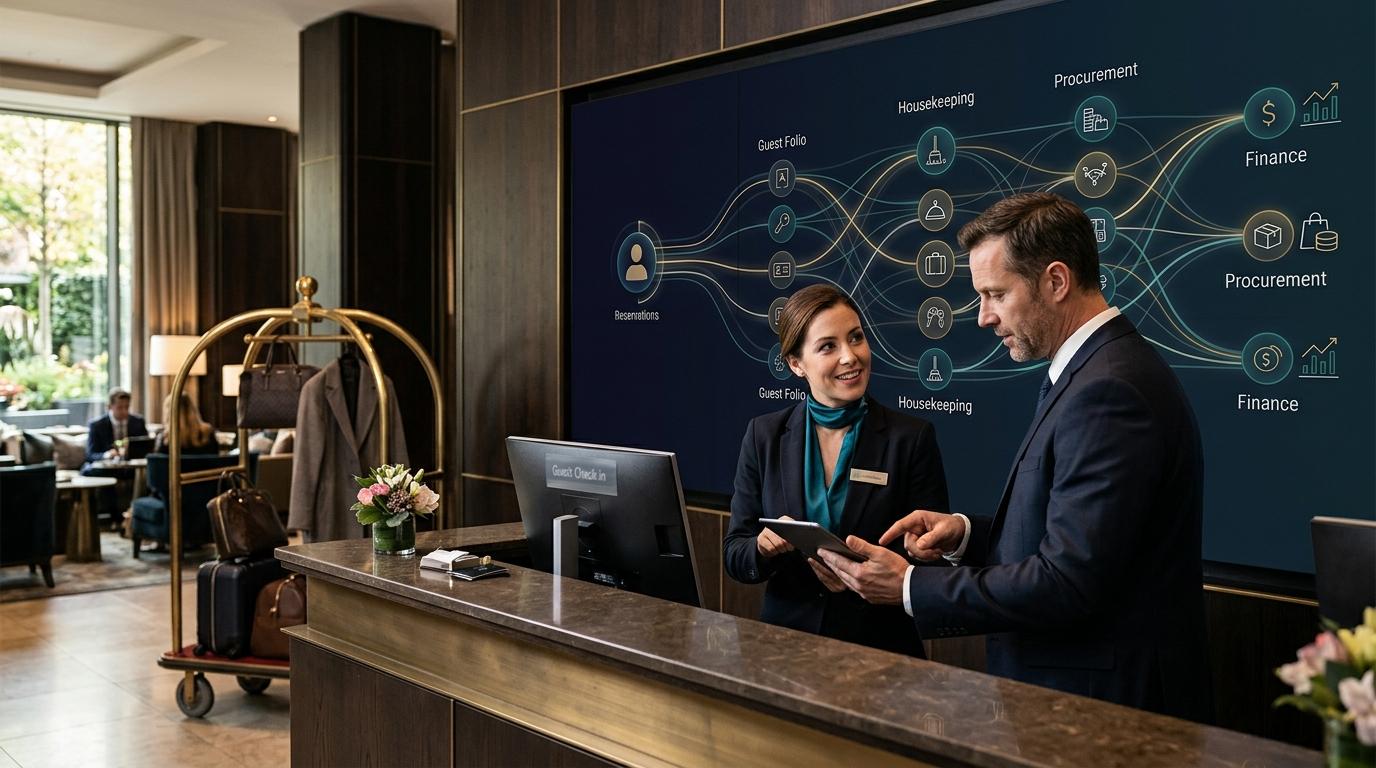
A guest’s restaurant charge appears twice at checkout. Housekeeping is waiting on linen that purchasing believes arrived. Finance is rebuilding yesterday’s results from PMS, point-of-sale and payment exports. Connected hotel systems prevent these everyday handoffs from becoming guest-service and control problems by moving reservations, operations, procurement and finance information through governed workflows. For a practical example of a PMS-to-finance connection, see Softype’s Djubo and NetSuite hotel integration.
Answer: Connected hotel systems are a PMS, ERP and specialist operational tools that exchange the data needed to complete shared workflows. A reservation, folio charge, purchase approval, goods receipt and accounting entry can be traced across their originating systems. It does not mean every capability sits in one application; it means systems have clear ownership and reliable handoffs.
Reservations begin in the property management system (PMS), which manages the guest stay. The PMS holds the booking, room and guest details. During the stay, room and tax charges post to the folio. Meals, minibar, laundry and spa charges may start in other tools. Purchasing follows a separate path: a department requests supplies, someone approves the request, a supplier delivers, and accounts payable (AP) checks the invoice.
When systems do not share data and status, staff fill the gaps. Front-desk teams investigate charges. Night auditors compare settlement files. Finance enters totals again. A room may stay unavailable because housekeeping status has not reached the PMS. An invoice may wait because no one can confirm what arrived.
These are not simply reporting inconveniences. They affect checkout, room readiness, stock availability and managers’ ability to act on current property conditions. The goal is not fewer software products at any cost; it is fewer broken handoffs and less duplicate entry.
A connected architecture assigns each application a clear job. The PMS remains the operational authority for the stay; an ERP provides governed financial records; procurement and operations tools handle specialist work around the property. AHLA’s HTNG Express PMS Workgroup describes the PMS as the primary interface for guest, reservation, folio and room data, which helps explain why the PMS and connected systems have complementary responsibilities.
System | Primary role and ownership | Information exchanged |
|---|---|---|
PMS | Reservations, room inventory and status, guest profiles, folios, deposits, stay charges and night audit. | Occupancy context, revenue and tax, payments, receivables, folio references and room-status events. |
ERP / financial core | General ledger, accounts payable and receivable, supplier master, purchase orders, budgets, cash and close. | Account mappings, approved suppliers, invoice and payment status, property dimensions and financial results. |
Procurement and operations tools | Requisitions, approvals, inventory movements, outlet transactions, housekeeping tasks and maintenance work orders. | Requests, approvals, quantities, receipts, costs, folio charges, completed work and exceptions. |
The PMS does not become an ERP module, and ERP does not replace a PMS. Their roles are complementary. Oracle’s Hospitality Adapter documentation describes connecting OPERA Cloud PMS with Oracle ERP Cloud and other applications through PMS business events and REST APIs. If the immediate challenge is group-wide reporting rather than operational handoffs, see Hotel ERP: Managing Multiple Properties Without Losing Financial Visibility.
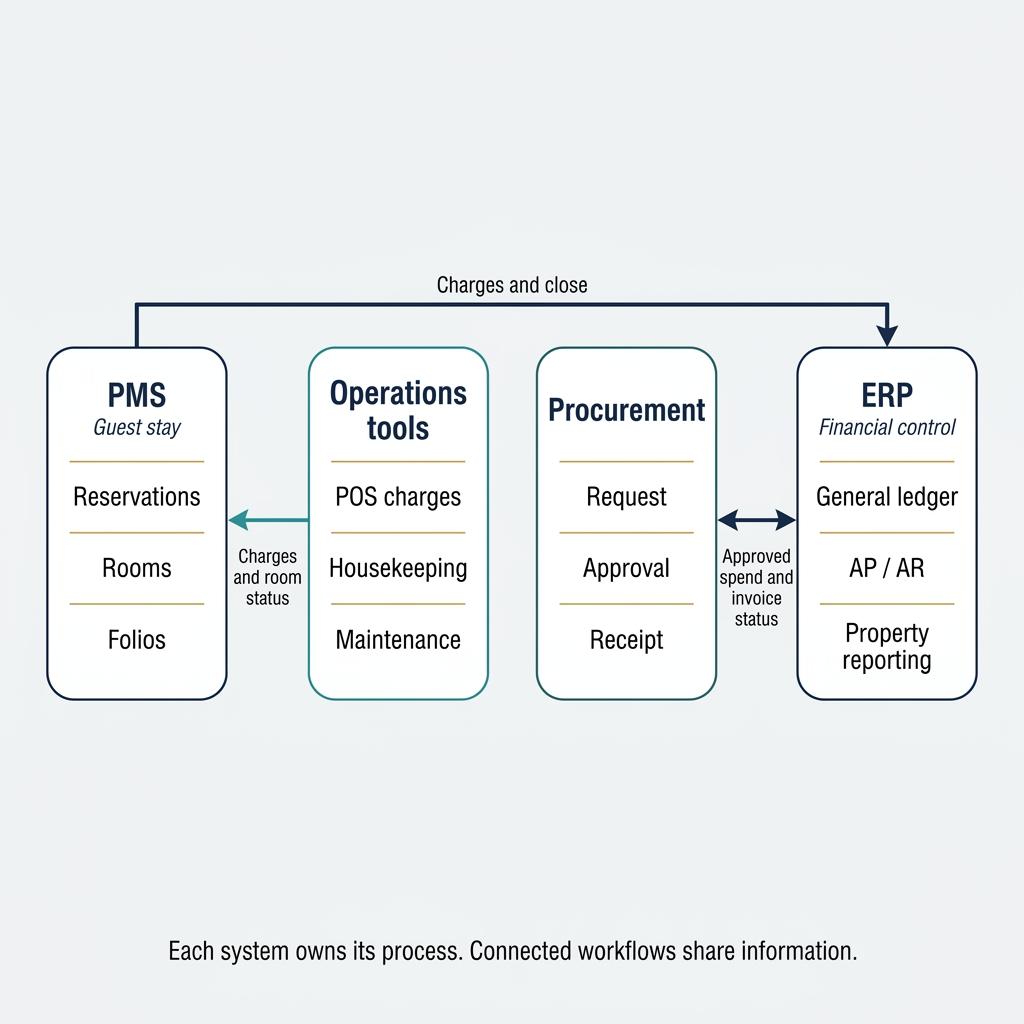
Integration changes how routine handoffs work: the same business event can move downstream with its property, date and source references intact.
Workflow | Disconnected tools | Connected workflows |
|---|---|---|
Reservations-to-finance handoff | Finance downloads PMS reports and rebuilds journals after close. | Mapped revenue, tax, payment and receivable postings move with property, business date and batch references. |
Purchasing approvals | Requests arrive by email or chat; approval is hard to track. | Requisitions carry property, department and budget coding; rules apply before commitment. |
Invoice reconciliation | AP compares invoices with paper receiving notes and calls departments. | Purchase order, goods receipt and invoice are matched; variances route to an owner. |
Property reporting | Teams assemble exports after the period they describe. | Shared dimensions support timely reporting and drill-down to source transactions. |
Duplicate data entry | The same charge, quantity or invoice total is keyed in several places. | Information is captured at its legitimate origin and reused downstream. |
Exception visibility | Errors surface during close, sometimes as unexplained adjustments. | Failed transfers and variances are visible with reason, age and accountable owner. |
Reservation and folio activity should reach finance with enough detail to explain each posting. PMS transaction codes map to general-ledger accounts and reporting dimensions. Revenue, taxes, payments, deposits, adjustments and receivables can then move through a daily close or a more frequent feed. Oracle OPERA Cloud’s back-office export documentation explains how end-of-day processing can create balanced ledger entries and export financial totals to a general ledger or accounts-receivable system.
Keep the property, business date, outlet or department, payment type and source batch with each posting. Retain the folio reference when needed. A daily journal may fit the night-audit process. More frequent updates may help teams make decisions during the day. Choose the timing based on business need and the checks finance must perform.
This is hotel PMS and ERP integration in practice: the PMS records the stay and folio, while the ERP manages the financial result. Finance checks that the postings match the property close and payment settlements. Softype’s Djubo and NetSuite integration is one example of connecting hotel operations with finance.
Occupancy and arrivals can help teams plan purchases, but should not trigger orders on their own. A controlled procure-to-pay process links a request to approval, purchase order, receipt, invoice and payment. Recording what arrived helps AP spot short deliveries, price differences and missing invoices. NetSuite’s Advanced Receiving guidance explains how received items can be matched with vendor bills and quantity or rate differences reviewed. Its three-way match workflow checks bills against purchase orders and receipts.
Operational tools should send useful updates back to the PMS. A guest departure can start a housekeeping task. When cleaning is complete, staff can update room status for the front desk. A minibar charge may also be sent to the guest folio with a reference. Not every detail belongs in the ERP, and some updates can wait for a scheduled transfer.
Connected hotel operations system integration makes status useful across teams. Front desk can see what operations completed; procurement can see request and delivery progress; finance can follow the financial consequence. That shared context supports consistent purchasing controls and smoother coordination without forcing every team into the same application.
PMS integrations can be lengthy and complex. AHLA’s HTNG Express PMS Workgroup notes that limiting an integration to the functionality it needs can simplify the process. Settle these five business decisions before rollout.
Which system owns each data point? Assign one authority for reservations, folios, room status, suppliers, receipts, invoices and the general ledger. Define who can update each and which system prevails if values differ.
What triggers an update? Name the business event, data sent, direction and timing. Define how retries avoid duplicate charges or postings.
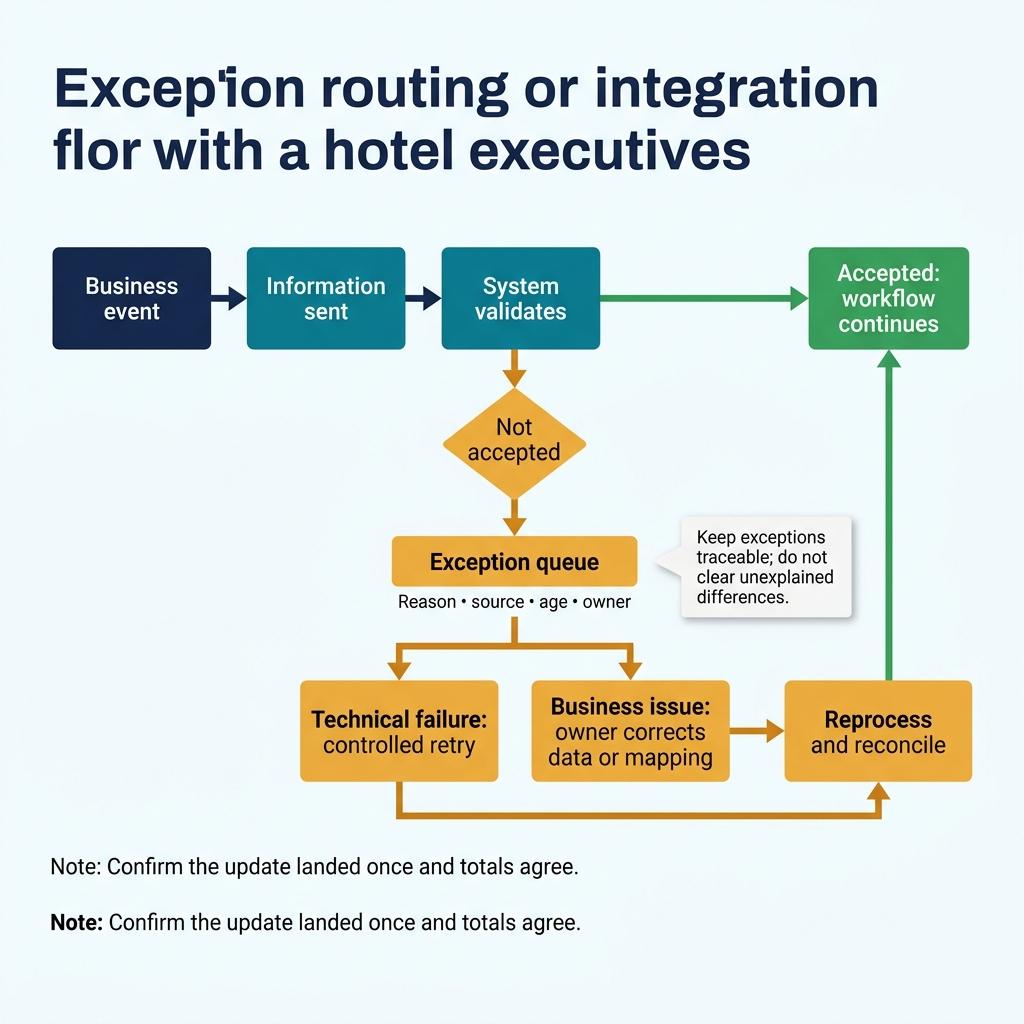
How are exceptions resolved? Make each failure visible with its reason, source, age and owner. Retry technical failures; route business decisions to the responsible team.
How will property reporting stay consistent? Standardize property, department, outlet, revenue, tax, tender and business-date definitions. Label data as live, preliminary or closed.
How will rollout protect hotel service? Pilot a bounded workflow outside peak periods, test realistic scenarios and prepare outage fallbacks. Reconcile daily through cutover until issues and workarounds stabilize.
A hotel is genuinely connected when teams can answer these questions with evidence, not vendor claims.
Is the PMS the agreed authority for reservations, rooms, folios and hotel business date?
Can finance trace a stay from reservation and charges through payment or receivable, PMS close and general ledger?
Are PMS transaction codes mapped to financial accounts and property dimensions, with an owner for changes?
Do requisitions carry property and department context, and do approval rules apply before commitment?
Can receiving record partial deliveries and link them to the purchase order and supplier invoice?
Are invoice variances held for review before payment rather than cleared through unexplained adjustments?
Does each interface have control totals, a monitored exception process and a named resolution owner?
Is there a tested continuity procedure for front desk, operations and finance during an outage?
If the answer depends on “we export it,” “finance fixes it,” or “someone checks a spreadsheet,” the hotel may have capable applications but disconnected workflows. The next step is to clarify ownership, data movement and exception handling without disrupting day-to-day service.
It is a set of hotel applications that exchange information through governed workflows, with clear ownership for each process. Reservations, charges, purchasing, receipts and accounting entries remain traceable rather than being rebuilt manually at each handoff.
The PMS manages reservations, rooms, guest profiles, folios and the stay. The ERP manages the general ledger, payables, receivables, procurement, cash and financial reporting. They serve different roles and work together.
PMS transactions map to financial accounts and dimensions, then flow through a controlled feed or close process with property, date and source references. Finance reconciles the accepted postings against PMS close and payment settlements.
Use shared references across requisition, approval, purchase order, receipt, supplier invoice and payment. Matching the order, receipt and invoice helps AP focus on real variances before paying.
No. The PMS remains the operational authority for guest stays, rooms and folios. ERP provides financial control and a governed accounting record; it does not need to run the reservation workflow.
Clarify which system owns each data point, what events trigger updates, how exceptions are reconciled, how property reporting is standardized and how rollout protects service. Also test realistic scenarios such as cancellations, split folios, refunds and partial deliveries.
Automate a bounded workflow, test it against existing reports and control totals, then expand after the results agree. Maintain time-limited, approved fallbacks for outages and reconcile transactions entered during the interruption.
A connected hotel is not one where every capability lives in one application. It is one where a stay, purchase and financial result move through clear, traceable handoffs. For an interim resource while a readiness checklist is in development, explore the Djubo and NetSuite integration content.


Helping businesses thrive with integrated ERP solutions.
NetSuite
Service
Company
Contact Us
Copyright © 2026


