

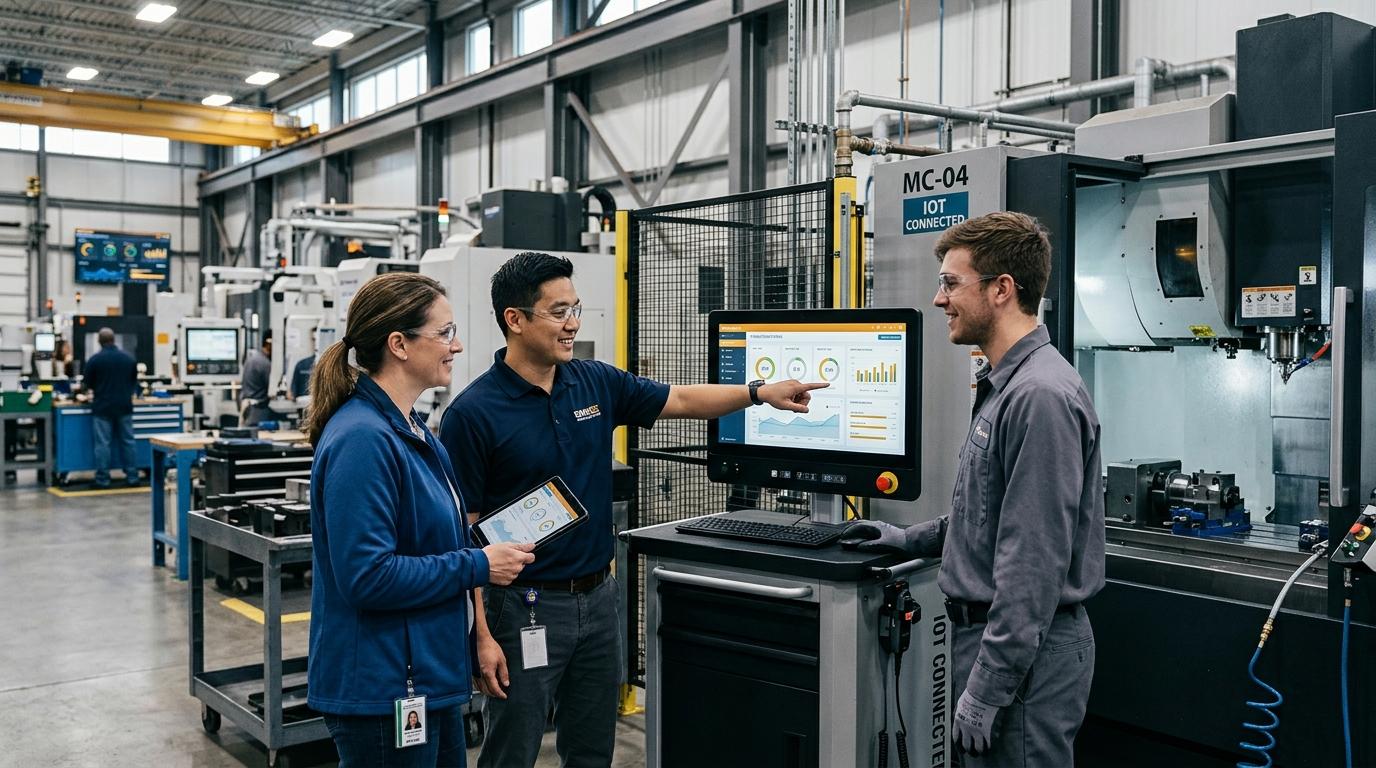
Most manufacturers do not have a system problem. They have a connection problem. Planning lives in ERP, execution lives in a shop-floor workflow, and machine signals live somewhere else entirely. When those layers do not talk to each other, production leaders still manage the plant through spreadsheets, end-of-shift updates, and conflicting versions of the truth.
That is why erp mes and iot has become such an important operating conversation. The goal is not to add another disconnected tool. The goal is to connect planning, execution, and machine reality tightly enough that operations, finance, and plant leadership can see what is happening during the shift, not after it.
TL;DR: ERP plans the business, MES manages execution, and IoT shows what machines are actually doing. Manufacturers get better visibility, traceability, and decision-making when those layers share the right data instead of running as separate systems. The goal is not more software. It is cleaner connection between planning, production, and machine reality.
Take Softype’s ERP readiness assessment to see how connected your production, machine, and costing data really is today.
Answer: ERP plans and records the business, including demand, inventory, purchasing, work orders, and cost. MES manages execution on the floor, including instructions, WIP, labor, quality, and production events. IoT captures what machines are actually doing, such as counts, cycle time, temperature, and downtime signals. Connected factory systems turn those three layers into one operating loop.
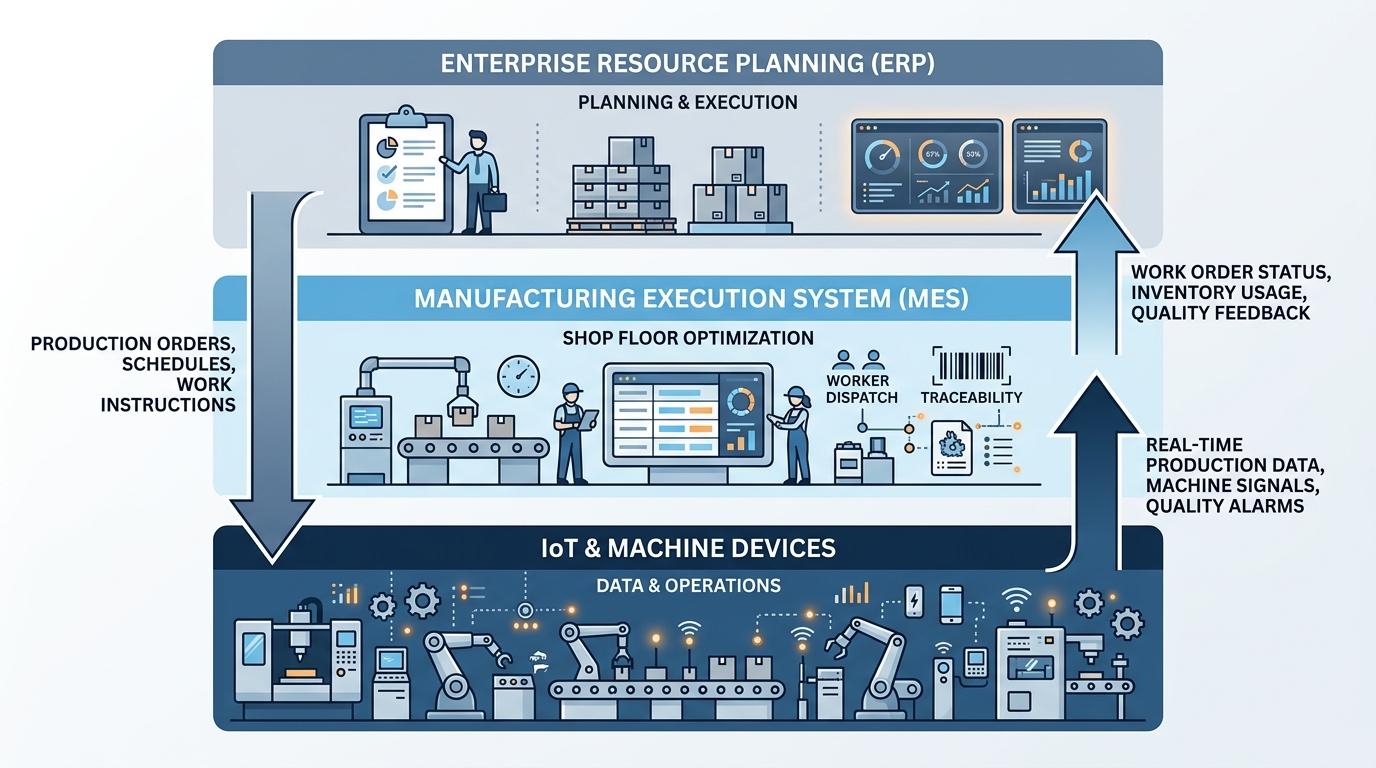
The best place to start is not with software names. It is with system ownership. ERP should handle business planning, inventory, purchasing, production orders, and financial impact. MES should handle execution, operator workflow, production confirmation, quality checks, and plant traceability. IoT should capture machine signals and equipment status, including counts, runtime, alarms, and process conditions.
That is why ISA-95 still matters in manufacturing systems integration. It separates business planning from plant operations and machine control. In simple terms, it helps teams avoid a common mistake: asking one layer to do another layer’s job. ERP should not act like a machine historian. A machine interface should not decide production cost or order status. Integration works best when each layer keeps a clear role and shares only the data needed for better decisions.
ERP is the planning and business control layer. It typically owns item masters, bills of material, routings, purchasing, inventory, production orders, material requirements planning, WIP accounting, costing, and financial reporting. It answers questions like: What should we make? What materials do we need? What is committed to customers? What did the order cost? What inventory and margin position did production create?
MES sits between the business plan and the physical process. It turns a released production order into work the plant can run. It manages dispatching, operator instructions, labor reporting, WIP movement, quality checks, scrap, rework, genealogy, and production reporting. It answers the questions ERP usually cannot answer well: Which operation is running now? Which line is behind? Which lot is still in process? Which order is blocked by quality or downtime?
IoT and machine interfaces sit closest to the equipment. They capture signals such as machine state, count, cycle time, runtime, temperature, vibration, alarms, power draw, and downtime triggers. That matters because it shows what the equipment is really doing, not what someone plans to report later. But IoT is not the same as execution management. A machine count means very little until it is tied to the work order, operation, shift, product, and quality status that give it meaning.
See how Softype’s manufacturing ERP approach supports planning, production, and operational visibility across connected factory systems.
Layer | Primary role | Typical data captured | Primary users | Timing | Operational value |
|---|---|---|---|---|---|
ERP | Plan and record the business | Demand, work orders, BOMs, routings, purchasing, inventory, WIP value, costs | Planners, supply chain leaders, finance, executives | Hours to months | Reliable planning, inventory control, costing, and financial visibility |
MES | Manage and confirm execution | Dispatch, instructions, labor, WIP, scrap, quality events, genealogy, production reporting | Supervisors, operators, quality, plant leadership | Seconds to shifts | Production control, traceability, exception handling, and faster response |
IoT | Capture machine reality | Counts, cycle time, states, alarms, temperatures, downtime signals, process values | Maintenance, controls, plant IT, operations engineering | Milliseconds to seconds | Actual output, downtime visibility, equipment condition, and real machine performance |
When ERP, MES, and IoT are disconnected, the business runs on delayed information. ERP may show a production order as open, but it may not show that the line is starved, cycle time is below standard, or a quality hold is blocking completion. The machine may know output is behind. Finance may still expect the planned result. Supervisors then fill the gap with manual reporting, and every downstream decision gets weaker.
Connected factory systems improve performance because they close the loop. ERP releases the order and planning context. MES turns that into executable work. IoT reports what the equipment is actually doing. MES then turns raw machine signals into usable production events. ERP receives summarized actuals it can use for inventory, WIP, schedule, and cost. That is what creates the gains manufacturers care about.
Better production visibility because line status and order status reflect current execution, not delayed manual updates.
More accurate WIP and costing because actual labor, time, scrap, and output flow back with context.
Faster issue detection because downtime, slow cycles, and quality deviations appear while the order is still running.
Reduced manual reporting because operators are not rekeying data machines already know.
Stronger traceability because lots, serials, materials, operations, and machine conditions can be tied together.
Better decisions on scheduling, maintenance, quality, throughput, and customer commitments.
This is where many IoT in manufacturing ERP projects fall short. Raw machine data is not the same as operational visibility. A temperature reading, a stop signal, or a production count only becomes useful when it is connected to the order, product, operation, line, and shift that explain what that signal means.
For example, IoT can report that a filler completed 1,420 cycles and stopped for 12 minutes. MES can identify that the event happened on Work Order 5481 during Operation 20 on Shift B, with 1,392 good units, 28 rejects, and one quality hold. ERP can then use the validated actuals for WIP, inventory, production variance, and schedule impact. That is the difference between data collection and connected factory systems.
Standards and governance matter here. Protocols such as OPC UA help normalize industrial communication, but protocol support alone does not fix master data problems. If one system names a line one way and another uses a different ID, integration still breaks down. The same happens when plants define downtime and yield differently. The architecture also has to support plant security and resilience, especially where operational technology and business systems connect. NIST’s OT security guidance and CISA’s OT mitigation guidance both reinforce the need for secure separation and controlled data flow between plant and business environments.
For a deeper operations view, compare Advanced Manufacturing vs Standard, review how MRP supports shop-floor execution, and see assembly manufacturing production tracking.
No. A mid-market manufacturer does not automatically need a separate MES just because the plant has ERP and machine data. Some operations can get strong results from ERP-centered production reporting, especially when routings are manageable, automation is limited, genealogy is basic, and operators can reliably report completions, scrap, and time.
A dedicated MES becomes more useful when execution changes too fast for manual reporting. It also matters more when routings are complex, quality gates must stop the process, traceability spans many operations and machines, or leaders need dependable downtime, OEE, and WIP visibility during the shift. This is not about sounding modern. It is about knowing when ERP-only shop-floor reporting has reached its control limit.
That is where resources like manufacturing ERP implementation guidance, Advanced Manufacturing vs Standard, MRP planning guidance, and shop-floor production tracking become useful. They help teams decide whether the missing capability is planning, execution discipline, machine capture, or the integration between them. For teams evaluating how much structure ERP can already support, Oracle’s documentation on manufacturing routing and work orders is also a useful reference point.
When the stack is working properly, operations leaders should be able to see the following without waiting for end-of-shift reconciliation:
Work order status by line, work center, and operation
Actual machine output tied to the order and product running
Downtime duration with consistent reason capture
Labor reporting against operations, not just payroll collection
Quality events, holds, scrap, and rework linked to affected quantities
WIP visibility by step, line, and order age
Actual material consumption by lot or batch
Genealogy from finished lot or serial back to materials, machine, and process
Production-to-finance alignment without manual cleanup between systems
A simple rule helps here: if the data supports business planning, inventory position, purchasing, costing, or financial control, it belongs in ERP. If it supports dispatching, execution control, WIP movement, labor, quality, or production confirmation, it belongs in MES. If it describes what the machine is doing at high frequency, it belongs in IoT or in an edge layer first.
ERP should receive: released orders, actual completions, scrap totals, material consumption, labor or machine time summaries, inventory movements, and cost-relevant production results.
MES should manage: operator instructions, operation status, in-process quality, downtime capture, genealogy, exception handling, and the link between work orders and execution.
IoT should capture: counts, state changes, cycle time, alarms, temperature, pressure, vibration, and similar machine observations.
The design principle is straightforward. Move summarized, contextualized events upward instead of flooding business systems with raw signals. When the architecture is right, executives get trustworthy visibility. Supervisors get live control. Plant teams stop reconciling three versions of the same production day.
ERP plans and records the business, including demand, materials, work orders, inventory, and cost. MES manages execution on the floor, including dispatching, instructions, WIP, quality, labor, and genealogy. ERP answers what should be made and what it cost. MES answers how production is actually running right now.
IoT fits at the equipment layer. It captures machine signals such as state, counts, cycle time, alarms, temperatures, and downtime triggers. Its value increases when those signals are tied to the order, operation, product, and shift that give them context for operations and finance.
No. Many manufacturers can run effectively with ERP-centered production reporting when routings are simpler and manual reporting remains reliable. MES becomes more valuable when execution complexity, traceability, downtime visibility, quality control, or real-time production management exceed what ERP alone can support.
ERP should receive business-ready results, not raw signal streams. That usually means summarized good quantity, scrap, actual labor or machine time, actual material consumption, downtime totals when relevant, and genealogy or quality results that affect inventory, WIP, schedule, or cost.
Together they connect the finished product to the materials consumed, the route followed, the line and machine used, the people involved, and the quality events recorded along the way. That gives leaders faster issue detection, cleaner recall response, and a more reliable picture of current production.
The usual signs are delayed order status, downtime recorded after the fact, weak WIP visibility, inconsistent labor or scrap reporting, and traceability that breaks across operations or equipment. When planners and plant leaders cannot trust production status during the shift, ERP-only reporting has likely reached its limit.
No. IoT can report what equipment is doing, but it does not replace execution logic. Manufacturers still need a layer that ties machine signals to work orders, instructions, quality rules, labor, and genealogy. That execution role is where MES or a strong manufacturing execution capability fits.
The most common causes are unclear system ownership, inconsistent master data, different definitions for downtime and yield across plants, too much raw data flowing into the wrong layer, and weak exception handling. The project succeeds when ownership, context, and data movement rules are defined before integration work begins.
A connected factory is not one where every signal goes everywhere. It is one where each layer has a defined job, and the right production information moves between those layers in time to change decisions. ERP plans and records the business. MES manages execution. IoT reports what the equipment is actually doing. When those responsibilities are connected properly, manufacturers gain the visibility, traceability, and operational control they were missing all along.
Book a 30-minute factory systems scoping call to map what belongs in ERP, what needs execution management, and what your machines should be reporting.
ERP should hold business-ready production outcomes, not raw machine signal streams.
MES adds the execution context that turns orders and machine data into usable operational visibility.
IoT matters most when machine data is tied to work orders, operations, shifts, and quality events.
Manufacturers do not always need a separate MES, but they do need a clear handoff between planning, execution, and machine reporting.
The best connected-factory design moves summarized, contextualized data upward so decisions improve during the shift, not after it.


Helping businesses thrive with integrated ERP solutions.
NetSuite
Service
Company
Contact Us
Copyright © 2026


