


The short answer: yes, NetSuite is fully cloud-based. It has been a multi-tenant Software as a Service (SaaS) ERP since its founding in 1998-1999, and it has never offered an on-premise version you can install on your own servers.
The longer answer is more useful.
The real decision most companies face is not "NetSuite cloud vs NetSuite on-premise" (that is not an option) but "should we move from our on-premise ERP to a cloud platform like NetSuite?"
This guide covers that decision, including how cloud and on-premise ERPs differ, what hybrid deployments look like, and how data residency concerns are handled.
For a side-by-side comparison of NetSuite vs SAP Business One specifically, see our NetSuite vs SAP Business One comparison.
NetSuite is 100% cloud-based ERP, delivered as SaaS over the internet. Users access it via a web browser or mobile app. Oracle NetSuite hosts and manages all application and database infrastructure in its own global data centers running on Oracle Cloud Infrastructure (OCI).
Key facts:
NetSuite was "born in the cloud" in 1998-1999, architected from day one as a browser-based, multi-tenant application
There is no NetSuite edition you can deploy as classic on-premise software on your own physical servers
Infrastructure, security, backups, and upgrades are all handled by Oracle as part of the subscription
Customers do not manage hardware, operating systems, or database software
The NetSuite cloud is the combination of its multi-tenant SaaS application and the Oracle-managed cloud infrastructure underneath. Customers consume ERP as a service rather than as software they own and host.
Core characteristics:
Multi-tenant architecture. Many customers share one application codebase, with logical separation of data. This simplifies upgrades and enables continuous innovation.
Vendor-managed infrastructure. Oracle operates global data centers and handles redundancy, backups, patching, and performance tuning.
Subscription pricing. Recurring fees based on modules and user counts, rather than perpetual licenses and hardware.
Browser-based access. Teams log in securely from anywhere with internet access.
Automatic biannual upgrades. Two major releases per year delivered to all customers, with no manual install required.
Generic claims about cloud uptime are easy to make. Here are the specific commitments that come with NetSuite:
99.5% uptime SLA. Historical performance typically exceeds 99.7%.
Recovery Point Objective (RPO) of 1 hour or less. Maximum data loss in a disaster recovery event.
Recovery Time Objective (RTO) of 4 hours or less. Maximum time to restore service.
Daily incremental backups, weekly full backups. Automatically managed.
Annual disaster recovery testing. Part of SOC 2 audit.
SOC 2 Type II and ISO 27001 certified. Security controls audited annually.
Encryption. TLS 1.2+ in transit, AES-256 at rest.
Authentication. OAuth 2.0 and Token-Based Authentication for APIs, native 2FA, SAML Single Sign-On (SSO).
These are the numbers Softype provides to clients as part of due diligence. They typically exceed what mid-market companies achieve with their own on-premise infrastructure.
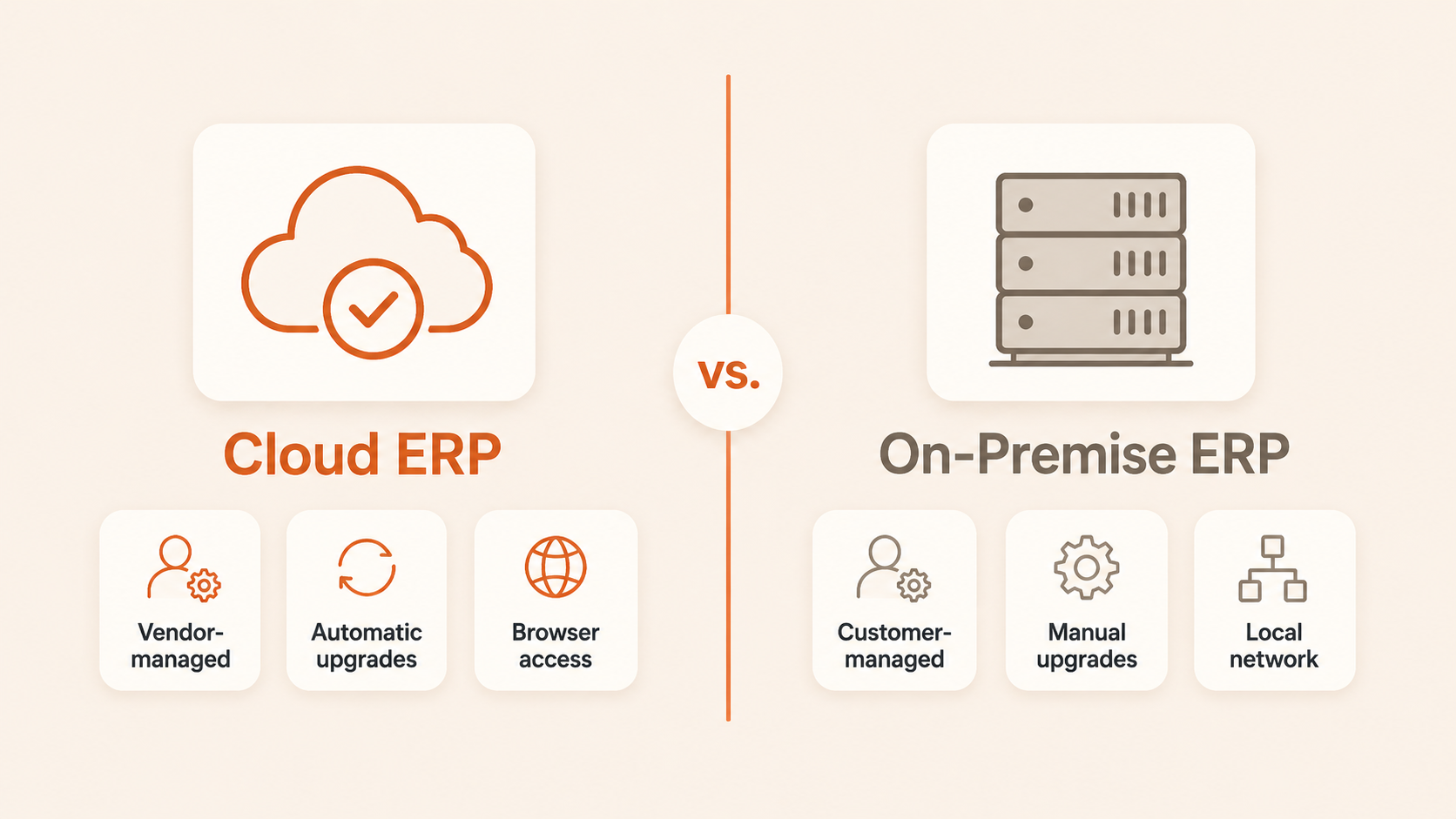
Before diving into specifics, here is the conceptual difference:
Cloud ERP. Vendor hosts the application and database. Customers access via internet and pay subscription fees.
On-premise ERP. Customer buys licenses, installs software on their own servers in their own facilities, and maintains the full stack internally.
Aspect | Cloud ERP (NetSuite) | On-Premise ERP |
|---|---|---|
Hosting location | Vendor-managed remote data centers | Company-owned servers on-site or in private data center |
Infrastructure ownership | Vendor provides hardware, OS, database, application stack | Customer buys and manages servers, storage, networking, OS, database |
Access | Secure browser/mobile access from anywhere | Typically local network; remote access requires VPN |
Implementation time | Months (no hardware provisioning) | Often 12+ months for hardware, install, configuration |
Upgrades | Automatic, vendor-managed, biannual | Manual projects; often deferred, leading to version lock |
Customization | Platform-level tools designed to survive upgrades | Possible but can complicate upgrades |
Security | Centralized, vendor-managed, SOC 2/ISO 27001 certified | Customer-managed; depends on internal processes |
Cost structure | Subscription (operating expense), lower upfront | High upfront license and hardware (capital expense) plus maintenance |
Maintenance | Vendor handles patches, monitoring, backups, disaster recovery | Internal IT responsible for full stack |
Scalability | Elastic scaling by adjusting subscription | Requires new hardware, database tuning, IT projects |
Theoretical comparisons are one thing. Here is what we have actually seen.
 The Flood Story
A retail client running their ERP on a local server experienced a severe flood. The server was damaged. Backups were inadequate. They lost 3 to 8 years of financial data and had to engage external auditors to reconstruct records from bank statements and supplier records. The cost in time, money, and audit risk was significant. They migrated to NetSuite shortly after.
The Vendor Abandonment StoryA holding company with 20+ subsidiaries was running a fragmented mix of on-premise systems including Exact Globe, Dynamics 365 / AX, SAP Business One, and several legacy applications. Their Dynamics 365 implementation failed: the partner closed, the migration from Dynamics AX left beginning balance errors that were never fixed, and the manufacturing module was abandoned. They replaced everything with NetSuite cloud for unified consolidation.
The Multi-Entity Logistics GroupA large logistics and transportation group was running on-premise ERP across multiple entities. They had no consolidated reporting, paper-based procurement, and no multi-entity approvals. They moved to NetSuite cloud OneWorld with a phased rollout, starting with a subset of entities.
These are the patterns we see repeatedly. On-premise systems work until something breaks: a flood, a vendor closure, a regulatory deadline, a failed upgrade. The cloud removes most of these failure modes from the customer's responsibility.
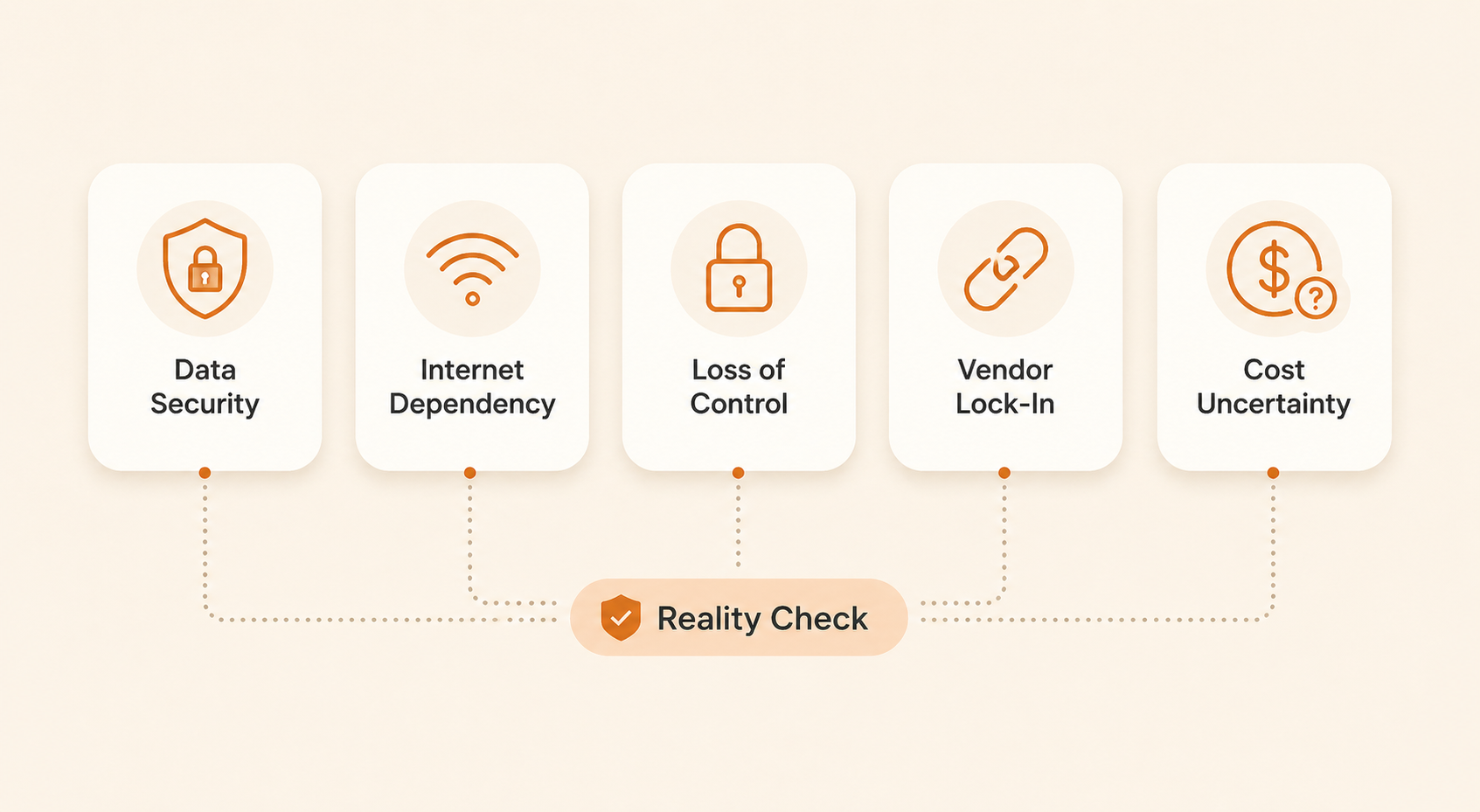
Companies considering a move from on-premise to cloud raise the same concerns repeatedly. Here is how each one actually plays out.
The concern: "Our data is safer if we hold it ourselves."
The reality: Most mid-market organizations cannot match the security investment Oracle makes in OCI: physical data center security, 24/7 monitoring, dedicated security teams, SOC 2 and ISO 27001 audits, encryption at rest and in transit. The flood story above is one of many examples where on-premise security failed.
The concern: "What if our internet goes down?"
The reality: Internet outages are typically shorter than the downtime caused by on-premise hardware failures, server upgrades, or local IT incidents. Modern offices have redundant connectivity. For high-availability scenarios in connectivity-challenged environments, certain workflows can be designed with offline modes.
The concern: "We will not be able to customize or change things ourselves."
The reality: NetSuite's SuiteCloud platform (SuiteScript, SuiteFlow, SuiteBuilder, SuiteTalk, SuiteCloud Development Framework) provides extensive customization. Most customizations survive upgrades automatically, which is something on-premise customers cannot say.
The concern: "We will be stuck with Oracle forever."
The reality: Lock-in is real with any ERP, cloud or on-premise. The mitigation is data portability, API access, and clear migration paths. NetSuite offers all three.
The concern: "Subscriptions look more expensive over time."
The reality: Once you factor in the hardware, database licenses, IT staffing, backup infrastructure, disaster recovery setup, security tooling, and upgrade projects that on-premise requires, total cost of ownership over five to seven years often favors cloud. The cost is also more predictable.
For a detailed breakdown of NetSuite subscription costs, see our NetSuite Pricing 2026 guide.
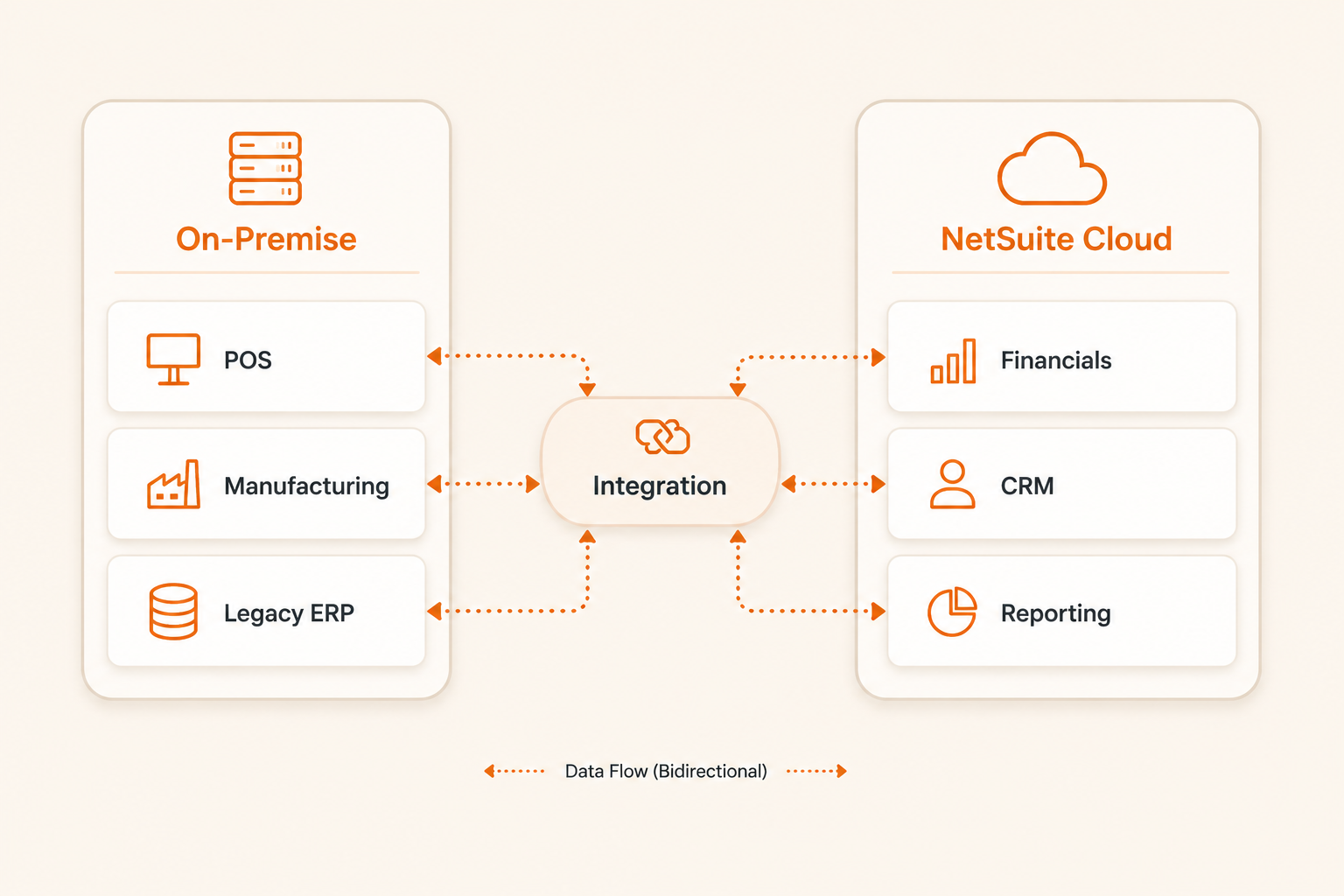
Some organizations end up running NetSuite alongside on-premise systems for specific reasons. Common patterns:
Two-tier ERP. NetSuite for subsidiaries or new business units, with a legacy on-premise ERP retained at headquarters during transition.
Functional split. NetSuite for financials and CRM, with on-premise solutions for plant-level manufacturing, shop-floor control, or specialized vertical systems.
Gradual migration. On-premise ERP is phased out module by module, with NetSuite becoming the system of record over time.
Branch point-of-sale resilience. Retail branches may need local POS capability for connectivity outages, with NetSuite as the central system of record.
In these scenarios, integration is critical. NetSuite's SuiteTalk APIs and SuiteCloud platform connect with on-premise databases, warehouse systems, and industry-specific applications.
This is the one area where a pure cloud deployment can hit limits. Some jurisdictions require that certain data physically remain within the country.
OCI operates data centers across multiple regions including North America, Europe, Asia-Pacific, and selected emerging markets. Customers can typically choose a regional data center to address performance, availability, and residency expectations.
For markets where OCI does not have a local data center (some African and developing-market jurisdictions), a hybrid setup may be required. The local system holds the regulated data physically in-country, and only summarized financial data flows into NetSuite for consolidation. This is not a NetSuite limitation in itself. It is a function of regulatory geography.
For most regulated mid-market organizations in the Philippines, North America, Europe, and major APAC markets, OCI regional coverage handles residency requirements adequately.
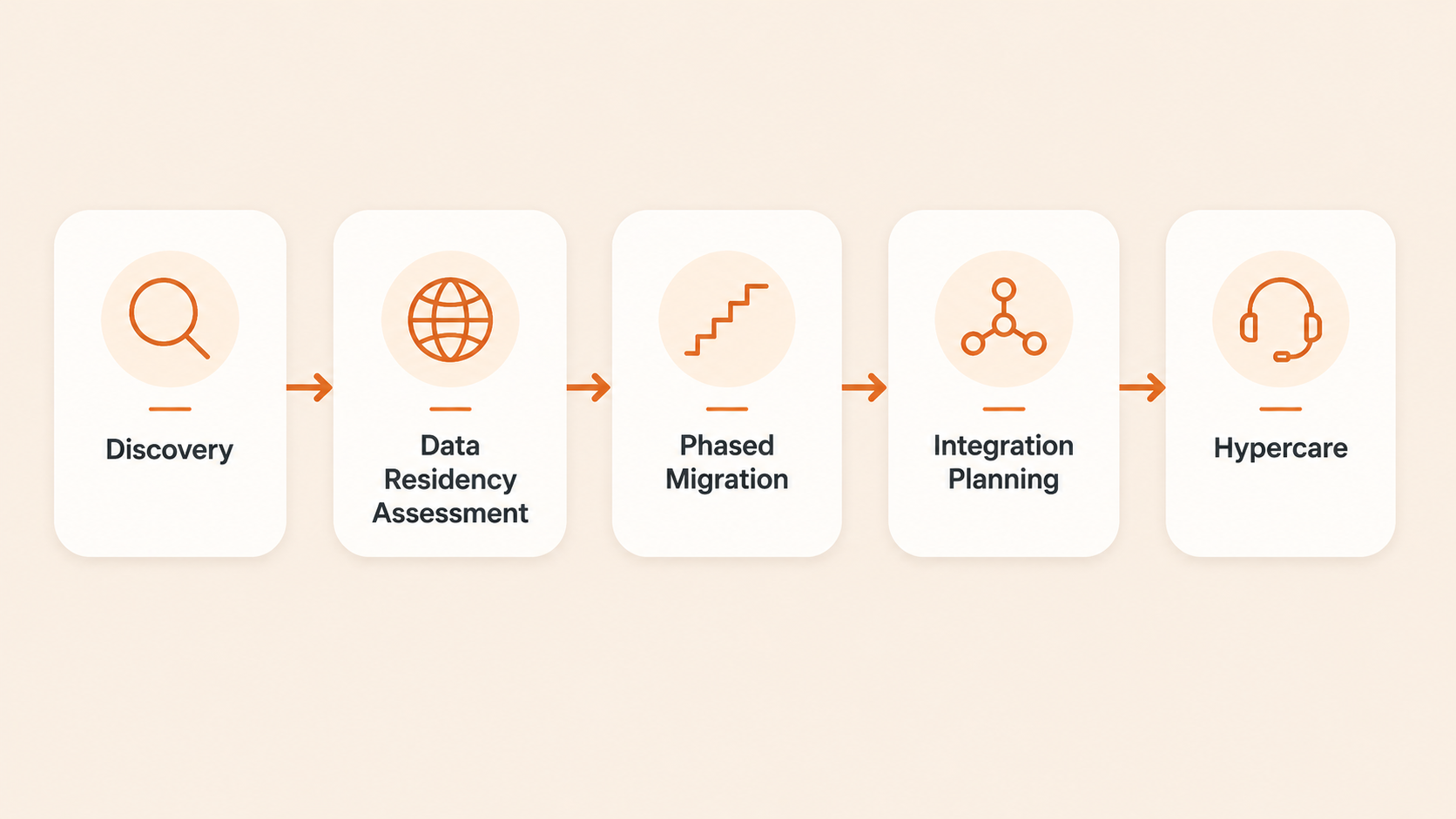
Most of our implementations are migrations: from on-premise SAP, Dynamics, Exact Globe, QuickBooks, or fragmented legacy systems into NetSuite cloud. We have moved single-entity companies in 70 days and multi-entity holding companies with 20+ subsidiaries in 6 months.
Our approach to cloud migration:
Discovery first. Understand the current on-premise environment, data quality, integration points, and regulatory requirements before quoting timeline.
Data residency assessment. Confirm OCI regional coverage matches your regulatory needs. If not, design a hybrid architecture upfront.
Phased migration where appropriate. Multi-entity organizations rarely move everything at once. We design rollout sequences that prioritize highest-value entities first.
Integration planning. Map all the systems that need to talk to NetSuite, design middleware where needed, define data ownership clearly.
Hypercare. 30 to 90 days post-go-live to stabilize the new environment before transitioning to ongoing support.
For a step-by-step view of the full implementation process, see our NetSuite Implementation Guide.
Talk to Softype about migrating from your on-premise ERP to NetSuite cloud.

NetSuite is fully cloud-based. It is a multi-tenant SaaS ERP accessed via browser or mobile app. There is no on-premise version. NetSuite has been cloud-native since 1999.
No. NetSuite does not provide a classic on-premise deployment. Your data and application run in Oracle's cloud infrastructure. You can integrate NetSuite with on-premise systems in a hybrid architecture, but the NetSuite application itself is always cloud-hosted.
No. NetSuite does not provide a classic on-premise deployment. Your data and application run in Oracle's cloud infrastructure. You can integrate NetSuite with on-premise systems in a hybrid architecture, but the NetSuite application itself is always cloud-hosted.
NetSuite is delivered as cloud ERP with vendor-managed infrastructure, automatic upgrades, and subscription pricing. SAP Business One and Microsoft Dynamics GP were originally designed for on-premise deployment, requiring local servers, manual upgrades, and more in-house IT management. Both vendors now offer cloud options, but the cloud capabilities and roadmaps differ from NetSuite's cloud-native design.
Yes. Many organizations adopt a hybrid model, using NetSuite in the cloud and keeping certain legacy or specialized systems on-premise, connected via APIs and integration tools.
Your NetSuite data is stored in Oracle's secure data centers running on OCI. Regional options are available across North America, Europe, Asia-Pacific, and select emerging markets to support performance, availability, and data residency requirements.
NetSuite's contracted uptime SLA is 99.5%. Historical performance typically exceeds 99.7%. Backup and disaster recovery objectives are RPO of 1 hour or less and RTO of 4 hours or less.
NetSuite's cloud infrastructure includes SOC 2 Type II and ISO 27001 certifications, encryption at rest and in transit, OAuth 2.0 API authentication, and native two-factor authentication with SAML SSO. Most mid-market regulated industries can meet their compliance obligations on NetSuite. Highly regulated sectors (defense, certain government, jurisdictions requiring strict data residency in markets without OCI presence) may require hybrid architectures.
NetSuite delivers two major releases per year automatically. Customers do not install upgrades. The platform handles version compatibility for customizations built using SuiteCloud tools. Regression testing typically focuses on customizations rather than the platform itself.


Helping businesses thrive with integrated ERP solutions.
NetSuite
Service
Company
Contact Us
Copyright © 2026


