


Most "NetSuite recovery" efforts fail when companies jump straight into tweaking scripts and forms instead of diagnosing the real problems. The system rarely is the root cause. Failure usually comes from how the implementation was planned, configured, and adopted.
This guide walks through the diagnostic framework, the decision between recovery and re-implementation, and what a structured rescue actually looks like.
NetSuite is the most-deployed cloud Enterprise Resource Planning (ERP) platform in the mid-market. So why do some implementations stall, fail, or end up unusable? In our experience across recovery engagements, the patterns repeat:
Poor requirements and discovery. Incomplete or vague business requirements lead to configurations that do not match real-world processes.
Weak project governance. No clear executive sponsor, no decision-making structure, shifting scope. Milestones slip, the system goes live with unresolved defects.
Data migration and integration issues. Inaccurate mapping and lack of validation create broken reports, duplicate records, and erode trust in the system.
Misaligned processes and over-customization. Teams try to recreate their legacy ERP inside NetSuite, layering customizations instead of improving processes. Custom code becomes brittle, expensive to maintain, and risky during upgrades.
Training and adoption gaps. End users are brought in too late or trained too lightly. They revert to spreadsheets. Shadow processes develop and fragment data.
A recovery project succeeds only when it addresses these underlying issues, not surface symptoms like slow performance or "bad reports."
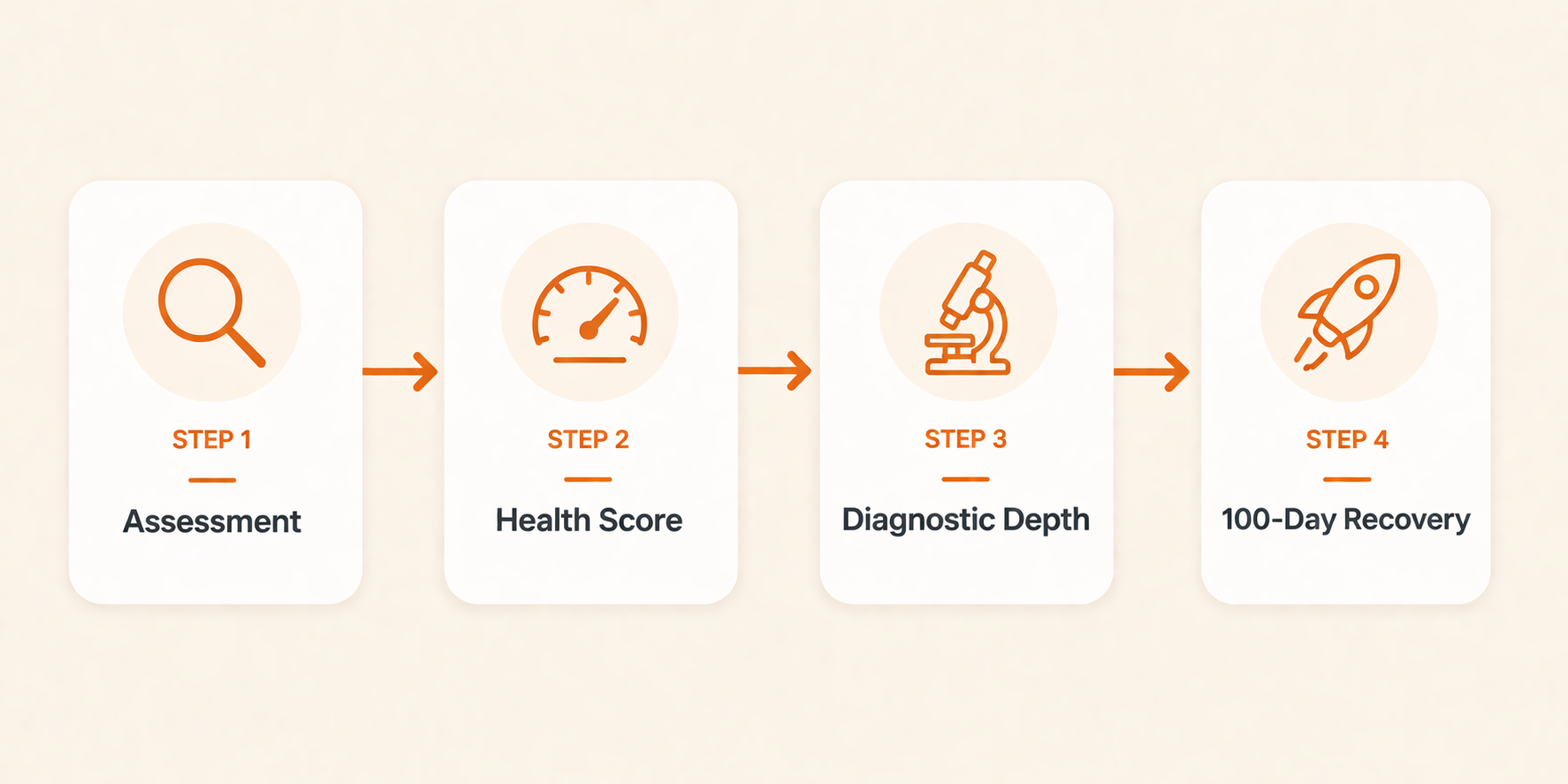
Softype runs Project Recovery as a defined service line, with a four-step methodology. The same steps apply whether you came to us with a stalled implementation, a partner transition, or a failed third-party deployment.
We run a structured NetSuite efficiency analysis to identify system inefficiencies and improvement areas. This is not a critique or audit. We frame it as a medical check-up for your NetSuite environment.
The assessment covers eleven domains:
Architecture and environments
Intercompany configuration
Master data integrity
Transaction flows
Tax and compliance
Period close and consolidation
Controls and approvals
Reporting and Key Performance Indicators (KPIs)
Testing and defects
Performance and scalability
Cutover readiness (for rescues at the implementation stage)
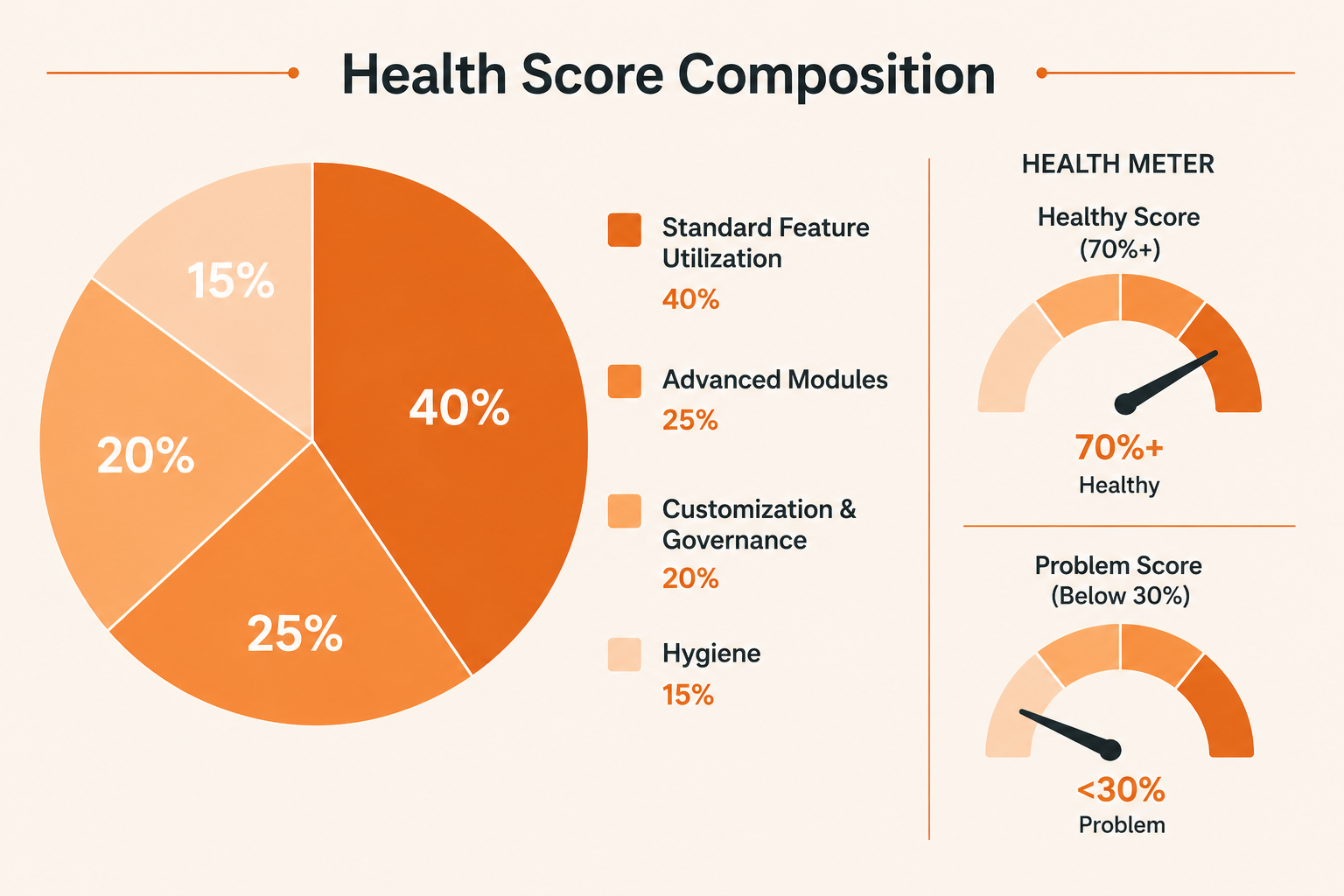
We translate the assessment into a quantitative health score. The framework weights four areas:
Category | Weight | What It Measures |
|---|---|---|
Standard feature utilization | 40% | Are the core out-of-the-box capabilities being used? |
Advanced module adoption | 25% | Are licensed advanced modules actually deployed? |
Customization and governance | 20% | Is custom code maintainable? Is there a governance process? |
Hygiene | 15% | Master data quality, orphaned records, transaction backlog |
The score ranges from 0% to 100%. A healthy environment scores 70%+. A score below 30% typically signals a deeper problem that incremental optimization will not fix.
In one engagement, a manufacturing company scored 20% overall, with order-to-cash at 0% (revenue was being recognized through manual journal entries only). That score made the recovery path obvious: rebuild the foundation, do not patch it.
A thorough recovery diagnostic looks beyond the obvious symptoms. The most useful diagnostics examine:
Configuration drift. Has the system moved away from its original design intent? Are roles, workflows, and custom records still aligned with how the business operates?
Master data integrity. Are there orphaned records, duplicate items, inconsistent customer or vendor data? How clean is the General Ledger (GL) posting validation?
Script and customization audit. Are existing scripts documented? Are they running successfully? How much technical debt has accumulated?
Saved search and report optimization. Are core reports still producing accurate results? Are saved searches efficient or causing performance issues?
Audit trail validation. Can changes be traced? Are governance controls in place?
The goal of this phase is to produce a prioritized, evidence-based findings report that separates symptoms from root causes. Without that, recovery work risks fixing the wrong things.
Where the recovery is salvageable, we target go-live or stabilization within 100 days. This timeline is not about speed for speed's sake. It is about minimizing further business disruption while a stalled or failed system continues to drag on operations.
Use this checklist to gauge whether you need a netsuite rescue, a re-implementation, or incremental optimization.
 Business Impact
Are critical processes (order-to-cash, procure-to-pay, financial close) consistently delayed or manually bypassed?
Is executive confidence in reporting low because numbers differ between NetSuite and offline tools?
Are there audit or compliance risks tied to how NetSuite is configured or used?
System ConfigurationDoes the chart of accounts, item structure, or subsidiary configuration fundamentally block reporting or process automation?
Are workflows and scripts heavily customized, poorly documented, or frequently failing?
Are there multiple unused or partially implemented modules and features?
Data and IntegrationsWas data migration done without robust validation, leaving ongoing mismatches?
Do integrations fail regularly or require constant manual intervention?
Is there widespread duplication or inconsistency in master data?
Adoption and TrainingAre significant user groups still working in spreadsheets or legacy systems instead of NetSuite?
Was training one-time and generic, with no ongoing role-specific enablement?
Is there an internal champion or owner for NetSuite, or is it "owned by no one"?
Governance and Partner RelationshipIs your original partner no longer engaged, or are you in an adversarial relationship?
Is there a clear roadmap and decision-making framework for changes?
Do you have documented standards for configuration, customization, and integration?
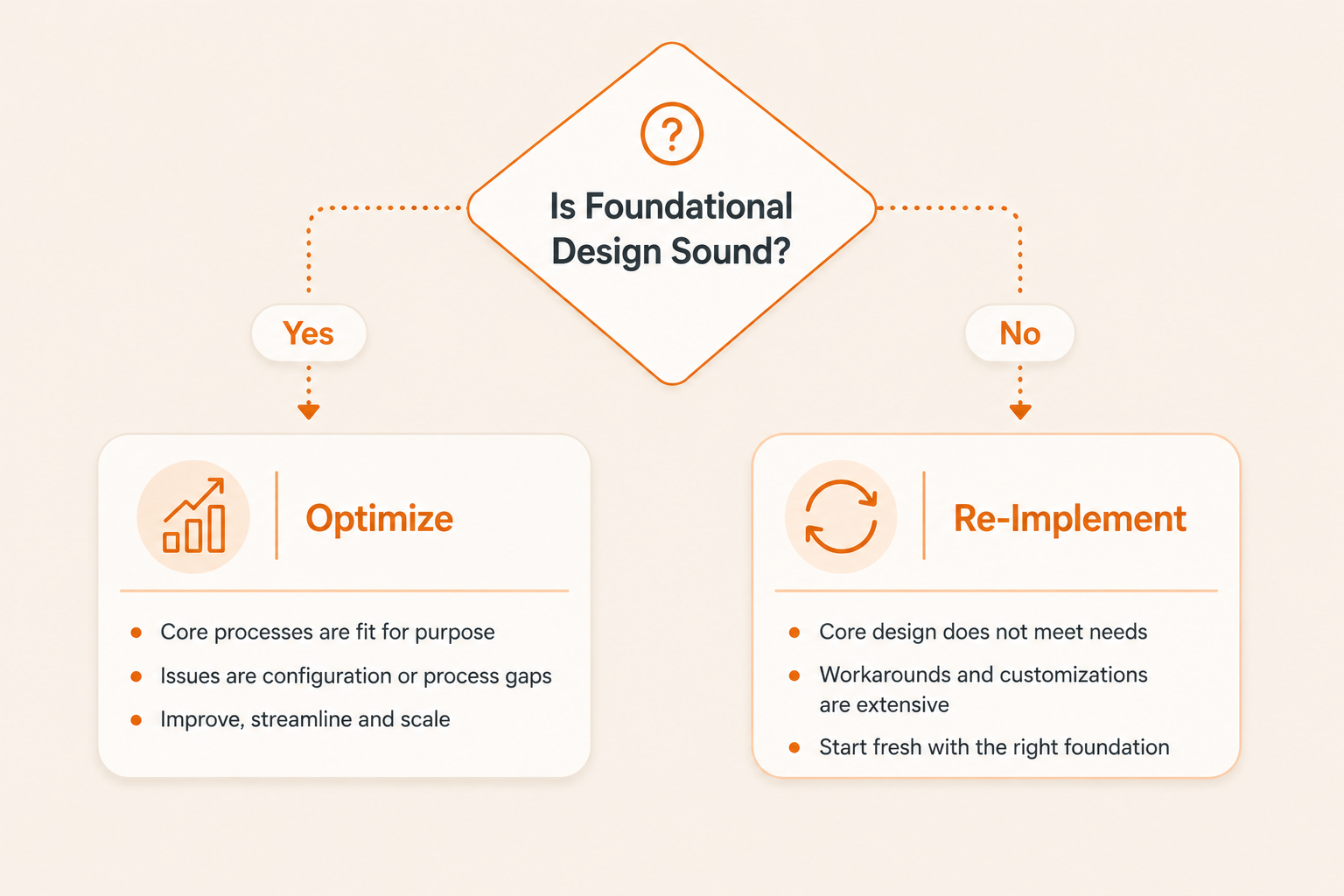
Choosing between a netsuite rescue and a fresh start is one of the most strategic decisions in a recovery project.
 Indicators You Can Recover and Optimize
Stay on your current environment when:
Core design is sound (subsidiary structure, chart of accounts, item and customer models align reasonably with the business)
Pain points cluster around specific modules, workflows, or reports rather than everything
Master data can be cleaned and standardized without fundamentally restructuring it
Adoption problems are primary (users were poorly trained but the system can support desired processes once tuned)
For these cases, structured recovery with remediation and optimization is faster and less disruptive than a full re-implementation.
Indicators You Should Re-ImplementA NetSuite re-implementation becomes compelling when:
Foundational design is flawed (subsidiary structure, currencies, tax regimes, or legal entities incompatible with how you actually operate)
The chart of accounts is so misaligned that you constantly work around it to produce basic financial statements
Customization and technical debt are overwhelming (dozens of poorly documented scripts and workflows creating instability)
Your business has materially changed (acquisitions, new markets, new operating model) since the original design
These are anonymized examples of recovery patterns we have seen and addressed.
A manufacturing company had attempted to migrate from a legacy ERP to Microsoft Dynamics 365 with another partner. The partner closed mid-project. Beginning balance errors from the legacy migration were never fixed. The manufacturing module was abandoned entirely. They came to us looking for a rescue.
The recovery: rather than salvage D365, we built a new NetSuite implementation with manufacturing-first scope, completing it before their D365 license renewal. The fresh start cost less long-term than continuing to patch a broken system with no vendor support.
A multi-entity organization had paused their NetSuite implementation at 511 of 807 tasks completed (63% through configuration, 0% User Acceptance Testing (UAT) executed). The original partner relationship had broken down. The Business Requirements Document was 131 pages and partially outdated.
The recovery: we used AI-driven analysis to parse the BRD and identify which configurations were complete, which needed rework, and which had become irrelevant. Estimated timeline reduction was 18 to 20%. The project resumed with a clear remaining scope of approximately 1,082 development hours.
An organization with an active NetSuite environment wanted to move from their original partner to Softype. The Oracle partner transfer process took 2 to 4 weeks for approval. Phase 1 was a fixed-fee Configuration Assessment and Gap Analysis. Phase 2 was a 165-hour remediation plan addressing specific compliance and configuration gaps identified during the assessment.
The recovery: the client kept their existing NetSuite environment. We took over support, ran the health check, and delivered the remediation plan as a structured fixed-fee project.
A retail and food services group had a NetSuite implementation that worked but lacked proper disaster recovery and integration architecture. Operations were vulnerable to outages. We rebuilt the integration layer with middleware, established a Recovery Time Objective (RTO) of less than 4 hours and Recovery Point Objective (RPO) of less than 1 hour, added multi-region failover, and configured nightly backups.
The recovery: the core NetSuite environment was kept. The architecture surrounding it was reconstructed.
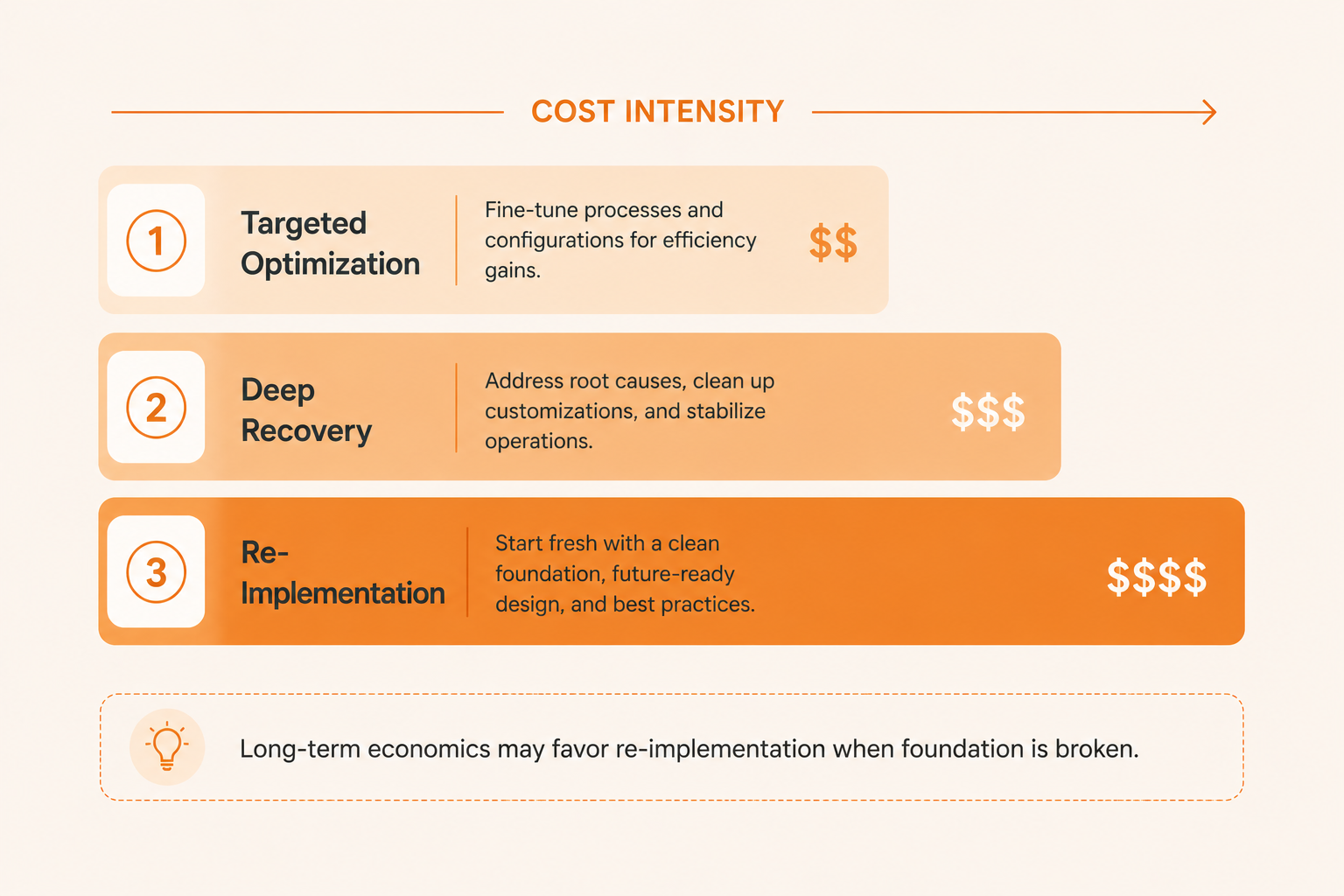
Recovery scoping depends on:
Depth of diagnostic required (light health check vs full forensic review)
Number of process areas in scope (finance only vs end-to-end operations)
Degree of rework to configuration, data, and integrations
Training and change management scope
Common patterns:
Targeted optimization. Tens of thousands of dollars for remediation of a few modules and reports. Several weeks to a few months.
Deep recovery. Multi-month efforts approaching a significant share of a new implementation budget, but typically still lower than a full rebuild.
Re-implementation. Sized similarly to a fresh deployment at your current scale, often with selective reuse of cleaned data and validated configurations.
For NetSuite Pricing context (license, modules, user costs), see our NetSuite Pricing 2026 guide.
To choose between recovery paths, quantify:
Current cost of failure: extra headcount for manual work, delayed close, audit risk, missed opportunities
One-time recovery vs re-implementation investment
Ongoing run-rate after the project: support retainers, internal admin time, expected efficiency gains
When longer-term savings on process efficiency and risk reduction outweigh project costs within 12 to 24 months, either a rescue or re-implementation can be justified.
We treat recovery differently from a standard implementation:
Independent diagnostic. Whether your current partner is still engaged or not, we run our own assessment with no preconceptions.
Fixed-fee Phase 1. The Configuration Assessment and Gap Analysis is scoped as a fixed-fee project with a defined deliverable. You get a roadmap before committing to remediation.
Evidence-based findings. Every recommendation in our remediation roadmap is tied back to a specific finding from the diagnostic. No guesswork.
100-day target where appropriate. For salvageable implementations, we target go-live or stabilization within 100 days.
Honest re-implementation recommendations. When the data shows a rebuild will be cheaper long-term than continued patching, we say so.
For details on how a fresh implementation runs end-to-end, see our NetSuite Implementation Guide. For typical timelines by deployment type, see our guide on How Long NetSuite Implementations Take.
Talk to Softype about a NetSuite recovery assessment.

NetSuite recovery (also called netsuite rescue) is a structured process for diagnosing and fixing a struggling or failed NetSuite implementation. It typically starts with a health check, identifies root causes, and either remediates the existing environment or recommends re-implementation when the foundation is broken.
You likely need a rescue if critical processes are broken, users are bypassing NetSuite with spreadsheets, data cannot be trusted, or your partner has run out of ideas. A health check assessment will quantify the issues and recommend whether incremental fixes or a re-implementation is the right path.
Re-implementation is recommended when foundational design elements are wrong: the entity structure, tax setup, or chart of accounts is incompatible with your business. If fixing the current environment would cost as much as rebuilding it, and still leave structural compromises, a fresh start is often the better long-term economics.
Targeted optimization can run in the tens of thousands of dollars over several weeks. Broader rescues cost a meaningful share of a new implementation budget. Full re-implementation is sized similarly to a fresh deployment. Costs depend on the depth of the issues and the scope of remediation.
Lighter optimization can deliver improvements within weeks. Comprehensive recovery or re-implementation programs span several months. For salvageable implementations, Softype targets stabilization or go-live within 100 days.
Sometimes. But many organizations bring in an independent recovery specialist to ensure an objective diagnostic and a clean break from past decisions. At minimum, an independent review of the current environment is worth the investment.
A health check is a structured assessment of your NetSuite environment across configuration, master data, customization, governance, and adoption. It produces a quantitative score and a prioritized remediation roadmap. It is the first step in most recovery engagements.


Helping businesses thrive with integrated ERP solutions.
NetSuite
Service
Company
Contact Us
Copyright © 2026


