

TL;DR
If you run a food and beverage manufacturing business and are evaluating NetSuite, the value of a unified cloud platform is real: one system for finance, inventory, CRM, and operations. NetSuite delivers that consistently for mid-market food and beverage companies. There is one important nuance, though. NetSuite’s native manufacturing modules are built for discrete assembly (electronics, machinery, widgets). Food production runs on process manufacturing recipes, variable yields, catch-weight ingredients, sub-recipes, and shelf-life constraints. Understanding that distinction early shapes the architecture and helps the implementation deliver what the platform promises.
What NetSuite Does Well for Food and Beverage
Where NetSuite Needs Help: Process Manufacturing
The Three Architectural Options
What to Test in Your Vendor Demos
What This Costs Directionally
What to Take Into Your Evaluation
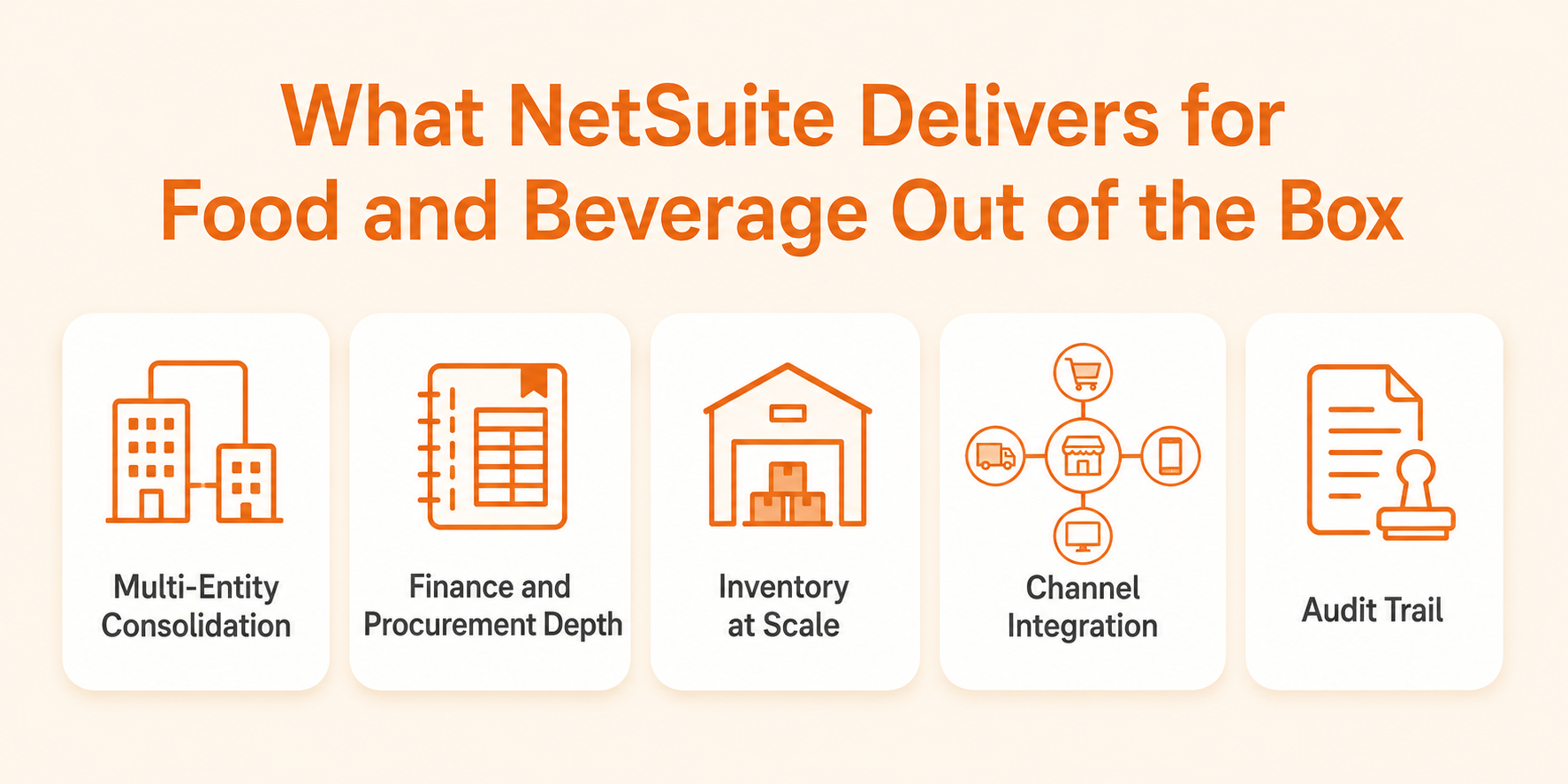
Five capabilities NetSuite delivers strongly out of the box make it a natural foundation for food and beverage operations at the mid-market, whether or not you add a process manufacturing layer.
 Multi-Entity Consolidation for Multi-Brand Groups
Food and beverage companies often grow into groups with several brands. Each brand may have its own profit and loss statement. Leaders still need one view of the whole group. NetSuite OneWorld supports reporting by entity, intercompany eliminations, and currency consolidation. Its audit trail lets teams trace a group total back to a transaction in any subsidiary.
In practice, multi-brand food service groups with multiple legal entities and dozens of locations often consolidate cleanly on OneWorld, with intercompany eliminations handled automatically. The alternative multiple separate accounting instances with manual monthly consolidation frequently becomes the bottleneck on month-end close.
Finance and Procurement DepthNetSuite offers mature tools for finance, purchasing, and order management. These tools support growing food and beverage businesses. They include three-way matching for purchase orders, receipts, and vendor bills. Teams can set tolerance limits and approval steps. NetSuite also supports inventory across warehouses, costs for imported ingredients, and local tax rules.
Inventory at Scale Across LocationsNetSuite’s Advanced Inventory module supports inventory across locations. It includes lot tracking, expiry dates, bin management, cycle counts, and unit conversions. These features can support central kitchens, satellite warehouses, regional distribution centers, and branches.
Food and beverage companies with three or more inventory locations and serious lot or expiry tracking requirements consistently outgrow QuickBooks and lighter platforms. NetSuite at the inventory layer often becomes the right answer well before the manufacturing conversation starts.
E-Commerce, Marketplace, and Channel IntegrationFood and beverage businesses sell through stores, business customers, distributors, marketplaces, and online shops. NetSuite can connect these sales channels in several ways. It offers connectors for major marketplaces and REST APIs for direct links. Middleware such as Celigo or Boomi can manage more complex connections. Multi-brand groups can also bring sales from several point-of-sale systems into NetSuite in real time.
Audit Trail and Compliance ReportingFood manufacturers face rules such as FDA and FSMA requirements in the United States, BIR audits in the Philippines, and similar standards elsewhere. NetSuite helps teams prepare for these checks. It keeps a history of changes to each transaction, supports period locks and role-based access, and offers electronic signatures where needed. This makes audit readiness part of daily work, not a last-minute scramble. For foods on the FDA’s Food Traceability List, the rule requires specific data for certain critical tracking events. Read the FDA’s Food Traceability Rule for details.
Many food and beverage manufacturers do not discuss this issue until implementation is underway. Yet this decision can determine whether the project succeeds.
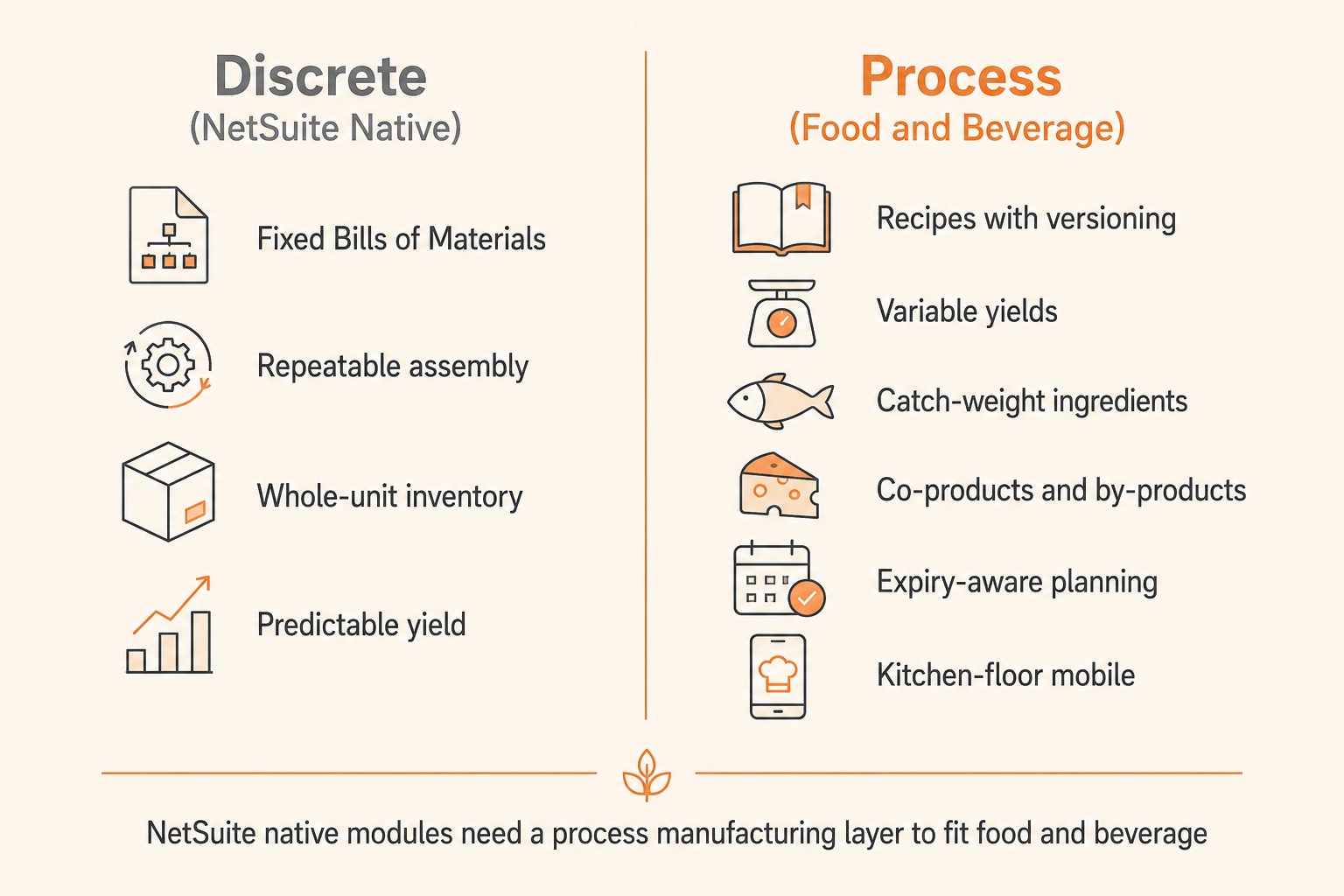
NetSuite’s native manufacturing tools include Work Orders, Assemblies, and Routings. They are built for discrete manufacturing, such as making electronics, machines, or other finished units. This model uses a fixed Bill of Materials, repeatable assembly steps, whole units, and predictable output. Oracle defines a manufacturing routing as an ordered set of steps for building an assembly item.
Food production is fundamentally different:
Recipes, not BOMs. A recipe has versioning, approval workflows, sub-recipes, effective dates, and menu cycles. A BOM does not.
Variable yields. A batch of soup is supposed to produce 100 portions. It produces 97. The yield variance has to be captured and costed.
Catch-weight ingredients. A case of chicken thighs is 22 kilograms one day and 24 the next. The system needs dual unit of measure handling natively.
Co-products and by-products. Trimming during preparation produces secondary products that need to be tracked.
Expiry-aware planning. Materials Requirements Planning (MRP) needs to account for shelf life, not just lead times.
Kitchen-floor mobility. Production execution happens in environments where operators are wearing gloves, working with wet hands, near heat. The mobile interface needs to be designed for that, not for a clean office workstation.
NetSuite’s native tools do not support these process needs out of the box. Teams can try to recreate them with custom work. That approach often costs more and can be hard to maintain. Forcing discrete manufacturing tools to handle food production can also create problems during upgrades. A process manufacturing SuiteApp is designed for these needs.
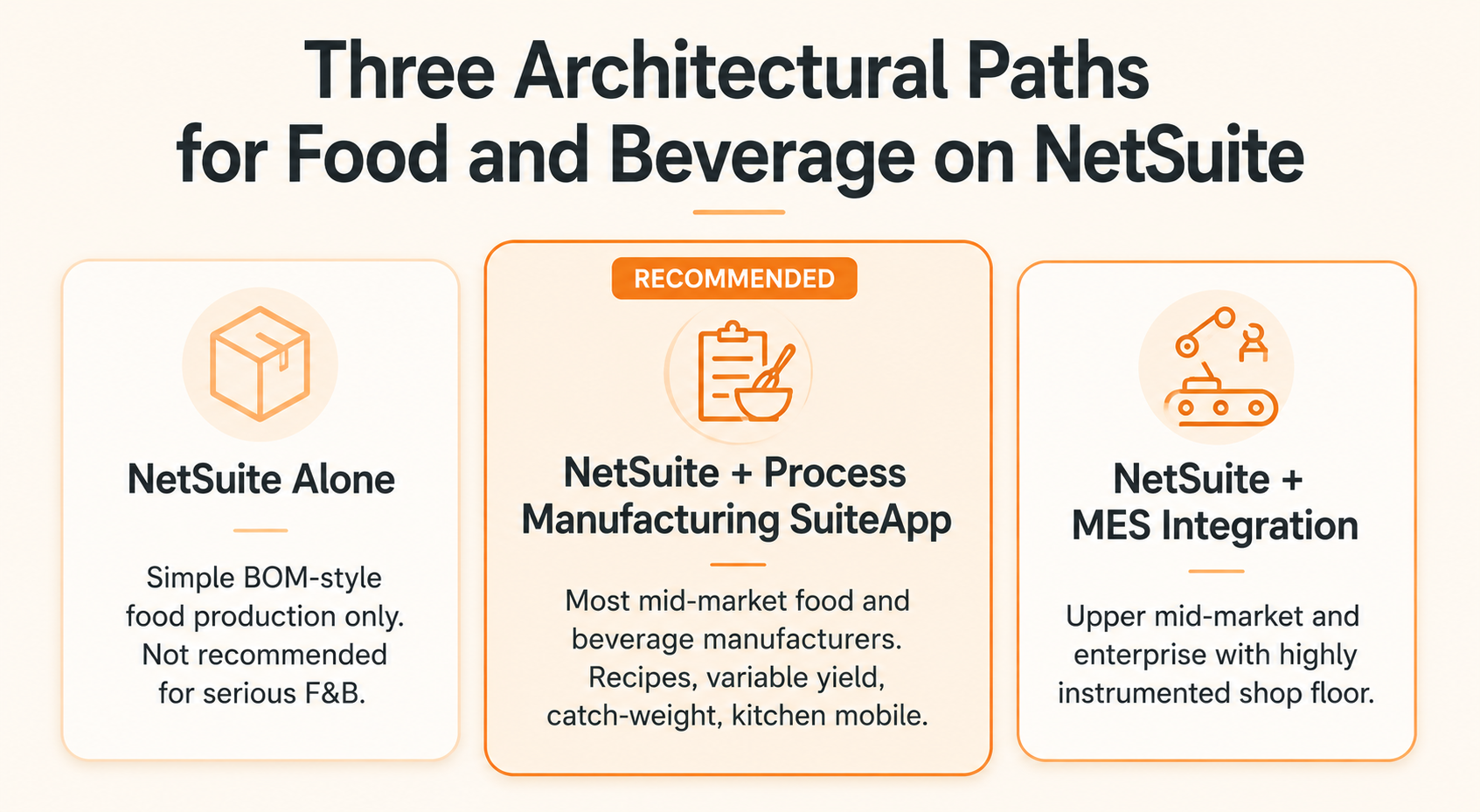
For food and beverage manufacturers evaluating NetSuite, the realistic options are these three.
Best for: food and beverage businesses where production is genuinely simple, BOM-style assembly. Examples might include packaged dry-good resellers who do minimal value-add, contract packing operations with fixed input-output ratios, or beverage businesses with very limited recipe complexity.
Trade-offs: any meaningful recipe complexity, variable yield, catch-weight handling, or expiry-aware planning will need custom development. The customization burden scales with operational complexity. We do not generally recommend this option for serious food and beverage production.
Best for: most mid-market food and beverage manufacturers. Commissaries, central kitchens, packaged food production, catering operations, food distributors, and multi-brand food service groups.
This option has three layers that work together:
NetSuite is the system of record. It handles financials, inventory, procurement, sales, audit trail, and the consolidation engine if you operate multi-entity.
SuiteSuccess Food and Beverage is Oracle's pre-configured industry edition. It is essentially NetSuite deployed with the chart of accounts, dashboards, reports, and standard workflows already tuned for a food and beverage business, which materially shortens the implementation timeline.
FernSpeed is the Built-for-NetSuite SuiteApp that Softype implements for food and beverage manufacturers. It adds the production-side capabilities NetSuite does not handle natively: recipe management with versioning, variable yield tracking, catch-weight and dual unit of measure, expiry-aware Materials Requirements Planning (MRP), co-product handling, and a kitchen-floor mobile interface designed for operators wearing gloves.
A chef can open a recipe on a tablet and scale it from 100 portions to 2,500. During the batch, the chef can record the actual yield and log production. That work then flows into NetSuite. It updates the financial transaction, inventory, and lot record. All three layers use the same database, General Ledger, and security model.
This option requires an extra SuiteApp license and parallel implementation work. The team also needs to learn an added application layer. For many mid-market food and beverage manufacturers, this combination can offer better value over three years than building similar features with custom development.
Best for large food and beverage manufacturers with highly instrumented production floors. They may need a specialized manufacturing execution system (MES) to manage production. The MES then sends production data to NetSuite.
Trade-offs: integration complexity. This is upper-mid-market and enterprise territory, not the typical mid-market profile.
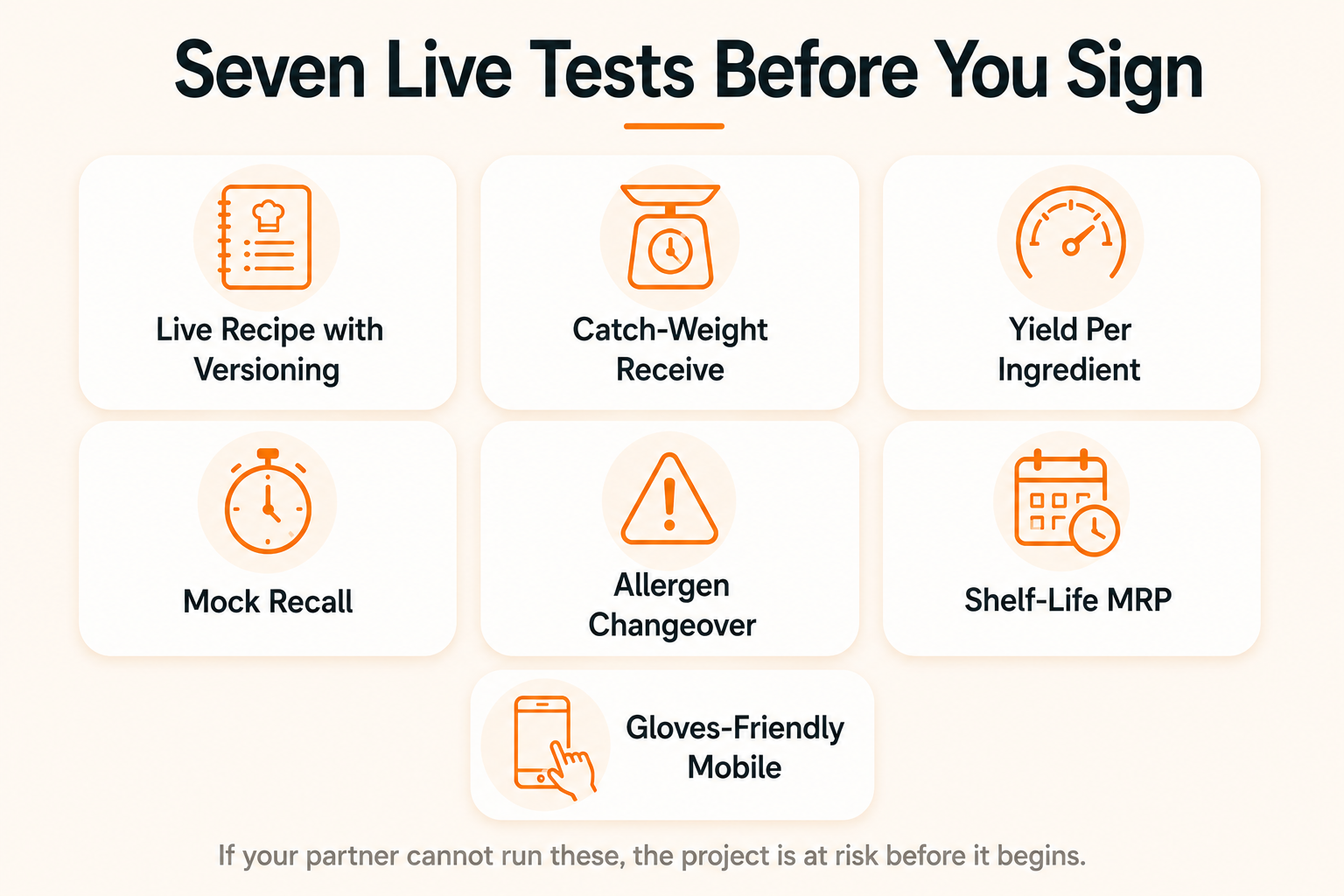
Use the demo to confirm how the architecture works in practice. These are practical scenarios your partner should be able to walk through with representative data.
Question | What You Are Testing |
|---|---|
Show me a live recipe with versioning, approvals, and a sub-recipe rolled into a finished product. Trace the lot back to the recipe version that produced it. | Whether the platform handles recipes as a first-class concept or as a BOM workaround |
Receive a case of variable-weight meat, invoice the supplier on actual weight, sell the product per pound. Show me the GL impact. | Catch-weight or dual unit of measure handling |
Generate a production order from a sales order. Show me yield and waste captured per ingredient on the production floor. | Process manufacturing depth versus discrete BOM approximation |
Run a mock recall. Trace an affected raw ingredient lot to every finished product and customer that received it. Time it. | FSMA 204 traceability readiness |
Schedule an allergenic recipe followed by a non-allergenic recipe on the same line. Show me how the system enforces cleaning and updates the labels. | Allergen logic and changeover controls |
Run Materials Requirements Planning (MRP) with shelf-life constraints and short-coded inventory. | Expiry-aware planning |
Hand a tablet to an operator wearing gloves. Have them complete a production order on the kitchen floor. | Mobile interface designed for food production, not a corporate workstation |
If the partner cannot run these scenarios live against representative data, the implementation is at risk before it begins.
For a mid-market food and beverage manufacturer, NetSuite with a process manufacturing SuiteApp can cost less over three years than heavy customization of NetSuite’s native manufacturing tools. One reason is that it avoids much of the custom work. Year-one costs often range from $150,000 to $450,000. The total depends on company size, modules, and integrations. This estimate includes NetSuite and SuiteApp subscriptions, plus implementation services for both. Use it as a starting point for discussion, not as a fixed quote.
A NetSuite plus FernSpeed implementation for a mid-market food and beverage manufacturer is materially more cost-effective over three years than heavy customization of NetSuite's native manufacturing modules, primarily because the customization burden is avoided.
NetSuite can be a strong platform for food and beverage manufacturers. Three principles help shape a successful implementation.
The architecture matters as much as the platform. NetSuite + SuiteSuccess Food and Beverage + a process manufacturing SuiteApp is the pairing that delivers the full value for food production.
The methodology and the production layer work together. SuiteSuccess accelerates the standard NetSuite layer; the SuiteApp completes the picture with the production-side capabilities food manufacturers need.
The partner shapes the outcome. A partner with food and beverage implementation experience will scope, configure, and deliver the project differently than one without. References from your sub-segment are worth more than general references.
Typical timelines run 16–30 weeks for small to mid-market businesses and 30–40 weeks for larger multi-entity operations with multiple production sites.
NetSuite is a strong foundation for mid-market food and beverage finance, inventory, multi-entity consolidation, and compliance.
Native manufacturing modules are built for discrete assembly, not process manufacturing.
Most serious food production needs recipe management, variable yield, catch-weight, expiry-aware planning, and kitchen-floor mobile tools.
The recommended architecture for most mid-market manufacturers is NetSuite + SuiteSuccess Food and Beverage + a Built-for-NetSuite process manufacturing SuiteApp.
Test the architecture in demos with real process scenarios (recipes, catch-weight, yield, recall, allergen changeover, expiry-aware MRP, and glove-friendly mobile).
Partner experience in food and beverage materially affects scope, configuration quality, and timeline.
Softype is an Oracle NetSuite solution provider with more than 25 years of experience and over 600 implementations. We work with food and beverage manufacturers, from packaged food producers to high-volume commissaries. Our team implements NetSuite with FernSpeed, a process manufacturing SuiteApp built for NetSuite. This helps set up the right system design from the start.
If you are evaluating NetSuite for a food and beverage business, we can walk through the architectural options, the demo scenarios that matter, and a realistic timeline for your production model. Reach out when you are ready.
NetSuite is one of the strongest cloud ERP platforms for food and beverage at the mid-market, but with a critical caveat: native NetSuite manufacturing modules are designed for discrete assembly, not process manufacturing. For serious food and beverage production, the right architecture is NetSuite paired with a Built-for-NetSuite process manufacturing SuiteApp such as FernSpeed, which Softype implements for food and beverage manufacturers, adding recipe management, variable yield, catch-weight, and expiry-aware planning.
Discrete manufacturing produces finished units from fixed Bills of Materials (BOMs) with repeatable assembly. Examples: electronics, machinery, automotive components. Process manufacturing produces output from recipes with variable yields, ingredient substitution, sub-recipes, and often catch-weight ingredients. Examples: food and beverage, chemicals, pharmaceuticals. The data model and execution patterns are fundamentally different.
SuiteSuccess Food and Beverage is Oracle's pre-configured industry edition. It deploys NetSuite with the chart of accounts, dashboards, reports, and standard workflows already tuned for a food and beverage business, which accelerates the implementation. FernSpeed is a Built-for-NetSuite SuiteApp that adds the production-side capabilities (recipes, variable yield, catch-weight, expiry-aware planning, kitchen-floor mobile) that NetSuite itself does not handle natively. They are not alternatives to each other. They are complementary layers, and the strongest implementation pattern for most food and beverage manufacturers uses both.
NetSuite provides lot tracking, audit trail, recipe version control, expiry management, and quality control workflows that map directly to FDA and FSMA requirements including FSMA 204 traceability. For the deep dive, see our companion guide on FDA Compliance for Food Manufacturers.
For a small to mid-market food and beverage business with NetSuite plus a process manufacturing SuiteApp, plan 16 to 30 weeks. Larger multi-entity operations with multiple kitchens or production sites often run 30 to 40 weeks across phased rollouts.
Year 1 all-in estimates for mid-market food and beverage typically range from $150,000 to $450,000, depending on scale, modules, and integration scope. This includes the NetSuite subscription, a process manufacturing SuiteApp subscription, and implementation services across both layers.
For small food businesses under roughly 20 users with limited recipe complexity, lighter platforms or QuickBooks plus targeted tools may be sufficient. NetSuite becomes the right answer at the point where lot tracking, multi-location inventory, audit trail depth, and recipe management become operationally critical.
This guide focuses on the architectural decision specific to NetSuite (alone, with a process manufacturing SuiteApp, or with MES integration). The Key Features of a Food ERP System: F&B Buyer's Checklist is the vendor-agnostic feature evaluation framework with the eleven capability areas, the feature matrix, and the demo scenarios. Use the checklist for cross-platform comparison. Use this guide for the NetSuite-specific architectural call.


Helping businesses thrive with integrated ERP solutions.
NetSuite
Service
Company
Contact Us
Copyright © 2026


