


For a nonprofit CFO or grants manager, every new award creates both mission capacity and a control obligation. You need to know which transactions belong to each grant, whether planned costs fit the award’s terms, what remains available after commitments, and which funder reports are coming due. When those answers depend on matching spreadsheets to the ledger, administrative work can crowd out the financial oversight and program support your team needs.
Start by assessing the pressure points in your current process with the NGO Grant & Audit Readiness Scorecard.
Grant management software connects each award’s terms, budget, restrictions, transactions, approvals, evidence, and reporting schedule throughout the grant lifecycle. When those elements share a reliable workflow, teams can see what has been spent, what is committed, what remains available, and what requires attention—without rebuilding the story from disconnected spreadsheets every reporting cycle.
The grant agreement describes what the funder approved, but daily spending happens across purchasing, payroll, accounts payable, program delivery, and finance. For nonprofit grant accounting, the challenge is connecting those workflows so teams can see which award and budget rules apply before they reconstruct the links after money moves.
An award’s restrictions may govern purpose, time period, cost category, geography, beneficiary group, match, indirect-cost treatment, or prior approval. A general ledger account identifies the type of cost; it rarely explains by itself which grant, program, location, activity, or funder budget line it belongs to. These dimensions need to travel with transactions from request through reporting.
Requirements vary by funder, jurisdiction, and organization. Effective grant budget management starts with each signed award and the organization’s own policies. For example, U.S. federal awards have specific financial management requirements and internal-control requirements, but one framework should not be treated as universal for every grant.
Spreadsheets can be useful for planning and analysis. They become fragile when they serve as the primary control system for a growing portfolio.
Balances lag behind activity. A workbook may reflect the last export, not new invoices, payroll, purchase orders, advances, or approved commitments. A balance that looks available may already be spoken for.
Costs are coded after the fact. If staff capture grant and budget-line details in a memo or separate tracker, finance must remap transactions for each report. Late corrections weaken traceability and can place costs against the wrong award.
Shared costs are hard to explain. Payroll, rent, vehicles, and other shared services require a consistent cost-allocation basis. Recalculating allocations from memory each month makes the rationale harder to reproduce later.
Approvals and amendments drift apart. A budget revision in an email thread may not reach the working tracker. Staff can continue using outdated limits or fail to route a purchase that requires prior approval.
Reporting becomes a reconstruction exercise. Finance totals, program results, supporting documents, and deadlines may sit in separate tools. Teams spend time reconciling versions instead of reviewing what the numbers say.
A connected model does not eliminate human review; it makes the relevant information visible earlier and keeps the audit trail with the work.
Control area | Spreadsheet-led tracking | Connected grant and fund accounting |
|---|---|---|
Grant balance visibility | Usually refreshed from periodic exports; commitments and forecasts may be missed. | Separates actuals, commitments, forecast, cash, and available-to-spend views. |
Restriction tracking | Terms stay in award documents or staff memory; issues surface during review. | Restrictions and period rules are available during request, coding, and approval. |
Program cost allocation | Shared costs are recalculated in workbooks and explained later. | Approved allocation drivers, dates, and calculations can be retained with entries. |
Report preparation | Ledger exports are rekeyed and adjusted in donor templates. | Governed mappings reuse coded transactions for reporting and review. |
Audit trail | Evidence, approvals, and budget versions must be gathered from separate files. | Report figures can link back to transactions, documents, approvals, and applicable budget versions. |
Administrative effort | Reconciliation and reminders multiply as awards and exceptions grow. | Capture grant context once, apply it in workflow, and reuse it for oversight and reporting. |
Software does not determine whether a cost is allowable. Eligibility follows the funder’s terms, applicable U.S. federal cost criteria where relevant, and the organization’s policies. This distinction matters for grant compliance reporting: a system can surface the relevant rule, flag a mismatch, route an exception to an accountable reviewer, and retain the decision and evidence.
Effective restricted funds management is more than documenting activity after the fact. It connects an award’s approved budget to the transactions, program allocations, approvals, supporting documents, and reports that follow.
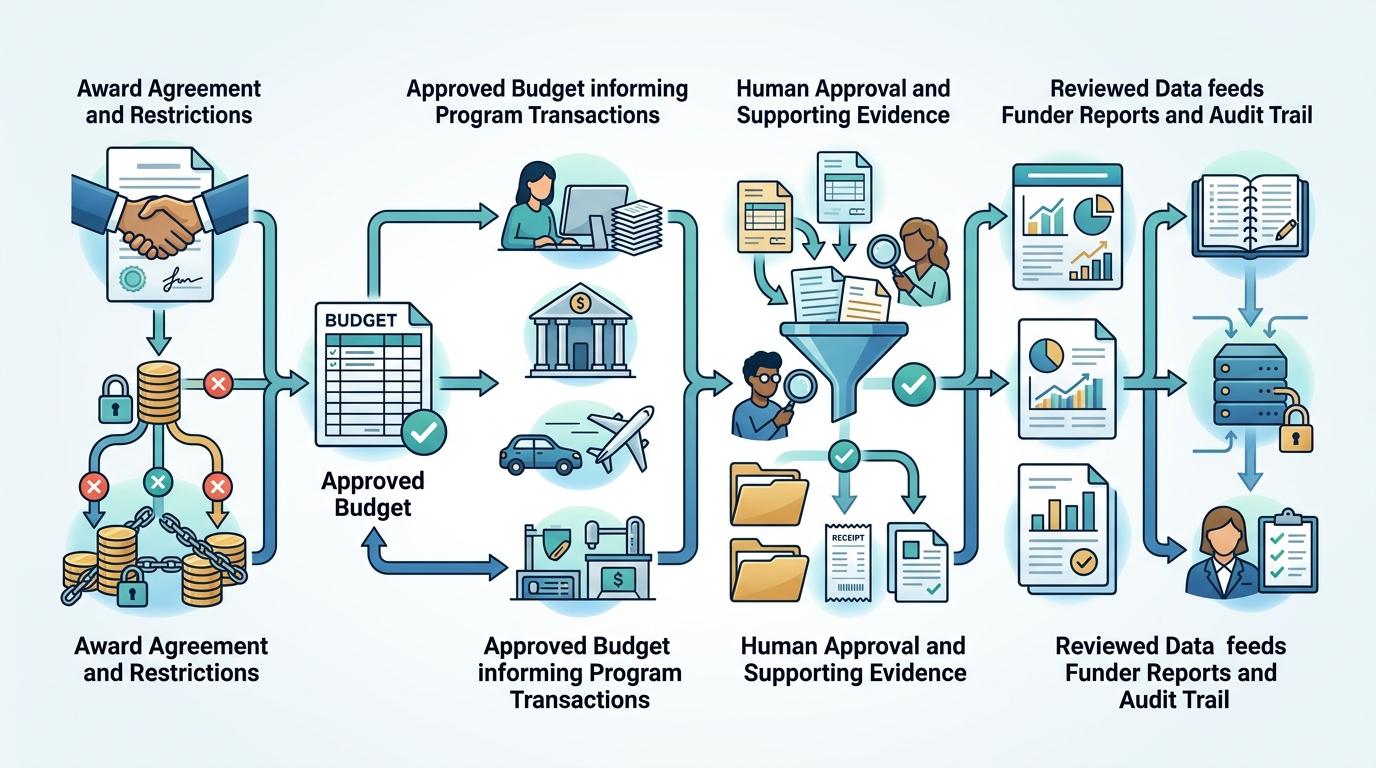
Consider a program purchase. In a disconnected process, a manager requests the item, finance processes the invoice, and the grants team later has to determine which award and budget category should absorb it. A more controlled workflow captures the grant, program, and funder budget line when the request begins, then lets the responsible reviewer check the agreement, organizational policy, available balance, and any prior-approval requirement before commitment. The decision remains a human one; the transaction carries its context forward.
The same principle supports payroll and shared costs. Federal guidance on allocable costs provides one example of how to treat costs that benefit multiple activities; the applicable approach depends on the award and governing requirements. Approved allocation rules can be applied consistently, with the basis and effective period preserved. Program teams and finance can use the same award identifiers and reporting periods, helping financial progress and delivery updates tell a coherent story.
After reviewing this approach, explore Softype’s ERP for Nonprofits for a fund-accounting perspective, or read NetSuite for Nonprofits: Fund Accounting, Grant Management & Donor Tracking for more detail on connected nonprofit finance workflows.
“Remaining grant balance” can hide several different measures. Separate them to avoid confusing budget authority with cash or assuming that unspent funds are immediately available.
Actual expenditure: costs posted to the award.
Commitments: approved purchase orders, contracts, and requests not yet posted as expenditure.
Forecast: expected payroll, procurement, and program costs through the end of the award period.
Available to spend: the remaining budget after actuals and relevant commitments, subject to the award’s restrictions and timing.
Cash and receivables: funds received, advances issued, and eligible costs claimed or awaiting reimbursement.
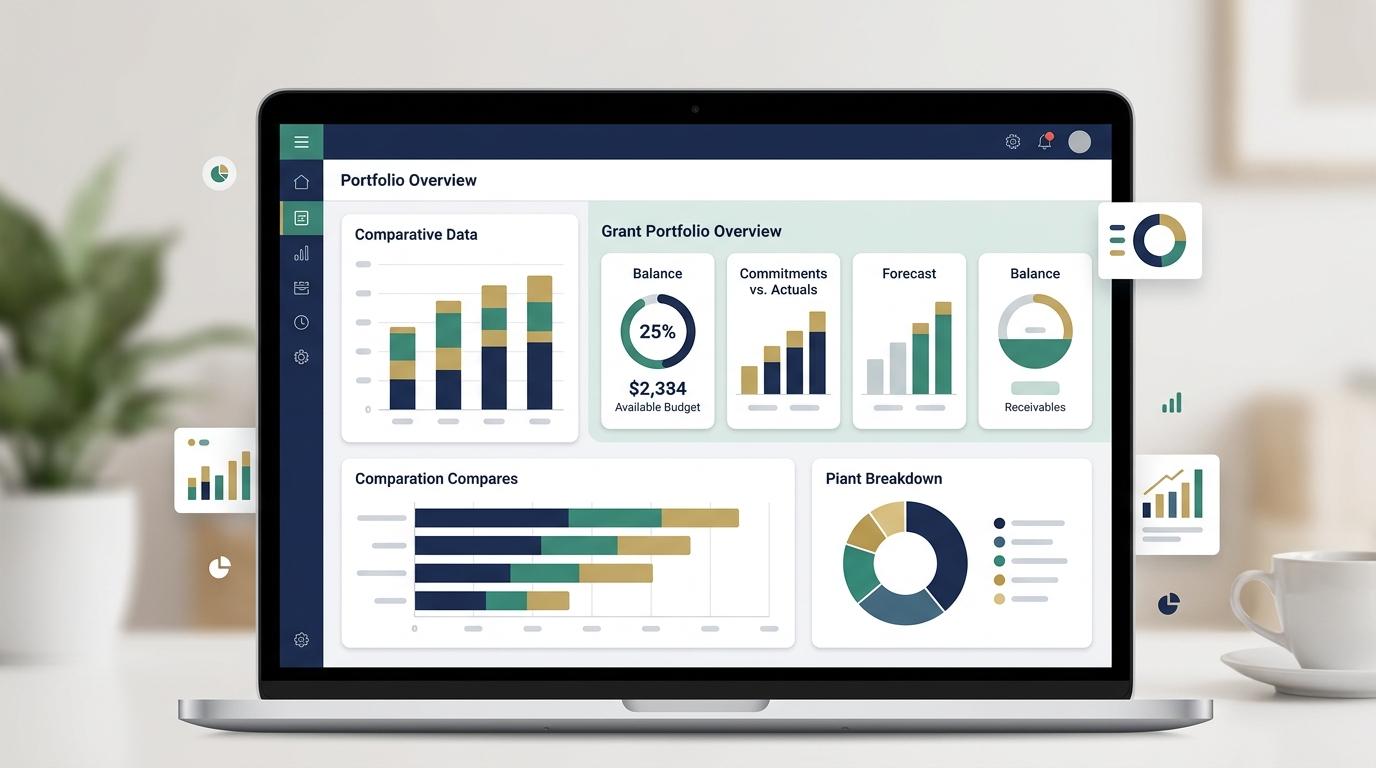
For a controller preparing month-end or a grants manager assembling a funder report, these distinctions turn reconciliation into review. The team can compare actuals and commitments with each approved budget line, identify costs that still need coding or evidence, and map the reviewed totals to the funder’s reporting categories. A report figure should trace back to its transactions, approval, and supporting documents, so staff can explain a variance without rebuilding the calculation from several files.
Use this checklist to test whether your organization can track every grant’s funding, restrictions, spending, reporting requirements, and remaining balance with confidence.
Award terms: Is there one current source for the grantor, award amount, period, conditions, amendments, owners, and source documents?
Budget categories: Can staff see the approved budget and revisions alongside actuals, commitments, forecast, and available balance?
Restrictions: Are purpose, timing, cost, location, beneficiary, matching, and approval rules documented for each award?
Transaction coding: Do requests, purchase orders, invoices, payroll allocations, expenses, and journals carry the grant and program identifiers needed for reporting?
Approvals: Are budget checks and required reviews performed before commitment, with exceptions assigned to an accountable approver?
Reporting deadlines: Does each financial, narrative, interim, reimbursement, and final report have an owner, reviewer, due date, and reminder?
Supporting documentation: Can reviewers find invoices, receipts, contracts, timesheets, allocation schedules, approvals, submitted reports, and funder correspondence?
Remaining balances: Does available-to-spend account for commitments while cash, receivables, and unliquidated advances remain visible separately?
A “yes, after manual reconciliation” is a warning sign. It often means the organization can produce a report but carries avoidable administrative effort and key-person risk to do so.
Audit readiness is a property of daily recordkeeping, not a binder assembled just before a review. For a sampled transaction, a reviewer should be able to identify its award, program, budget category, date, requester, approver, supporting evidence, allocation basis when relevant, and appearance in a claim or funder report.
Retention periods and required evidence vary by funding source and agreement. Build those obligations into the award record and confirm them with the appropriate finance, legal, or compliance lead. A complete trail should preserve changes to terms and budgets, not just the latest version.
In Softype’s nonprofit work, a foundation implementation included restricted and unrestricted fund accounting, grant tracking, budget-versus-actual dashboards, and audit-ready reporting. The design lesson is practical: agree on the control model and responsibilities before configuring workflows.
Grant management software organizes each award’s terms, budgets, restrictions, deadlines, and documents. When connected to finance workflows, it links that information to the transactions and approvals that use the funding.
Nonprofits track restricted funds by assigning each award a consistent identifier and coding transactions to the relevant fund, program, location, activity, and budget category. The right dimensions depend on the award, reporting needs, and the organization’s accounting policies.
Organizations can monitor multiple grants with an award-level view that separates actuals, commitments, forecast, available budget, cash, and receivables. Reviewing exceptions and deadlines alongside program progress helps teams act before a balance or reporting issue becomes urgent.
Fund accounting tracks and reports money by fund and restriction, while grant management coordinates the operational lifecycle of an award. They work best together when they share award identifiers and approved budget information across terms, spending, reporting, and closeout.
Nonprofits can reduce manual grant reporting by capturing grant coding when transactions begin and maintaining controlled mappings from internal accounts to funder categories. Reports can then reuse governed financial data, while review and adjustments remain documented.
No. Allowability depends on the award, applicable requirements, and organizational policy. Software can present relevant restrictions and route exceptions, but accountable people must make and document the decision.
Keep the agreement and amendments, approved budget versions, coded transactions, invoices and receipts, procurement records, payroll or allocation support, approval history, submitted reports, and funder correspondence. Confirm the exact requirements and retention period for each funding source.
Restricted funding should support mission delivery, not create a parallel administrative system. When award terms, budgets, transactions, allocations, approvals, reports, and evidence stay connected, teams spend less time reconciling and gain a clearer view of what remains available and what needs action.
Book a 30-minute nonprofit grant management discussion to review how your awards, budgets, allocations, and reporting fit together today.


Helping businesses thrive with integrated ERP solutions.
NetSuite
Service
Company
Contact Us
Copyright © 2026


