


NetSuite is sold as an annual subscription, but most buyers think in monthly terms because that is how they budget. Costs range from roughly $1,500 per month at the smallest end to well above $20,000 per month for complex multi-entity deployments. For an accurate number, you need a quote from a partner who can scope your specific requirements. This guide helps you arrive at that conversation with a defensible planning range in hand.
This blog is the directional estimating framework. For the five-year total cost of ownership view, see How Much Does NetSuite Really Cost? A Transparent Guide for Businesses. For Year 1 implementation budget planning, see NetSuite Implementation Cost: How to Plan Your Year 1 Budget. For the accurate quote tailored to your business, the next step is a conversation with Softype.
Note: All figures in this guide are directional planning ranges based on industry experience. They are not official Oracle quotes. Your actual cost will depend on your specific requirements, user count, operational capabilities, and negotiated terms.
Cloud Enterprise Resource Planning (ERP) subscriptions are built from a base platform plus user licenses plus capability layers.
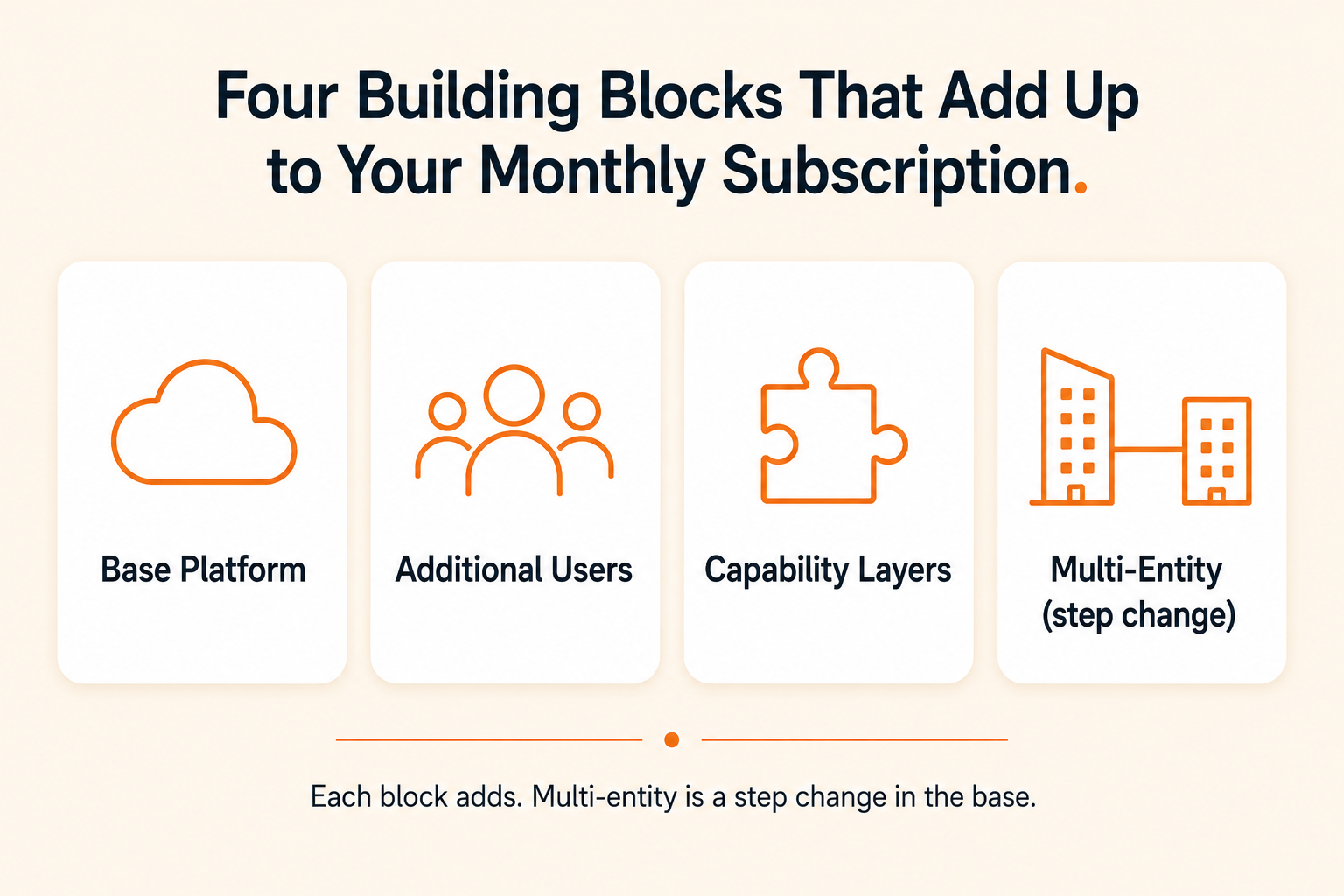
The four building blocks:
 Block 1: Base Platform
The base platform covers the core ERP tenant: general ledger, accounts payable, accounts receivable, bank reconciliation, basic sales and procurement, standard reporting and dashboards, and a starter set of user licenses (typically around five full users included in the base).
Directional range: $1,000 to $2,000 per month for an entry-level platform. Mid-market platforms with broader functionality start higher. Multi-entity platforms with consolidated reporting and multi-currency support are higher still.
Block 2: Additional User LicensesBeyond the starter licenses included in the base, additional users are added per named user (not concurrent). Most platforms distinguish between full users (finance, operations, sales, procurement, administrators who transact daily) and limited or self-service users (employees who need access only for time entry, expense submission, or basic reporting).
Directional ranges:
Full users: approximately $100 to $200 per user per month
Limited or self-service users: approximately $15 to $30 per user per month
A planning note: businesses approaching 30 users tend to also need capability layers and platform tiers that drive cost above what a pure per-user math would suggest. See the threshold note below.
Block 3: Capability LayersEach operational capability you add layers onto the base.
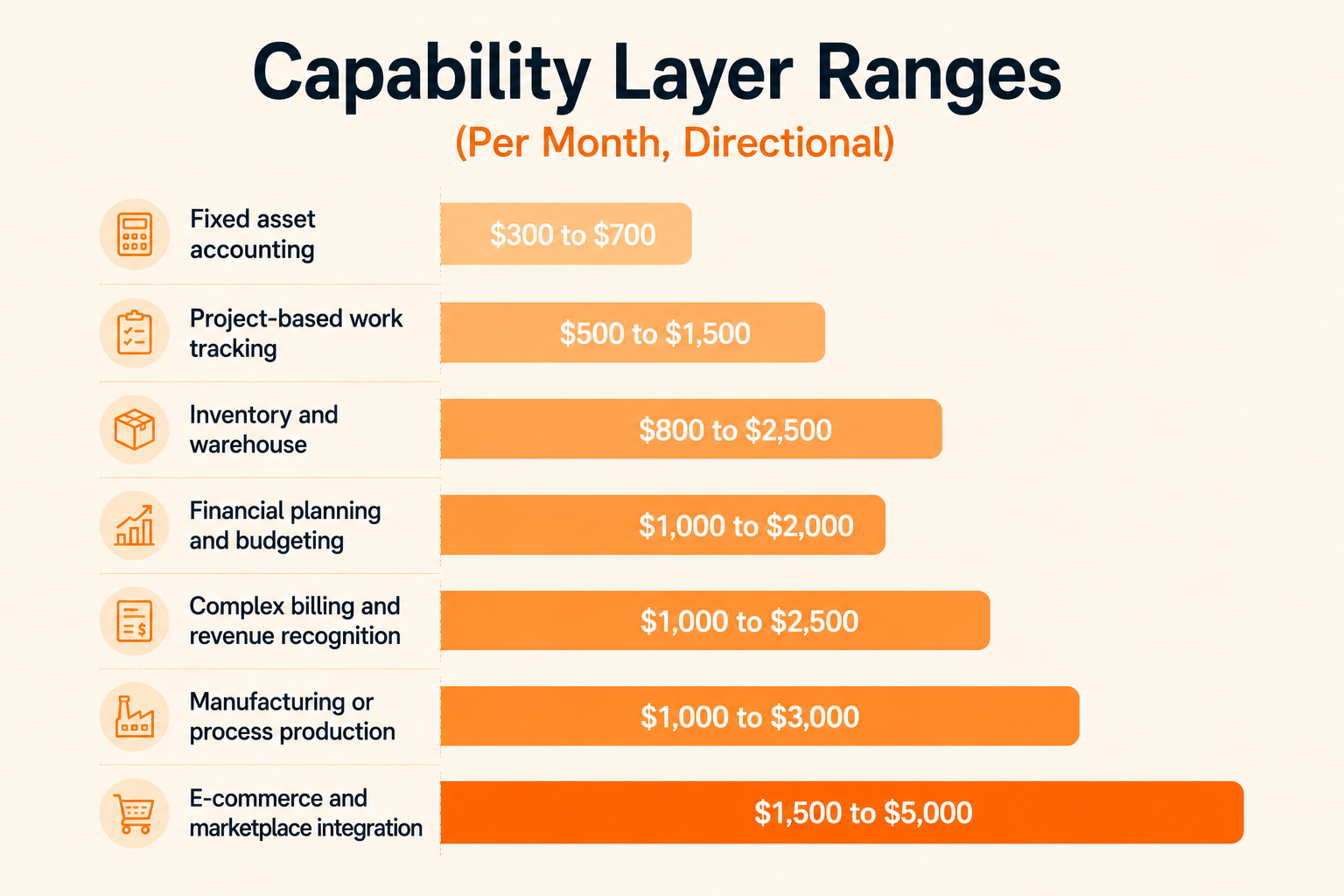
The most common additions and their directional ranges:
Capability Layer | Directional Range (Monthly) | When You Need It |
|---|---|---|
Inventory management and warehouse operations | $800 to $2,500 | Multi-location inventory, lot tracking, expiry management, bin management |
Manufacturing or process production | $1,000 to $3,000 | Recipes, work orders, yield tracking, production scheduling |
Complex billing and revenue recognition | $1,000 to $2,500 | Subscription billing, milestone billing, deferred revenue, contract-based invoicing |
E-commerce and marketplace integration | $1,500 to $5,000 | Online storefront, marketplace channels (e.g., Lazada, Shopee, Amazon), order management |
Financial planning and budgeting | $1,000 to $2,000 | Multi-scenario budgeting, forecasting, consolidated planning |
Fixed asset accounting | $300 to $700 | Asset register, depreciation schedules, asset disposal tracking |
Project-based work tracking | $500 to $1,500 | Project accounting, resource allocation, time and expense tracking |
Not every business needs every layer. Most mid-market deployments start with two to four capability layers and add more in subsequent phases.
Block 4: Multi-Entity, Multi-Currency SupportIf your business operates multiple legal entities, particularly across countries, the platform moves to a higher tier that supports consolidated reporting, intercompany transactions, and multi-currency operations. This is not an add-on layer; it is a step change in the base platform.
Practical impact: the base platform itself moves up by $1,500 to $3,000 per month compared to a single-entity equivalent, and the user license rates are slightly higher.
Cloud ERP pricing rarely scales linearly with user count past a certain point. Businesses that need 30 or more users typically also have operational complexity (multi-department, multi-location, or multi-entity) that requires a higher platform tier. The complexity of the business drives the tier change, and that change is more significant than the incremental cost of additional user licenses.
Practical implication: if your business is approaching 30 users, plan for the mid-market or multi-entity range, not the entry level with more seats.
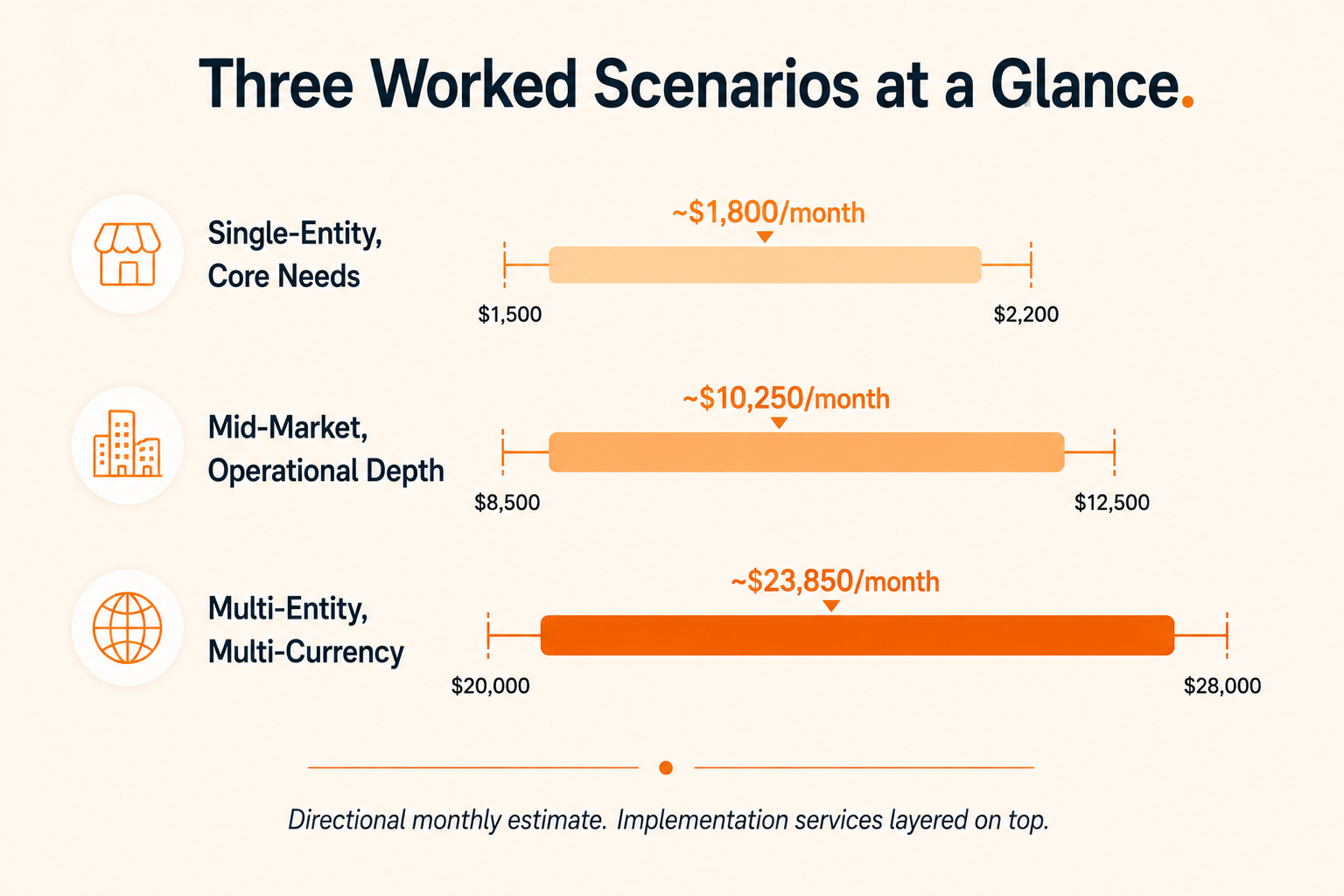
The fastest way to understand how the building blocks add up is to see three scenarios at different business profiles. Each shows a representative configuration that we would expect to see in practice, with a directional monthly estimate and a tighter practical range around it.
 Scenario 1: Single-Entity Business with Core Needs
Profile: A 15-person professional services firm. Core financials, basic customer relationship management, no inventory or manufacturing. Outgrown entry-level accounting software, ready for a proper ERP platform.
Representative configuration:
Component | Indicative Monthly |
|---|---|
Base platform (entry-level, ~5 full users included) | $1,200 |
Additional full users (3 above starter set) | $450 |
Limited users (7 self-service) | $150 |
Capability layers | None for phase one |
Directional monthly estimate | ~$1,800/month |
Practical range | $1,500 to $2,200 |
Annual equivalent | ~$22,000 ($18K to $26K) |
Scenario 2: Mid-Market Business with Operational DepthProfile: A wholesale distributor with 30 full users and 25 limited users. Multi-warehouse inventory, two retail branches, growing e-commerce channel.
Representative configuration:
Component | Indicative Monthly |
|---|---|
Base platform (mid-market tier) | $2,000 |
Additional full users (25 above starter set) | $3,750 |
Limited users (25) | $500 |
Inventory and warehouse operations | $1,500 |
E-commerce and marketplace integration | $2,500 |
Directional monthly estimate | ~$10,250/month |
Practical range | $8,500 to $12,500 |
Annual equivalent | ~$123,000 ($102K to $150K) |
Notes: The mid-market tier supports broader functionality. The e-commerce layer typically covers both the platform-side capability and the connector subscription used to integrate marketplace channels.
Scenario 3: Multi-Entity, Multi-Currency OperationsProfile: A holding company with five operating subsidiaries across two countries. 80 full users, 60 limited users. Manufacturing, distribution, complex billing, and financial planning across the group.
Representative configuration:
Component | Indicative Monthly |
|---|---|
Multi-entity base platform (higher tier with consolidation) | $4,500 |
Additional full users (75 above starter set) | $11,250 |
Limited users (60) | $1,350 |
Inventory and warehouse operations | $1,500 |
Manufacturing or process production | $2,000 |
Complex billing and revenue recognition | $1,750 |
Financial planning and budgeting | $1,500 |
Directional monthly estimate | ~$23,850/month |
Practical range | $20,000 to $28,000 |
Annual equivalent | ~$286,000 ($240K to $336K) |
Notes: At this scale, user licenses are the largest single component of the bill. Each additional country, capability layer, or business unit moves the total upward.
Want to model your own scenario? Use our Interactive Cost Estimator to adjust the user count, capability layers, and implementation complexity to fit your business and see your directional Year 1 total in real time.
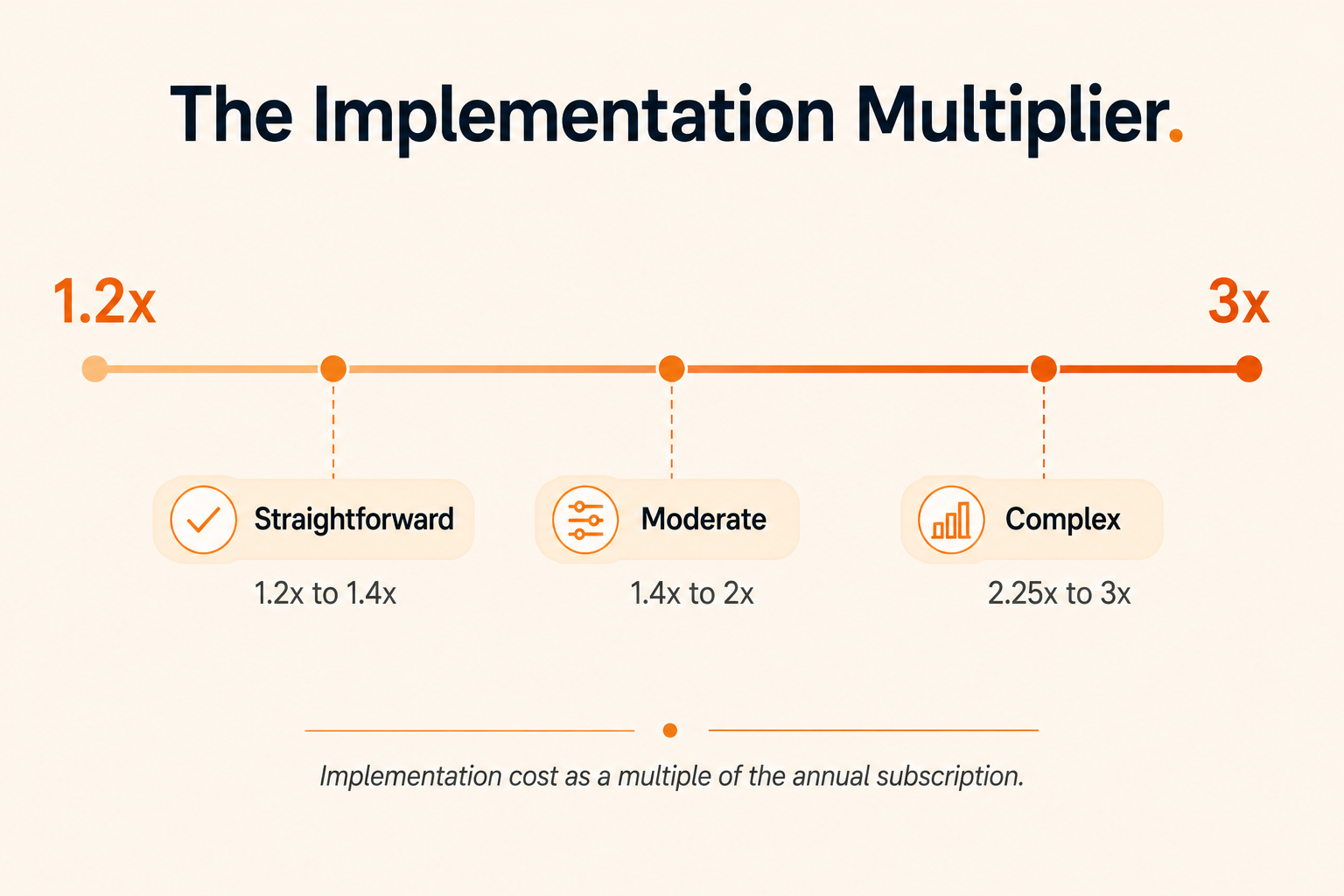
The subscription is only part of the Year 1 picture. Implementation services (configuration, data migration, training, go-live support) are a one-time cost layered on top of the subscription. A useful planning shortcut: implementation typically runs as a multiplier of the annual subscription, scaled to the complexity of the project.
Project Complexity | Implementation Multiplier | Typical Characteristics |
|---|---|---|
Straightforward | 1.2x to 1.4x | Single entity, core financials, clean data, minimal integrations |
Moderate | 1.4x to 2x | Operational capabilities, a few integrations, moderate data migration |
Complex | 2.25x to 3x | Multi-entity, multiple integrations, extensive data migration, customization |
Applying the multiplier to the scenarios above:
Scenario | Annual Subscription | Implementation Services | Year 1 All-In |
|---|---|---|---|
Scenario 1 (Single-Entity, Straightforward) | ~$22,000 | ~$29,000 (1.3x) | ~$51,000 |
Scenario 2 (Mid-Market, Moderate) | ~$123,000 | ~$210,000 (1.7x) | ~$333,000 |
Scenario 3 (Multi-Entity, Complex) | ~$286,000 | ~$715,000 (2.5x) | ~$1,001,000 |
For the detailed implementation budget framework, including the five cost drivers that swing the number and a walkthrough of what to expect in a partner Statement of Work, see NetSuite Implementation Cost: How to Plan Your Year 1 Budget.
Three patterns emerge:
 User licenses are the largest line item above a certain scale. Once user count crosses roughly 30 to 50, the per-user component becomes the biggest single block of monthly cost. This is why distinguishing full users from limited or self-service users matters financially.
Capability layers scale with what the business does, not how big it is. A 15-person business that needs inventory, warehouse, and e-commerce costs more than a 25-person business that only needs core financials. Operational scope drives the subscription more than headcount alone.
Multi-entity is a step change. Operating multiple legal entities with consolidated reporting and intercompany management moves the platform to a higher tier. This is a deliberate architectural decision, not just a pricing adjustment.
Cloud ERP subscriptions are sold on an annual basis, not month-to-month. The monthly figures in this guide are the monthly equivalent of the annual contract, presented in monthly terms because that is how most buyers budget.
In practice:
You sign an annual contract (sometimes multi-year) for the subscription.
You are billed annually or quarterly, depending on the agreement.
The "monthly cost" is a useful planning view but not a billing reality.
Multi-year contracts are common, particularly for larger deployments. Contract structures are commercial details best discussed with your partner during the proposal phase.
The monthly subscription covers the platform software. The Year 1 total above includes implementation services. Neither covers:
Data migration beyond standard scope. Extensive historical data or unusual data quality issues can extend migration work.
Training beyond the standard implementation package. Additional training for new hires or major process changes is usually a separate engagement.
Customization beyond standard configuration. Custom workflows, custom reports, and unusual integrations.
Third-party applications. Process manufacturing add-ons, e-commerce middleware, and similar applications have their own subscriptions paid to those vendors.
Ongoing partner support. Post go-live consulting, optimization, and managed services, typically retainer-based.
The building-block approach gives you a directional range. The scenarios show how the blocks add up at different business profiles. The implementation multiplier converts that into a Year 1 total. The final number depends on a scoping conversation with a partner who understands your business.
What you can do before that conversation:
Identify which scenario is closest to your profile.
Count full users versus limited users for your phase one rollout.
List the capability layers you need on day one and what can wait for phase two.
Count your legal entities and currencies.
Decide which implementation complexity tier applies to you, and apply the multiplier.
Try the Interactive Cost Estimator to model your specific configuration and see how the building blocks add up for your business.
Buyers who land good outcomes arrive at the partner conversation prepared: a clear internal view of their requirements and a directional budget range. The accurate number comes from the scoping conversation. The directional number from this guide is what helps you start that conversation on equal footing.
Talk to Softype about your cloud ERP subscription. We will help you scope the right configuration for your phase one needs and give you a directional estimate before committing to anything.

For single-entity businesses with core needs, expect a directional monthly estimate of approximately $1,800/month (practical range $1,500 to $2,200). For mid-market businesses with operational depth, approximately $10,250/month (practical range $8,500 to $12,500). For multi-entity, multi-currency operations, approximately $23,850/month (practical range $20,000 to $28,000). These are subscription-only figures. Implementation and other one-time costs are separate.
NetSuite is sold on an annual subscription basis, with annual or quarterly billing. The monthly figures used in pricing discussions are the monthly equivalent of the annual contract, useful for budgeting but not a billing reality.
Businesses that need 30 or more users typically have operational complexity (multi-department, multi-location, or multi-entity) that requires a higher platform tier. The complexity of the business drives the tier change, and that change is more significant than the incremental cost of additional user licenses.
The capability layers that add the most to the subscription tend to be e-commerce and marketplace integration, manufacturing or process production, and complex billing. Lighter layers like fixed asset accounting or project-based work tracking are less significant. The exact impact depends on the platform configuration and your partner's proposal.
Implementation typically runs 1.2 to 1.4 times the annual subscription for straightforward deployments, 1.4 to 2 times for mid-market with moderate complexity, and 2.25 to 3 times for complex multi-entity programs with multiple integrations. The variables are scope complexity, data migration effort, number of integrations, and customization depth.
If your business operates multiple legal entities or operates across countries requiring consolidated reporting and intercompany management, multi-entity support is essential. If you are a single-entity, single-country business, you likely do not need it. Multi-entity moves the platform to a higher tier, so it should be a deliberate decision.
Cloud ERP platforms like NetSuite are materially more expensive than entry-level accounting software but deliver substantially more depth at the mid-market. SAP Business One has comparable cost depending on configuration. Odoo is typically lower on license but higher on customization for complex deployments. See our dedicated comparison blogs for each matchup.
This guide builds the directional subscription estimate block by block and layers implementation on top. The NetSuite Implementation Cost: How to Plan Your Year 1 Budget guide goes deeper on the implementation side specifically: the five cost drivers that swing the number, a walkthrough of what to expect in a partner Statement of Work, and how to control Year 1 spend.


Helping businesses thrive with integrated ERP solutions.
NetSuite
Service
Company
Contact Us
Copyright © 2026


