


TL;DR
In this guide, we'll explore the different NetSuite training options and how to build a learning approach that helps your users move from “I don't know how to do this” to “I've got it.”
NetSuite training works best as a blend: use Oracle’s self-paced learning for broad, ongoing access, and partner-led sessions for hands-on practice tied to your setup and roles. Choose the mix that fits your team’s needs, budget, and time, and remember that certification is a separate exam—not a training course.
Imagine this: your company has just invested heavily in NetSuite.
The implementation goes live. The dashboards look great, processes are automated, and everyone is excited about finally moving away from spreadsheets.
Then, a few weeks later, things start to change.
Employees begin keeping their own Excel files “just in case.”
Finance teams start double-checking NetSuite numbers before using them in reports.
Admins struggle to make simple system changes without calling the implementation partner.
Slowly, the problem becomes clear: the company invested in the system, but not enough in the people using it.
NetSuite projects can fall short when people do not know how to use the system. Even a strong ERP works best when users feel confident and teams can manage it on their own.
Your team does not need weeks of classroom training to learn NetSuite. Oracle offers self-paced courses and certifications. Partners also offer training for specific roles and tasks. The key is to choose the right option for each team and stage.
The key is knowing which type of training your team actually needs—and when.
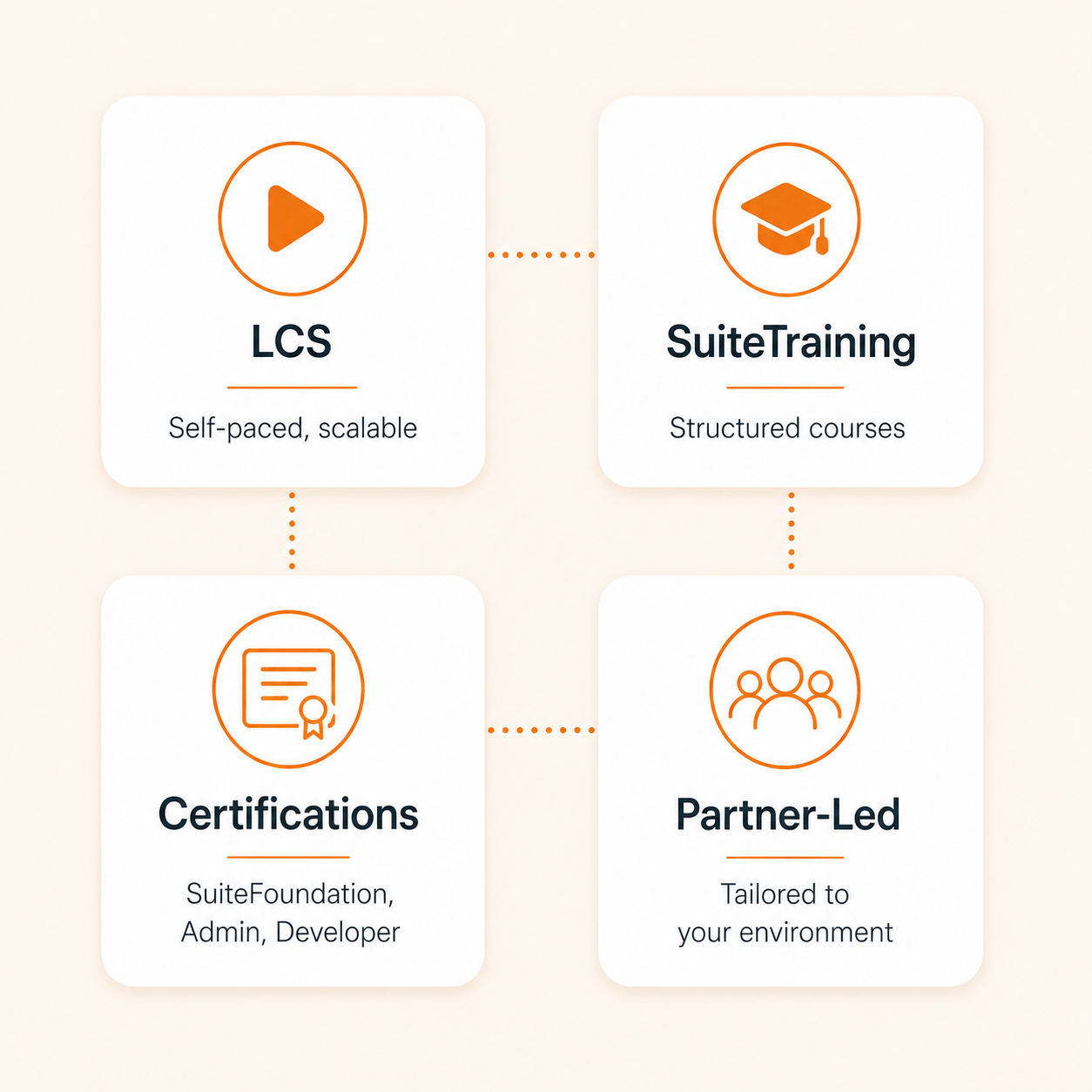
NetSuite Learning Cloud Support (LCS) is Oracle's subscription-based training service. A Company Pass gives several users access to courses and recorded lessons at any time. It also includes live webinars and practice in demo systems.
Role-based learning paths aligned to NetSuite's product releases (administrator, financial user, operations)
Mix of formats: on-demand courses, live sessions, and hands-on labs
Company Pass pricing tiers based on user count, making it cost-effective at scale
Designed for continuous, ongoing enablement, especially after go-live
LCS works best for broad organizational coverage: onboarding new hires, keeping the team current on biannual releases, and building baseline competency across large user groups.
Choose LCS when: you need broad, ongoing access for many users across the organization, especially post-go-live. The subscription model suits companies that want continuous enablement at scale.
SuiteTraining offers courses on specific NetSuite topics. These include system administration, finance, SuiteAnalytics, and SuiteCloud development.
Live virtual instructor-led classes, classroom sessions in some regions, and on-demand modules
Often mapped to certification preparation (SuiteFoundation prep, Administrator prep)
Can be purchased individually, bundled, or accessed via LCS subscriptions
Best for deeper understanding of specific areas (revenue recognition, scripting, multi-entity setup) rather than broad click-through familiarity
Choose individual SuiteTraining when: you need one or two specific deep-dive courses for a small number of people and do not want a full subscription. Many SuiteTraining courses are also available inside the LCS platform, so check your LCS entitlements before purchasing separately.
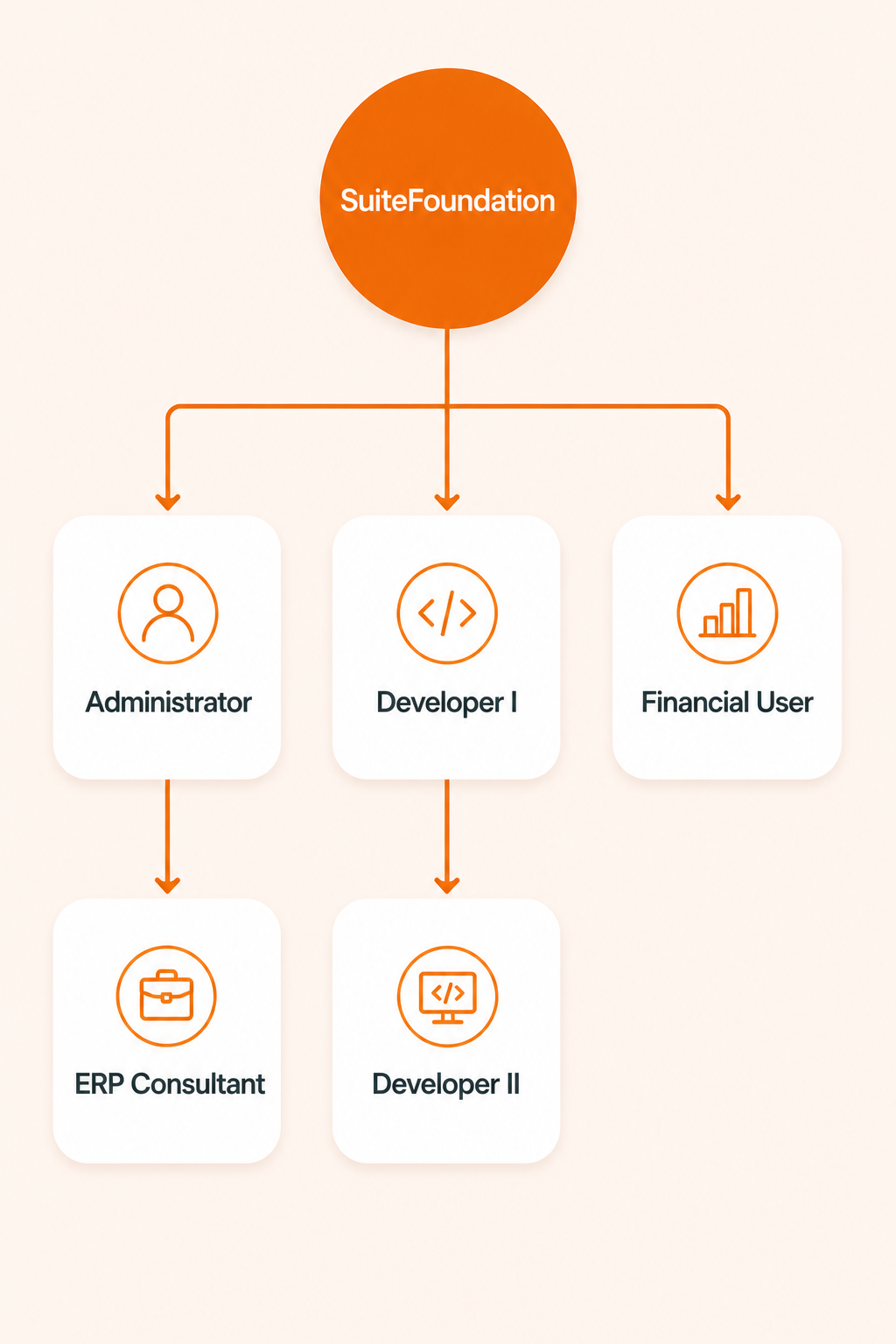
Certifications are separate from LCS and SuiteTraining. Those programs teach NetSuite skills. Oracle exams test what you have learned. You can prepare through courses, a partner, or self-study, but the exam has a separate fee. Most certification paths start with SuiteFoundation.
Certification | Audience | Focus Areas | Prerequisite |
|---|---|---|---|
SuiteFoundation | All roles | Navigation, records, transactions, basic workflows, reporting | None |
Certified Administrator | System administrators | Configuration, security, roles/permissions, troubleshooting | SuiteFoundation |
SuiteCloud Developer I | Developers | SuiteScript, SuiteTalk, customization best practices | SuiteFoundation |
SuiteCloud Developer II | Senior developers | Advanced scripting, integrations, architecture | Developer I |
Financial User | Finance teams | General Ledger (GL), revenue recognition, multi-book, advanced billing | SuiteFoundation |
ERP Consultant | Consultants, architects | End-to-end solution design and implementation | SuiteFoundation + experience |
NetSuite partners can train your team in your live or test system. They can use your data and business processes. This makes the examples specific to your work, rather than a general demo.
Delivered in your configured NetSuite environment with your chart of accounts, item structure, and workflows
Scenario-based exercises using real transactions your team will encounter on day one
Interactive with live demonstrations, Q&A, and hands-on practice
Often bundled into implementation projects as train-the-trainer sessions, go-live bootcamps, and post-go-live refreshers
Choose partner-led training during an implementation or major system change. It can also help with complex processes or when staff need practice in a system that matches the live setup. The Role-Based Learning Paths section explains how sessions can support each role.
NetSuite provides built-in resources at no extra cost: the in-app Help Center, SuiteAnswers knowledge base, Guided Learning walkthroughs embedded in the User Interface (UI), and Oracle Learning Library video tutorials. These are valuable as just-in-time references but are typically not sufficient as standalone training for complex use cases.
Training Option | Format | Best For | Strengths | Limitations |
|---|---|---|---|---|
LCS Company Pass | Self-paced, on-demand, webinars | Ongoing training across the organization | 24/7 access, role-based paths, scalable subscription | Less tailored to your specific configuration |
Individual SuiteTraining | Live virtual, on-demand | Deep dives into specific topics | Structured curriculum mapped to certifications | Per-seat cost; scheduling constraints |
Certifications | Exams + prep | Admins, developers, consultants | Recognized credentials, structured study paths | Exam fees; requires recertification |
Partner-Led | Live workshops, project sessions | Implementation, complex use cases, key roles | Tailored scenarios, in-environment practice | Higher cost; quality varies by partner |
Free Resources | On-demand, self-directed | Just-in-time reference | No cost; always accessible | Not sufficient for complex processes alone |
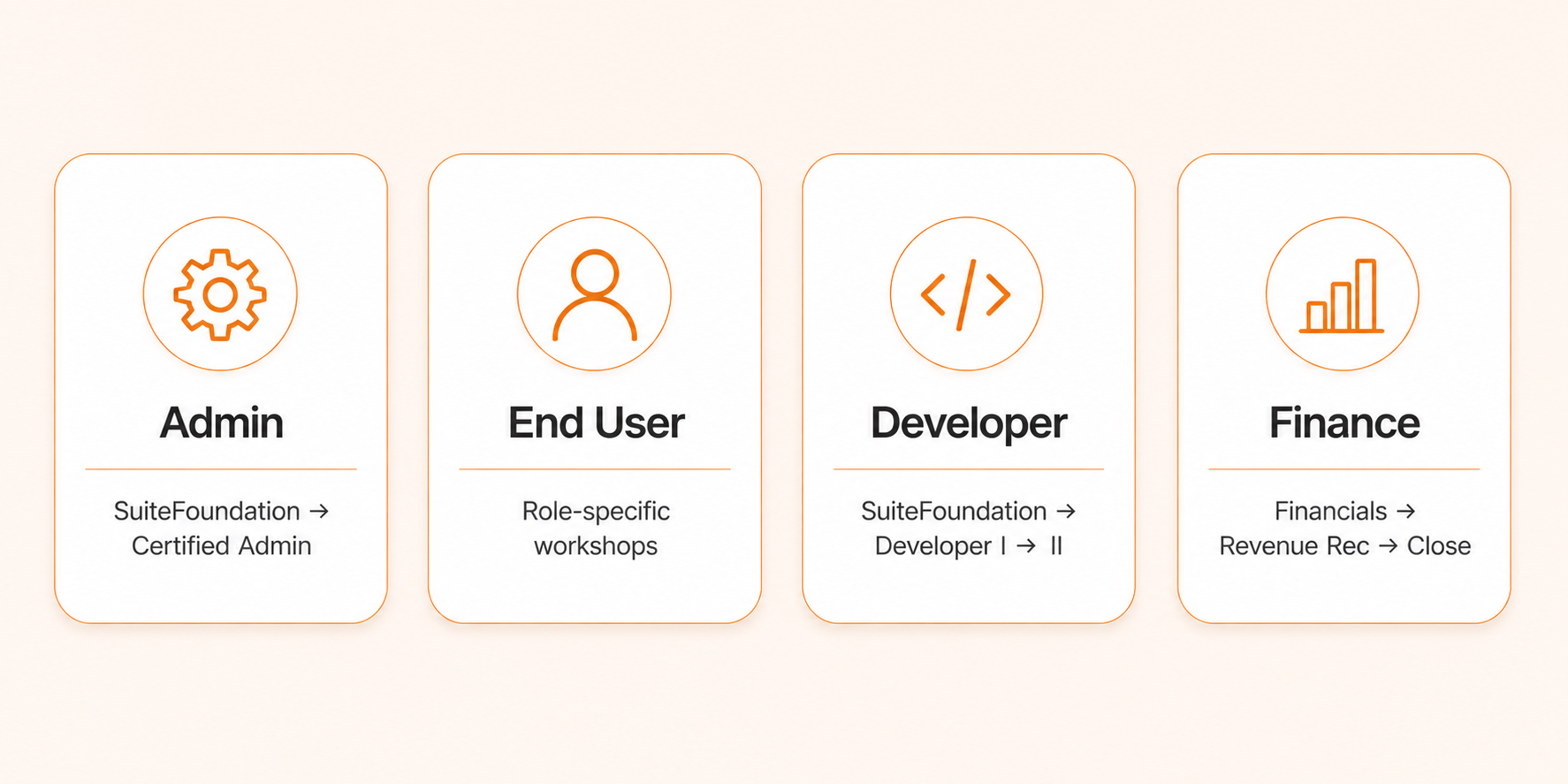
Different roles need different training. An administrator configuring subsidiaries does not need the same learning path as a warehouse manager processing receiving transactions.
 System Administrators
Administrators are responsible for configuration, security, roles, workflows, and ongoing system health. Their training needs are deep and ongoing.
Start with LCS or SuiteTraining fundamentals (navigation, basic configuration, SuiteAnswers)
Study for and pass SuiteFoundation within 3 to 6 months of active use
Complete administrator-focused courses (roles/permissions, CSV imports, workflow configuration, troubleshooting)
Sit for the Certified NetSuite Administrator exam after real-world project experience
Participate in partner-led configuration workshops, data migration planning, and advanced workflow design
Use LCS to stay current on releases and optionally pursue Enterprise Resource Planning (ERP) Consultant certification for solution design roles
End Users (Finance Clerks, Sales, Operations, Warehouse)End users need role-specific, hands-on training focused on their daily transactions, not the full platform.
Short role-based onboarding modules from LCS: logging in, dashboards, basic searches and reports
Guided Learning walkthroughs for common daily tasks where available
Partner-led department workshops using real scenarios from your environment (order-to-cash, inventory transactions, expense processing)
Microlearning and quick reference cards as ongoing desk references
Advanced power user training for team leads: saved search creation, simple workflow management, department-level analytics
Most end users do not need formal certifications. Strong role-based training directly drives adoption, data quality, and Return on Investment (ROI).
Developers and Technical ConsultantsDevelopers need both functional understanding and deep technical platform knowledge.
Start with fundamentals and end-user training to understand real business processes before scripting them
Complete SuiteFoundation certification to build platform knowledge
Take SuiteTraining courses on SuiteScript (1.0 and 2.x), SuiteTalk web services, REST integrations, and the SuiteCloud Development Framework (SDF)
Pursue SuiteCloud Developer I after meaningful project experience; Developer II after 12+ months of complex work
Work with technical leads for code reviews, architecture guidance, and design patterns
Finance and Accounting (Controllers, Accountants, CFOs)Finance training must connect system configuration to accounting policy. Generic click-through training is not sufficient.
Financials fundamentals: chart of accounts, journal entries, subsidiary structure, tax configuration, standard financial reports
End-to-end walkthrough of Procure-to-Pay and Order-to-Cash in your specific environment
Specialized modules: revenue recognition, multi-book accounting, advanced billing, fixed assets
Financial reporting training: SuiteAnalytics, saved searches, Key Performance Indicator (KPI) dashboards, variance analysis
Partner-led sessions to build monthly and year-end close checklists within NetSuite
For finance consultants or internal architects: Financial User or ERP Consultant certifications
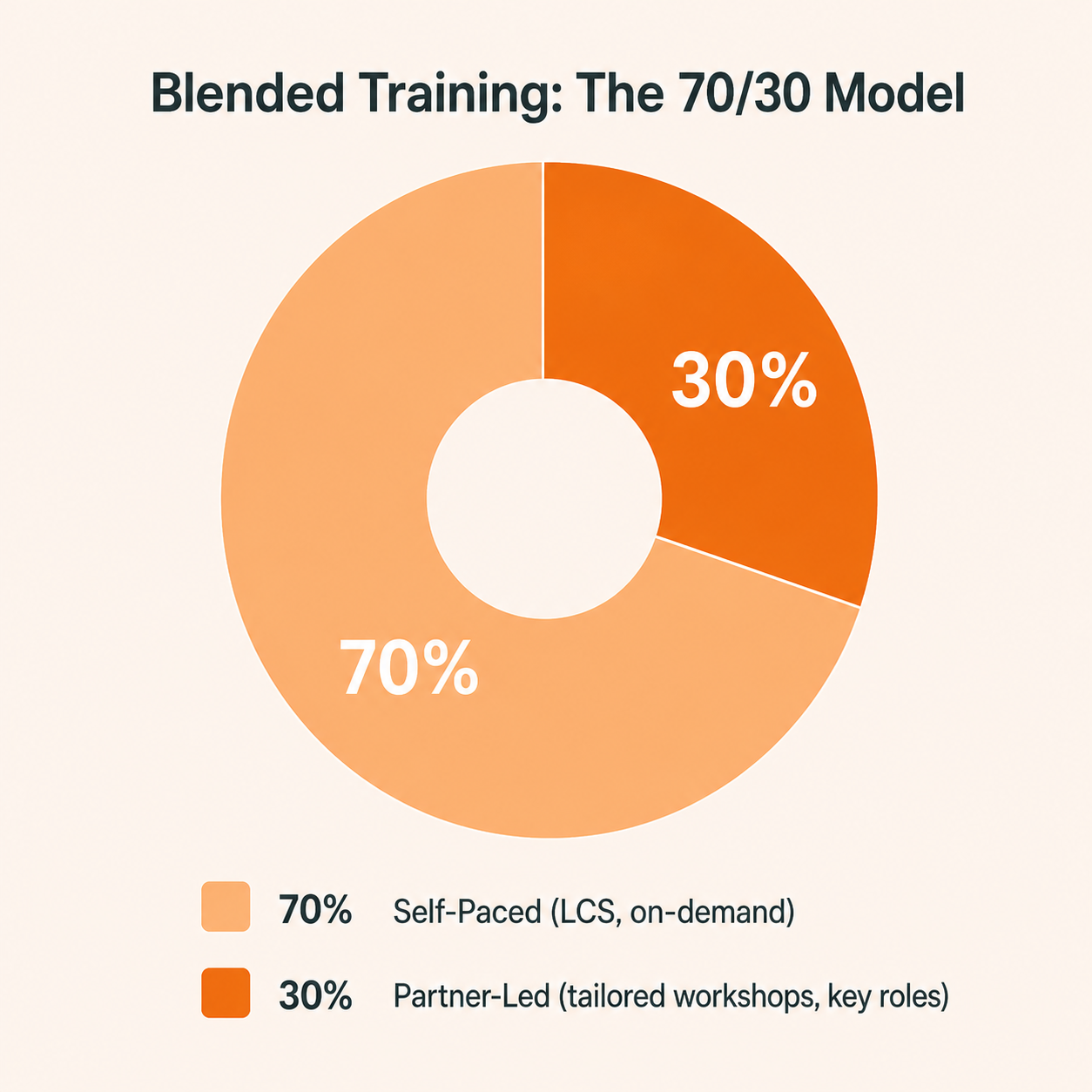
Most successful NetSuite customers combine self-paced and partner-led training rather than choosing one or the other.
Map users into clear groups: admins, finance, operations, developers. Define what "good" looks like for each (e.g., "Admin can set up a new subsidiary without partner support" or "AP team processes invoices without manual workarounds").
Use LCS and on-demand SuiteTraining for initial fundamentals across all roles, mass onboarding of new hires, and ongoing education about new releases. This is where training can reach the largest audience at manageable cost.
Use partner-led sessions for implementation, major reconfiguration, training admins and key finance staff, and transforming complex processes (revenue recognition, multi-entity consolidations, warehouse integrations). A practical split: self-paced for 70 to 80% of users, partner-led for the 20 to 30% whose decisions have the highest impact on NetSuite success.
For admins, developers, and consultants, certifications provide a structured roadmap and external validation. Link certifications to professional development plans for the roles that benefit most.
Track login frequency by role, error rates, support tickets, time-to-close before and after training, and confidence scores. Use metrics to guide refreshers, additional courses, and new workshops.
Softype offers partner-led training during implementation and standalone programs for teams already using NetSuite. Its approach provides one example of how training can fit into a broader project.
 Our Training Philosophy
The approach combines live classes with self-paced lessons and train-the-trainer support. Sessions focus on each role and its daily work. Teams practice with relevant scenarios, and sessions are recorded for later reference. Designated super users can then help teach their colleagues.
Maximum eight to ten participants per session. Training is completed within 30 days of go-live. All sessions are delivered online via video conference and recorded.
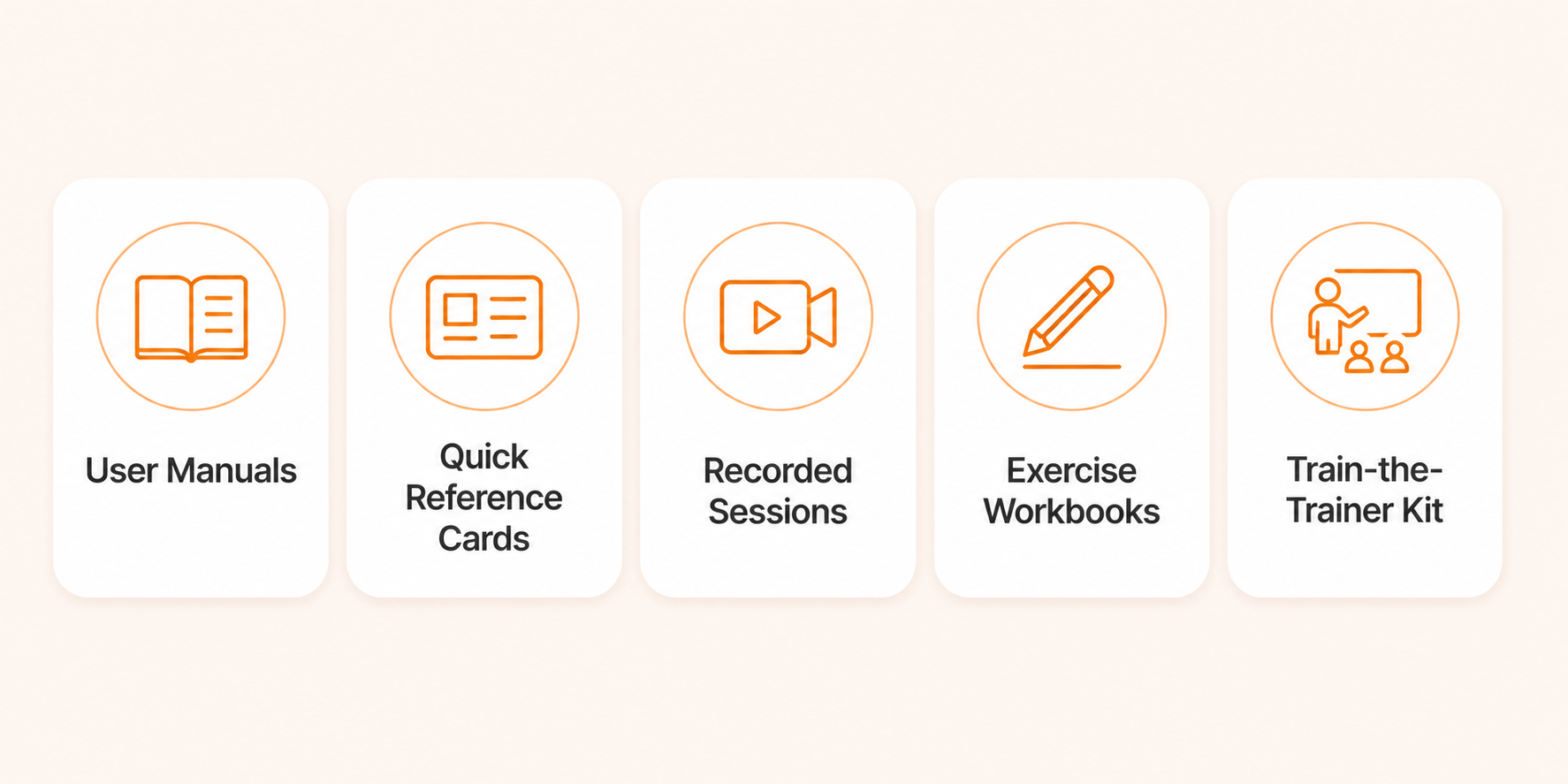
Standard Training DeliverablesRole-specific user manuals (AP, Accounts Receivable (AR), fixed assets, banking, reporting, system administration)
Quick reference cards (one-page, laminated for desk use) per process
Recorded training sessions for ongoing onboarding and reference
Exercise workbooks with scenario-based practice using your data
Train-the-trainer kit for self-service onboarding of new staff
Training Success StandardsTraining success can be measured against clear criteria:
100% attendance of designated users before go-live
80% or higher pass rate on post-training knowledge assessments
4.0 out of 5.0 or higher user confidence scores on post-training surveys
Zero training-related blockers at go-live
Certified TeamSoftype's training and change management leads hold Oracle NetSuite certifications, including SuiteFoundation, ERP Consultant, Certified Administrator, Financial User, Analytics User, AP Specialist, AR Specialist, Multi-Book Accounting, and AI Foundations Associate. Their experience can support teams preparing for similar exams.
Standalone Training ProgramsFor teams already using NetSuite, Softype offers standalone training for refreshers and role-based learning. Its five-day program covers Order-to-Cash, Procure-to-Pay, inventory, reporting and analytics, and system administration through instructor-led sessions and hands-on labs.
For partner selection context in the Philippines specifically, see our NetSuite Implementation Partners in the Philippines guide. For details on where training fits into a full implementation, see our NetSuite Implementation Guide. If your system needs recovery before training makes sense, see our NetSuite Recovery guide.
Talk to Softype about a training program for your NetSuite environment.

NetSuite Learning Cloud Support is Oracle's subscription-based training platform, providing on-demand courses, role-based learning paths, and live sessions. Organizations purchase an LCS Company Pass to give multiple users 24/7 access to the training library.
Most end users do not need formal certifications. Certifications are most valuable for system administrators, developers, consultants, and internal champions who design and maintain the NetSuite environment. SuiteFoundation is the typical starting point for all certification tracks.
Many professionals obtain SuiteFoundation within 3 to 6 months of active use. Administrator certification typically follows after 6 to 18 months of real-world experience. Advanced developer or consultant credentials generally take 18 to 36 months depending on project exposure.
For complex implementations, partner-led training typically shortens time-to-value, reduces post-go-live errors, and improves adoption because sessions are tailored to your actual configuration and processes. The investment is highest-value for admins, finance power users, and project leads.
Yes. NetSuite provides the Help Center, SuiteAnswers knowledge base, Guided Learning in-app walkthroughs, and Oracle Learning Library videos at no extra cost. These are valuable for just-in-time reference but generally not sufficient as standalone training for complex use cases.
SuiteTraining refers to individual NetSuite courses (instructor-led or on-demand). LCS is the subscription platform that provides access to a broad catalog including many SuiteTraining courses. LCS is more cost-effective at scale; individual SuiteTraining courses suit targeted learning on specific topics.
Finance teams benefit most from financial fundamentals courses, advanced modules covering revenue recognition and multi-book accounting, and financial reporting training. Partner-led sessions are especially valuable for building the period close process inside NetSuite and aligning configuration to your accounting policies.
Key Takeaways -
NetSuite success depends on people, not just technology. Without proper training, users may fall back to spreadsheets, create workarounds, or depend heavily on external support. Pasted text
There is no one-size-fits-all training approach. The right mix depends on your team's roles, goals, budget, and stage of implementation.
Use self-paced learning for scale. LCS and SuiteTraining are useful for onboarding, foundational knowledge, and keeping teams updated on new releases. Pasted text
Use partner-led training for hands-on depth. Training in your actual NetSuite environment helps teams practice the processes and scenarios they will encounter in their day-to-day work. Pasted text
Certifications are valuable for key technical roles. Administrators, developers, consultants, and internal NetSuite champions can benefit from structured certification paths, while most end users don't need formal certification. Pasted text
Training should be role-specific. An administrator, finance user, developer, and warehouse employee have very different learning requirements. Pasted text
A blended strategy works best. The guide recommends combining self-paced learning for broad coverage with partner-led sessions for complex processes and high-impact roles. Pasted text
Training should be measured. Login frequency, error rates, support tickets, time-to-close, and user confidence can help determine whether training is actually improving adoption. Pasted text
Training doesn't stop at go-live. Ongoing learning, refreshers, and training for new employees are important for maintaining adoption and keeping teams current. Pasted text


Helping businesses thrive with integrated ERP solutions.
NetSuite
Service
Company
Contact Us
Copyright © 2026


