


Batch tracking usually works when a business is small, and it works for a reason that has nothing to do with software. Experienced people carry the process in their heads. The warehouse supervisor remembers which delivery arrived short-dated. Production staff know which ingredient drum should be opened first. Customer service knows which supermarket rejects anything below ninety days of remaining shelf life. Labels, a whiteboard, an expiry log, and a morning walk through the racks are enough to keep spoilage and picking mistakes under control.
Then the operation grows. More SKUs, more active lots per SKU, more bins, a second and third warehouse, longer production campaigns, export customers with their own shelf-life terms, and several times the daily transaction volume. Nothing about the method is declared broken. It simply stops fitting, because no one can hold the current state of every batch in memory, and a spreadsheet of expiry dates is a static snapshot of inventory that never stops moving.
As the operation grows, the decision is which control model fits the risk: keep tightening manual checks, add warehouse-focused tools, or connect batch, expiry, quality, and production controls in an ERP. This guide compares what each approach can control—and where gaps remain—so operations leaders can judge the next step against their lot complexity.
Answer: Batch tracking and expiry date management is the control of inventory at lot level — quantity, location, quality status, and expiration date — so that First-Expiry-First-Out (FEFO) picking, production consumption, and traceability happen through system rules rather than manual checks. It matters because spoilage, wrong-lot shipments, and slow recall response are usually allocation failures, not warehouse failures.
In a single-site operation with thirty SKUs, “use the cartons on the left, those expire next month” is a functioning process. It is also person-dependent rather than system-dependent, and that distinction is what determines whether it survives growth.
What scale multiplies is not inventory volume but the number of combinations a decision has to consider:
SKU × batch × expiry date × warehouse × bin × inventory status × customer requirement × open demand
For example, 1,500 items across four warehouses, with four active lots per item, means about 6,000 item-and-lot combinations. That count does not include bins or quality status. One item may be split across several locations. One lot may be on hold, another promised to an export order, and a third may not meet a customer’s shelf-life requirement. The item balance might show 2,700 units, but far fewer may be usable.
This is where spreadsheet-based expiry tracking starts to fail. A spreadsheet may show that lot B260401 expires on Oct. 15. It may not show the current amount, exact storage location, quality hold, committed quantity, or stock already used in production. The date alone is not enough. Teams need the lot’s current status and quantity too.
That is why FEFO inventory management stops being a warehouse discipline and becomes an operational control issue. Once transactions accelerate, the business needs the system to remember quantity, location, status, remaining life, and customer-fit rules together. If those facts live in different places, expiry control becomes guesswork with a reporting layer on top.
FIFO sequences stock by receipt or production date. FEFO sequences it by expiry date, and the two diverge routinely because the most recent delivery can easily carry the shortest remaining life.
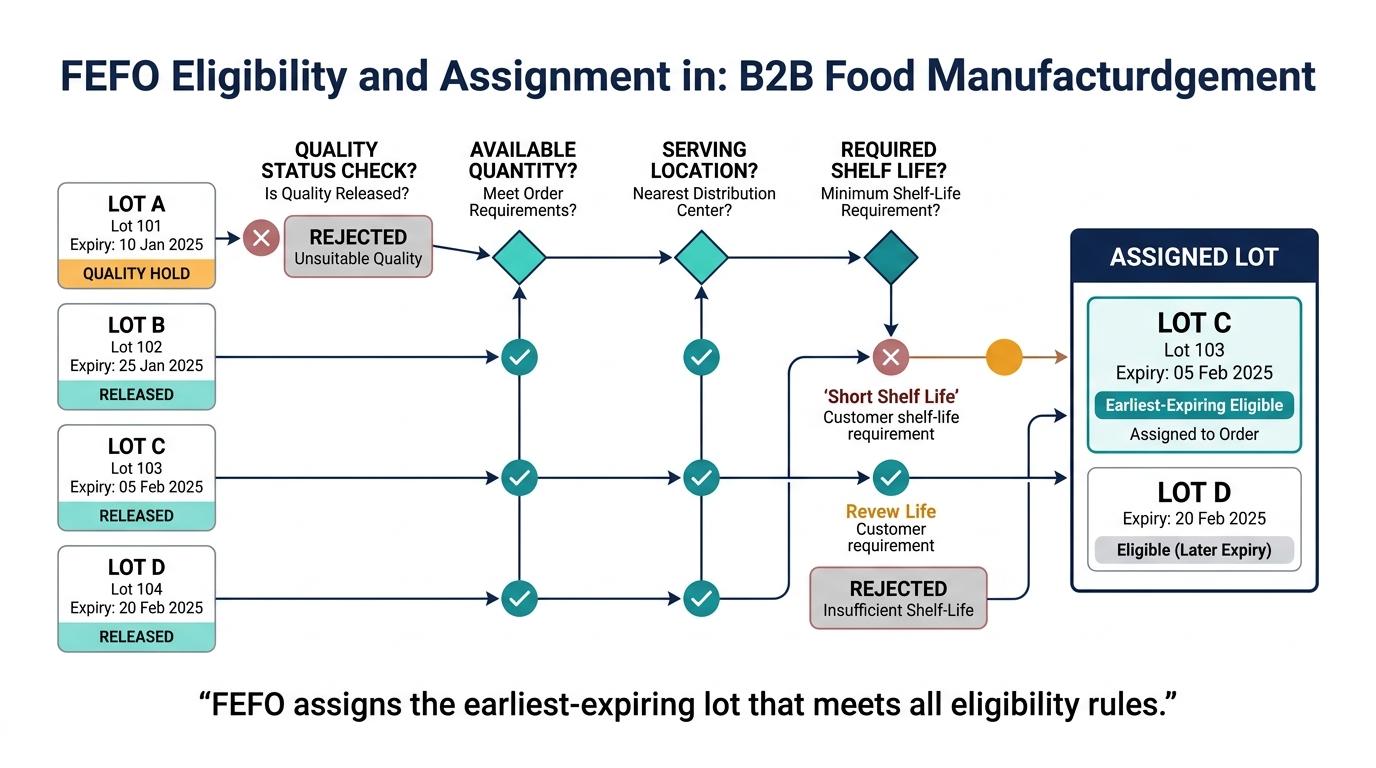
The naive reading of FEFO is “ship whatever expires first.” The operational definition is narrower: allocate the earliest-expiring lot that is actually eligible to satisfy this requirement. Consider four lots of one finished good, with a customer requiring sixty days of remaining shelf life on an Aug 1 shipment. The Aug 30 lot expires first but sits on quality hold. The Sep 15 lot is released but fails the shelf-life test. The correct FEFO answer is the Oct 20 lot — the third option in date order.
Reaching that answer requires several controls to be connected: item and customer shelf-life rules, lot records with expiry dates, quality status, batch-level quantity by location, order commitments, allocation logic, and warehouse execution. Without those connected controls, FEFO becomes a policy statement rather than a repeatable process. Oracle’s live, undated NetSuite FEFO Lot Assignments documentation describes shelf-life-aware assignment; verify the applicable behavior against your NetSuite release and configuration.
For food and process manufacturers, this affects much more than dispatch. FEFO inventory management influences production staging, replenishment, shelf-life promise dates, freshness, recall containment, and the speed at which quality teams can isolate suspect stock. Expiry date tracking is not useful if it does not also shape what gets picked, consumed, held, or transferred.
The wrong lot ships, and the loss appears months later. A pick list showing only item and quantity leaves the lot choice to the operator, who reasonably takes the accessible pallet. The transaction looks perfect — correct SKU, correct quantity, inventory relieved — while long-dated stock leaves the building and short-dated stock stays behind. Repeated across hundreds of orders, the eventual write-off is recorded as an expiry problem. The actual failure happened at allocation and picking.
Near-expiry exposure hides inside the on-hand balance. Twelve thousand units of Product X looks healthy. Split by remaining life — 3,500 units at 21 days, 2,000 at 45 days, the rest long-dated — and with only 3,000 units of demand in the next 45 days, roughly 2,500 units are already at risk. Mature expiry date management asks what is likely to expire before it can be sold or consumed, not only what has expired.
Procurement adds to the exposure when it buys against gross stock rather than usable stock. Buyers looking at 10,000 on hand against 14,000 of quarterly demand will order more. If 4,000 of that stock expires next month against 2,000 units of near-term demand, replenishment is being layered on top of inventory already heading for disposal. Purchasing needs quantity, shelf life, and projected consumption together.
Production consumes the wrong raw-material lot without system-directed issue. Operators stage the drum nearest the line, and the finished product turns out fine, but the earlier-expiring ingredient lot remains behind. FEFO inventory management is therefore a production-planning and material-staging control, not only a fulfillment control.
Each site then invents its own FEFO. One branch picks oldest expiry, another picks what the supervisor marks, and a third picks the easiest pallet unless something looks close. All three say they run FEFO. The business actually has three local interpretations, which becomes acute with staff turnover, peak-season temporary labor, new sites, or a third-party logistics partner.
Customer shelf-life terms also get missed. With one retailer at 30 days, a national supermarket at 90, and an export distributor at 180, shipping the longest-dated lot to the least demanding customer destroys the ability to serve the export order later. Intelligent expiry control asks for the shortest-dated lot that still qualifies.
Control area | Manual batch and expiry control | ERP-driven FEFO control |
|---|---|---|
Inventory accuracy | Item-level balances overstate usable stock because batch quantity, bin, and status live in separate files. | Quantity, location, expiry, and status are held per lot on the same transaction history. |
Spoilage risk | Near-expiry stock is found when someone opens the report, often after the selling window has closed. | Expiry horizons are evaluated continuously against demand and surfaced as owned exceptions. |
Picking discipline | Depends on operator judgment and supervisor memory, with little validation of the lot actually picked. | The system directs bin and lot, then blocks or reallocates when a different lot is scanned. |
Recall readiness | Genealogy is rebuilt during the incident from receiving files, batch sheets, and shipment exports. | Supplier lot to production batch to finished lot to customer shipment already exists in normal transaction history. |
Compliance confidence | Records are only as good as site-by-site discipline and manual upkeep. | Lot identity, quality disposition, and movement history are captured as part of normal work. |
Warehouse efficiency | Staff spend time locating information: which lot, where, released or not, acceptable to this customer. | Routine allocation is automatic, and teams work the exception queue instead of the search. |
Batch tracking supports recall readiness by preserving the links between incoming lots, production inputs, finished batches, and outbound shipments. For foods covered by FDA’s Food Traceability Rule, the required records depend on the critical tracking events a business performs and include specified key data elements; they are not a blanket requirement for every food or every transaction. FDA published the final rule on Nov. 21, 2022. Its Food Traceability Rule FAQ explains, for example, that receivers maintain receiving details for each traceability lot they receive.
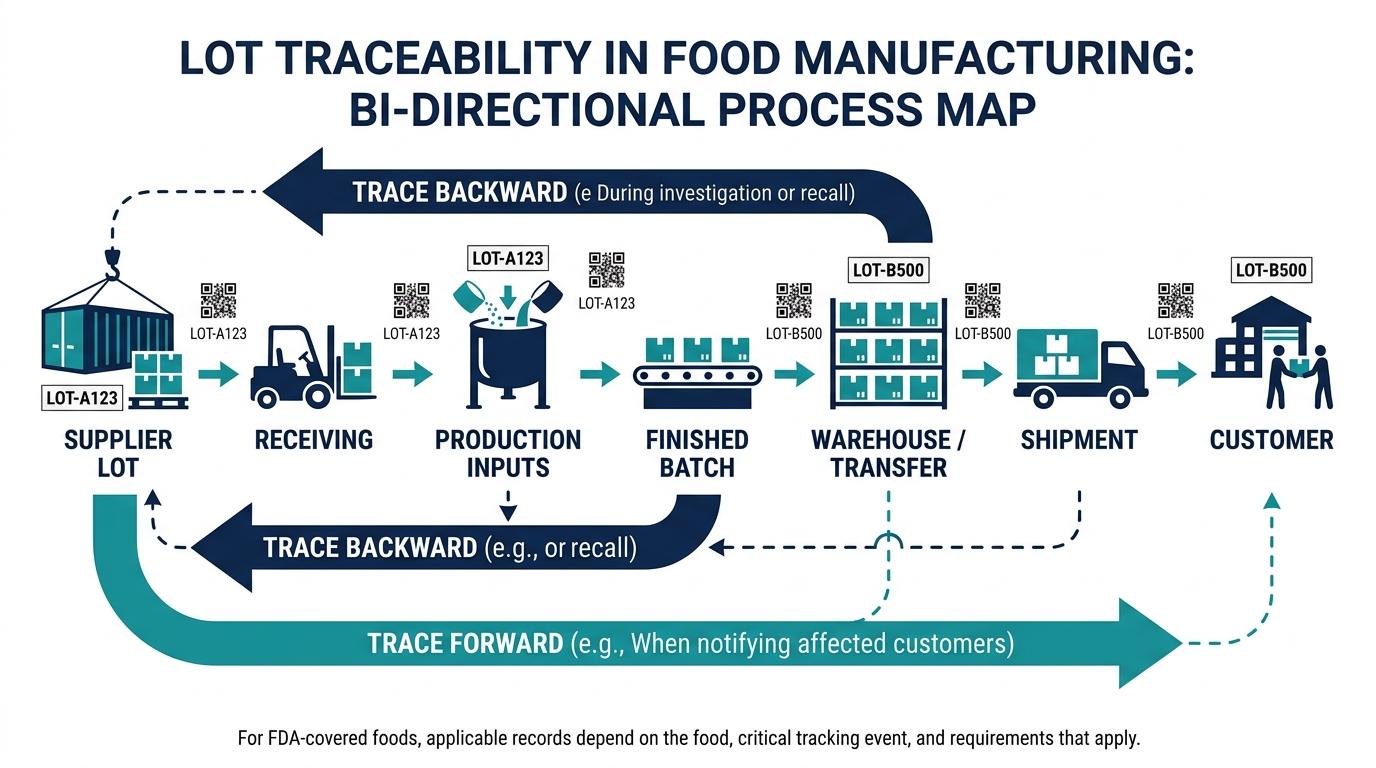
When records are scattered across purchasing, production, and warehouse workflows, teams may have to assemble lot history during a quality investigation. For covered events, FDA’s FAQ highlights location description as a required data element, helping identify where food moved in the supply chain. A connected lot history can help teams locate relevant quantities and customers faster, but actual obligations depend on product coverage, event type, and applicable exemptions. Use FDA’s Food Traceability List to check whether listed foods are in scope.
Operationally, the same lot-level information used for expiry control can also support bi-directional traceability and quality investigations when it is captured consistently across receipts, production, transfers, and shipments. GS1’s Fresh Fruit and Vegetable Traceability Guideline (Release 2.0, ratified Feb. 2021) describes identification and traceability practices for produce supply chains. Treat that guideline as an implementation reference, distinct from FDA’s requirements for covered foods.
Read Why NetSuite for Food and Beverage Manufacturers in 2026, review FDA Compliance for Food Manufacturers: How ERP Automates Traceability and Lot Tracking, and compare that with From Recipe to Results: NetSuite ERP Streamlines Recipe Management and Product Consistency for the broader food manufacturing architecture around recipes, batch records, and lot genealogy.
When comparing manual controls, a warehouse add-on, and an ERP-led model, test each against the same operating needs: FEFO at pick and production issue, customer-specific shelf-life rules, lot genealogy across locations, and early warning on near-expiry exposure. Manual controls may suit a small, stable operation; a warehouse tool can improve picking discipline; a connected ERP can link those controls with quality, planning, and production records. The right fit depends on where your current process loses visibility. Softype’s food and beverage ERP architecture guide shows how those requirements fit together.
“We track batches” describes very different maturity levels. The last two are where FEFO without manual checks actually begins.
Batch recording — a lot number is typed onto a receiving document.
Batch-level inventory — the system knows how much of each lot remains.
Location-aware tracking — it knows which warehouse and bin holds each lot.
Expiry-aware tracking — every applicable lot carries its expiration date.
Transactional traceability — lot identity survives receipts, transfers, production, and fulfillment.
Rule-driven allocation — the system decides which eligible lot should be used.
Exception management — leaders are alerted when stock nears expiry, fails a shelf-life rule, or needs intervention.
Receiving is the first key control point. FEFO cannot correct a wrong lot number or expiry date entered at receipt. Staff should capture the supplier lot and expiry, preferably by barcode, then check the date and remaining shelf life. The process should flag short-dated goods and place items on hold when quality review is needed. Put-away should also make eligible lots easy to pick first.
Quality status must update inventory availability right away. Planning and order allocation should not count held, rejected, temperature-exposed, or recalled stock as usable supply. Production records should show which material lots went into each work order and which finished batch came out. Keep the dates, quantities, yield, deviations, and rework links with that batch history.
Planning should treat expiry as part of time-phased availability rather than assuming all current stock is future supply. A planner needs the exception before materials are staged, not after. That is the practical difference between shelf-life-aware planning and classic reorder logic.
The system first checks which lots can serve the order, then sorts eligible lots by expiry date. A lot must be at the right location, available, released by quality, and not expired, blocked, or reserved. It must also meet any customer or market rules for remaining shelf life. A simple test is:
Lot expiry date >= expected delivery date + required customer shelf-life days
Warehouse teams complete the control at pick time. A mobile device directs the worker to the assigned bin and lot. Scanning confirms the pick. The system should block expired, recalled, held, or short-dated stock and suggest another eligible lot if the assigned one is missing or damaged. Any approved exception should log the lot, reason, approver, user, and time. Returns should stay out of saleable stock until staff check the lot, condition, and original shipment.
ERP does not solve expiry date management by storing more dates. It solves it by connecting transactions that manual methods keep separate. Lot identity is captured at receipt. Batch-level inventory by location stays current as stock moves. Quality holds change availability immediately. Production records preserve which lots were consumed and created. Allocation uses those facts together, not as separate reports someone has to interpret. This is the kind of batch-level control model Softype helps food manufacturers design when FEFO, shelf life, and traceability can no longer depend on manual checks.
<strong>Softype first-party implementation pattern—not a measured customer result.</strong> In its published food-processing architecture guide (May 28, 2026), Softype describes commissary setups that use storage type and item-level shelf-life rules—for example, chilled, frozen, and same-day bakery products—to guide system-enforced FEFO picking. In this model, eligibility is set by product rules rather than left to warehouse memory. The source describes an implementation pattern; it does not name a customer or report before-and-after spoilage, picking, or recall-response metrics. See Softype’s food-processing architecture guide for the stated context.
That matters because FEFO inventory management fails in the gap between visibility and execution. Many businesses can produce an expiry report. Far fewer can ensure that the lot at the top of that report is the same lot the picker actually ships, the same lot production actually consumes, and the same lot planning counts as usable supply.
At scale, that gap is where spoilage, write-offs, and traceability delays live. ERP closes the gap by moving the rule into day-to-day execution. Instead of asking people to remember what should move first, it makes the next eligible lot the default operating path.
If batch tracking and expiry date management are genuinely under control, operations leaders can answer the following without calling a warehouse or merging spreadsheets:
Batch-level inventory — quantity by SKU, lot, warehouse, bin, status, and expiry date.
Expiry horizons — which lots expire in the next 30, 60, 90, and 180 days, and the value at risk.
Demand-matched exposure — short-dated lots with insufficient projected demand before expiry.
Shelf-life failures — open orders with no eligible lot meeting the customer’s required remaining life.
Allocation intent — which lot FEFO has assigned to each open order, and which lots are held, rejected, or reserved.
Genealogy both ways — material lots consumed in each production batch, and every finished lot and customer affected by a given supplier lot.
Recall position — how much of a suspect lot remains, where it sits, and how much has already shipped.
Execution compliance — whether warehouse teams are actually picking the lots the system allocated, and the override history.
Network imbalance — locations holding short-dated stock while another location has open demand.
Replenishment discipline — buyers ordering while existing lots are already heading toward write-off.
If you want to know whether your controls are truly mature, this is the practical checklist. A batch-based manufacturer should be able to point to each capability in day-to-day use, not just in a procedure manual.
Lot tracking across receiving, production, transfer, fulfillment, and returns
Expiry-date visibility at lot level by item, warehouse, and bin
Quality holds that immediately remove stock from eligible supply
Batch-level inventory by location rather than item-level balances only
FEFO picking logic that considers expiry, status, commitments, and customer shelf-life rules
Near-expiry alerts by 30, 60, 90, and 180-day horizons
Bi-directional lot traceability from receipt to shipment and back again
Production batch records linked to consumed material lots and created finished lots
Override tracking for any non-standard lot allocation or release decision
Recall-ready reporting that isolates affected lots, customers, and remaining stock quickly
If several of those still depend on offline files, phone calls, or local knowledge, the operation has not yet removed manual checks from its FEFO model.
Use the checklist above to see where your current process still depends on memory, spreadsheets, or local workarounds — and where a system-level change would remove that risk first.
FEFO stands for First-Expiry-First-Out. Inventory is issued or shipped in order of expiration date rather than receipt date. In practice, it means allocating the earliest-expiring lot that is still eligible — released by quality, in the right location, unreserved, and able to meet the customer’s required remaining shelf life.
Batch tracking breaks at scale when the method depends on people remembering the current state of inventory. Every additional SKU, lot, bin, location, and daily transaction multiplies the combinations to check, while spreadsheets remain static snapshots that cannot block an ineligible lot or validate what was physically picked.
Manufacturers manage expiry dates without manual checks by capturing lot and expiry at receipt or production, keeping quality status live, filtering allocation to eligible lots only, sequencing those lots by expiry, directing the pick to a specific bin and lot, and validating the scan. People then handle exceptions rather than routine decisions.
Lot traceability is the ability to follow a batch backward to its inputs and forward to its customers. Expiry control governs whether a lot is still usable or saleable and which lot should move first. Both depend on the same lot-level records, but they answer different operational questions.
ERP improves recall readiness by preserving the chain from supplier lot through receipt, movement, production consumption, finished lot, and shipment as ordinary transaction history. Containment starts from existing records instead of a reconstruction exercise, which usually narrows the recall because unaffected stock can be proven unaffected.
Spreadsheets stop being enough when the same lot exists in several locations and statuses at once, when customer shelf-life terms differ, when production consumes tracked materials, or when write-offs and near-expiry surprises appear despite an expiry log being maintained.
Yes. Without system-directed material issue, operators consume whatever is staged nearest the line, leaving earlier-expiring ingredient lots behind. The loss surfaces later as a materials write-off but originates in production consumption.
Leaders should be able to see batch-level inventory by location, near-expiry exposure, customer shelf-life failures, quality holds, FEFO allocations, and bi-directional traceability without calling a warehouse or merging spreadsheets. If the answer lives outside the system, control is still manual.
The goal at scale is not to make warehouse teams better at manually checking expiration dates. It is to remove routine expiry decisions from human memory altogether, so the system already knows what lot exists, where it sits, when it expires, whether it is usable, what produced or consumed it, which demand it can serve, and where it went.
At that point FEFO stops being a warehouse instruction and becomes an operating control spanning procurement, receiving, quality, production, inventory, fulfillment, and traceability. That is the difference between recording batch numbers and managing batch-controlled inventory — and the operating-control shift Softype typically helps manufacturers make.
Use the checklist in this article to compare your current controls with the system-driven capabilities described above. Prioritize gaps that leave lot eligibility, expiry decisions, or recall history dependent on manual checks.


Helping businesses thrive with integrated ERP solutions.
NetSuite
Service
Company
Contact Us
Copyright © 2026


