


If you run a food processing business and you are evaluating NetSuite, the generic "food and beverage ERP" framing only takes you so far. A central kitchen operating on twelve-hour production cycles has different requirements from a meat processor managing farm-to-retail traceability, and both differ again from a specialty ingredients distributor managing live cultures with cold chain logistics. The platform handles all of them. The architecture differs.
This guide covers five food processing sub-verticals we implement most often, what makes each architecturally distinct, and the configuration choices that make NetSuite work for the operating model. For the underlying architectural framework (NetSuite plus SuiteSuccess Food and Beverage plus FernSpeed), see our companion guide, Why NetSuite for Food and Beverage Manufacturers. For the broader vendor-agnostic feature evaluation, see Key Features of a Food ERP System: F&B Buyer's Checklist. For the Food and Drug Administration (FDA) and Food Safety Modernization Act (FSMA) compliance deep dive, see FDA Compliance for Food Manufacturers.
Before the sub-vertical differences, the configuration patterns common to every food processing implementation on NetSuite:
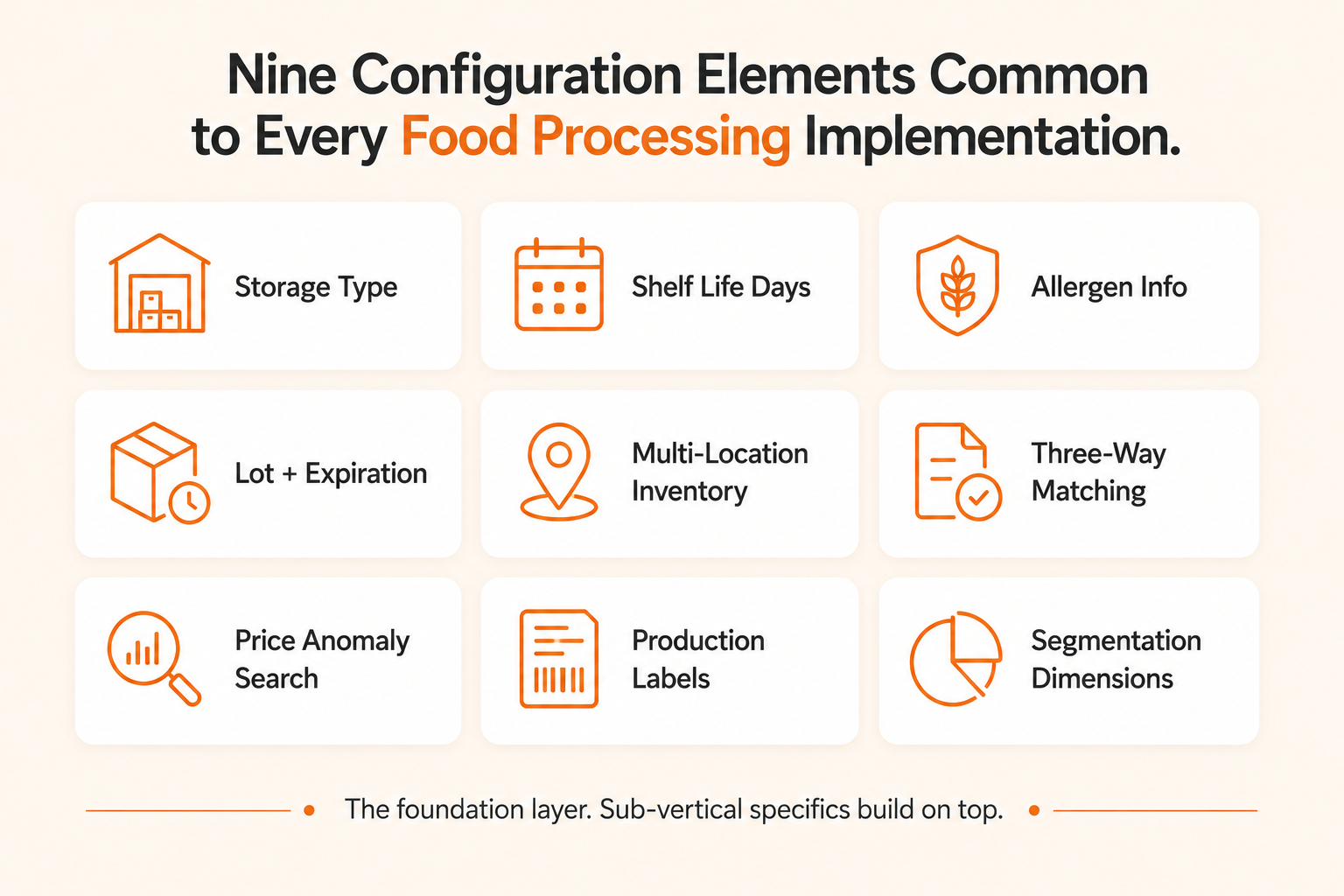
Lot-tracked inventory with expiration dates. Every raw ingredient and every finished good is lot numbered. Expiration dates drive picking sequences and shelf-life monitoring.
Custom item fields for food-specific attributes. Storage type (chilled, frozen, dry, bakery), shelf life days, allergen information, organic or certification flags, and sub-vertical-specific attributes are added to the item master.
Three-way matching for inbound goods. Purchase Order to Item Receipt to Vendor Bill, with tolerance for the small price and weight variances that come with food ingredients.
Multi-location inventory even when there is only one production site, because raw, work-in-progress, finished goods, and quarantine inventory all need their own logical locations.
Recipe or formula management if there is any value-add production, handled through FernSpeed (the Built-for-NetSuite process manufacturing SuiteApp Softype implements for food and beverage manufacturers) rather than through generic Bills of Materials.
What changes between sub-verticals is which of these patterns dominate and what additional capabilities the architecture needs to layer on top.
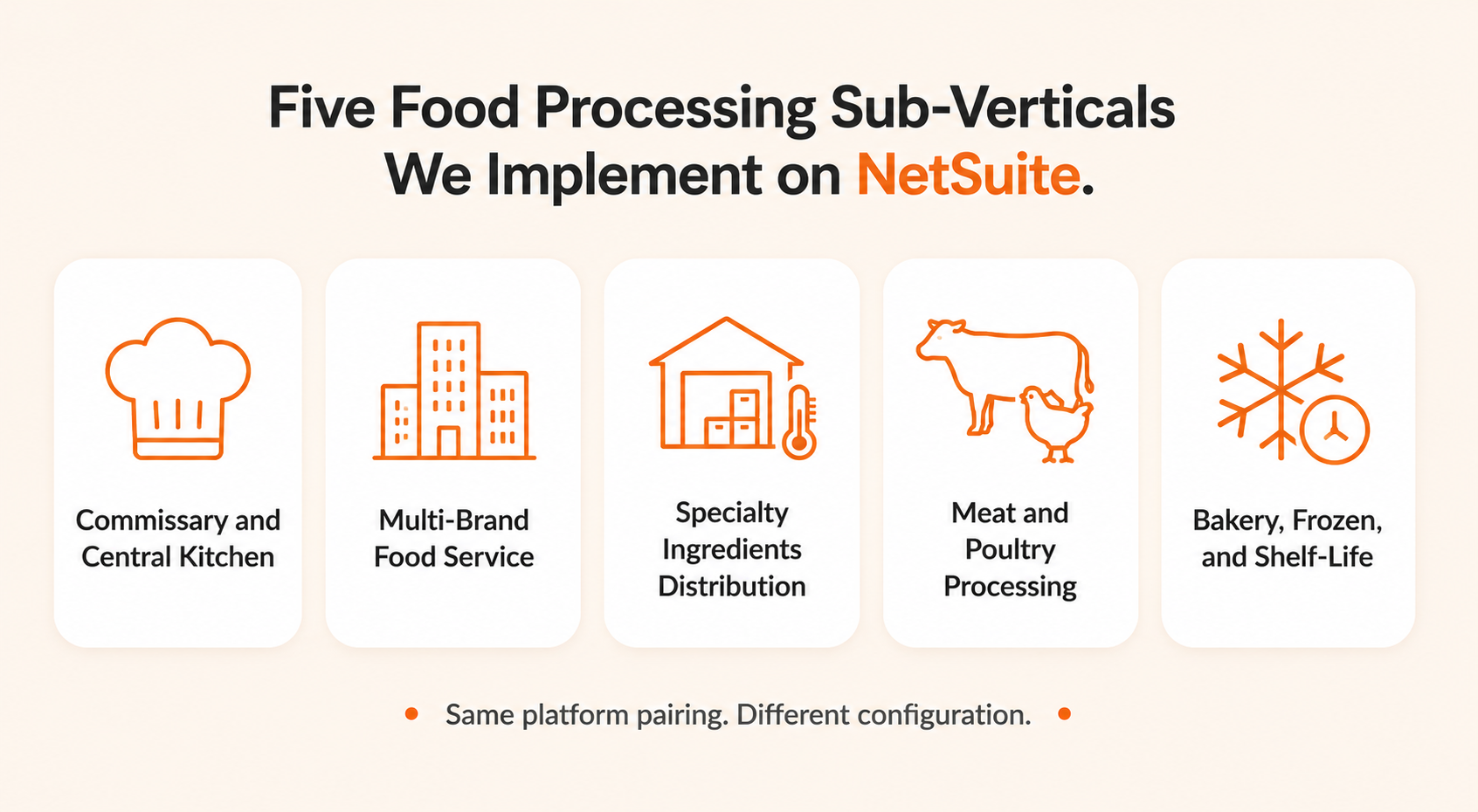
This sub-vertical covers central kitchens producing meals for institutional contracts (school food programs, corporate dining, healthcare, airlines, prepared meal delivery), commissaries supplying multiple retail concepts from a single production hub, and large-scale catering operations.
What changes architecturally:
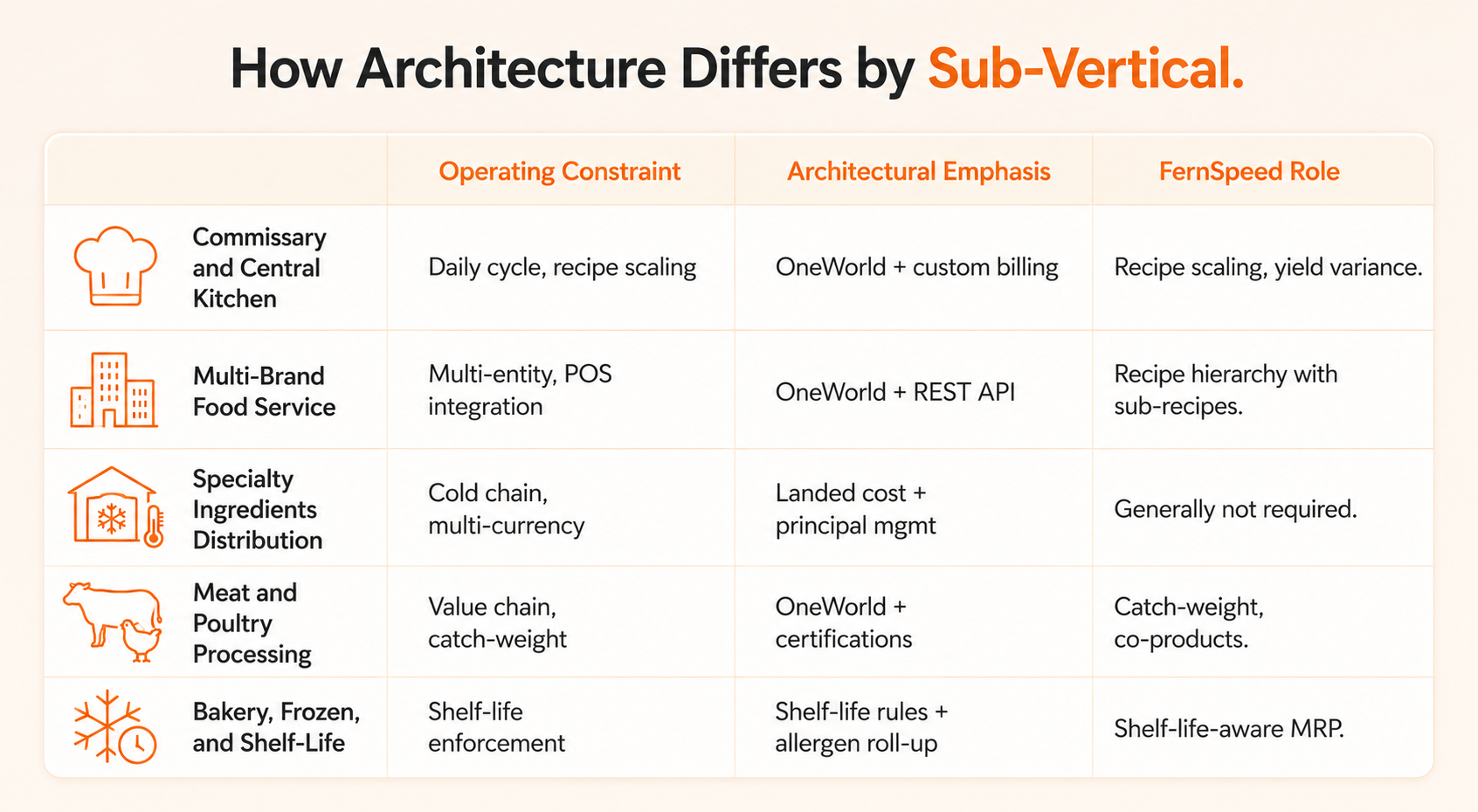
Production volume is the defining constraint. Operations producing 5,000 to 30,000 portions a day need recipe scaling, batch production tracking, and yield variance capture at meaningful scale. FernSpeed handles recipe scaling from 100 portions to 5,000 in a single production order.
Shelf-life rules are tight and tiered. A pattern we see in commissary implementations: storage type as a mandatory item attribute, with custom shelf-life rules (for example, 7 days chilled, 30 days frozen, same-day for bakery items). The system enforces First-Expiry-First-Out (FEFO) picking aligned to these rules.
Order-to-production-to-fulfillment runs daily, not weekly. Customer orders received today drive production tomorrow and delivery the day after. The cycle is too tight for batch-mode planning. NetSuite plus FernSpeed handles the daily cycle through scheduled production order generation tied to confirmed sales orders.
Customer contracts drive billing complexity. Institutional customers (schools, government programs, corporate dining contracts) require consolidated monthly invoicing with contract-specific billing rules. This usually means custom billing engines layered on top of NetSuite's invoicing.
Multi-kitchen consolidation is common. Commissary operations often run two or three kitchens, each producing for different customer segments, with consolidated finance and shared item master at the group level.
The architecture: NetSuite Financials First Premium with OneWorld, Advanced Inventory, FernSpeed for recipe and production management, custom fields for shelf-life and allergen attributes, and either standard invoicing or a custom billing engine depending on contract complexity.
This sub-vertical covers restaurant groups, multi-concept food service operators, hospitality companies with food and beverage divisions, and catering groups operating multiple brands under a holding structure.
What changes architecturally:
Multi-entity is the foundation. A pattern we see in multi-brand food service: six legal entities and over 30 locations under a single group, each brand with its own profit and loss but consolidated reporting at the group level. NetSuite OneWorld handles this natively. For the technical detail, see our companion guide on NetSuite OneWorld: Multi-Entity and Multi-Currency ERP Guide.
Point-of-Sale (POS) integration is critical. Each brand and location runs its own POS. Sales and inventory data flow back to NetSuite in real time, typically through a Representational State Transfer (REST) Application Programming Interface (API) integration.
Inventory complexity scales with concept count. Three thousand active Stock Keeping Units (SKUs) across casual dining, fine dining, café, and bakery concepts is common. The item master needs to support concept-specific subsets without duplicating records across brands.
Recipe management at scale. Each concept has its own menu, with shared sub-recipes (sauces, dressings, marinades) often used across brands. FernSpeed manages the recipe hierarchy with sub-recipes nested under finished products.
Branded reporting alongside group consolidation. Each brand needs its own P&L for operational management; the group needs consolidated visibility for strategic decisions. NetSuite's department, class, and location dimensions handle the segmentation cleanly.
The architecture: NetSuite OneWorld with multi-entity setup, Advanced Inventory, FernSpeed for recipe management across brands, REST API integration to brand-specific POS systems, and consolidated reporting structures using NetSuite's segmentation dimensions.
This sub-vertical covers companies that import, warehouse, and distribute specialty ingredients (cultures, enzymes, flavours, stabilisers, preservatives, emulsifiers) to food manufacturers in dairy, bakery, beverage, meat, and agro-processing. Operations are principal-exclusive (held under exclusive agency agreements with international manufacturers), B2B, and technically intensive.
What changes architecturally:
Production is not the focus. These businesses do not manufacture food. They distribute it. The architecture leans heavily on procurement, multi-currency landed cost, and warehouse management rather than on recipe and production execution.
Multi-currency landed cost is core. Free On Board (FOB) and Cost Insurance Freight (CIF) purchase orders are paid in USD or EUR. Customer pricing is in local currency. NetSuite computes the full landed cost (FOB price plus freight plus insurance plus duty plus VAT) per shipment, with forex exposure tracked at the shipment level.
Cold chain integrity is the operational constraint. Live cultures and enzymes require temperature-controlled storage. The architecture supports temperature zone segmentation (ambient, chilled, frozen), lot-level Certificate of Analysis (COA) validation on receipt, and shelf-life monitoring driven by manufacturer expiration dates rather than production dates.
Principal management is a discipline of its own. Each principal has exclusive territory definitions, volume commitments, rebate structures, and joint marketing arrangements. NetSuite's vendor master can be extended to track principal-specific commitments and rebate accruals.
Application support is part of the revenue model. Beyond product sales, these businesses generate revenue from technical service fees, application trials, and training workshops. NetSuite handles these as service items alongside the product catalog.
The architecture: NetSuite Financials First Premium, Advanced Inventory with temperature zone segmentation, multi-currency configuration with full landed cost handling, vendor master extensions for principal management, and service items for technical revenue. FernSpeed is generally not required for pure distribution; it becomes relevant only if the business begins blending or repackaging ingredients.
This sub-vertical covers integrated meat producers (poultry, beef, pork, seafood) operating across feed mills, farms, hatcheries, processing facilities, and retail or wholesale distribution. Many are multi-brand and multi-entity at significant scale.
What changes architecturally:
The value chain is end-to-end and the data model has to follow it. Feed cost flows into livestock cost, which flows into processing cost, which flows into finished goods cost, which flows into retail pricing. Lot traceability runs from feed batch to retail receipt. The architecture needs to model the whole chain, not just the production layer.
Catch-weight is operationally critical. Bone-in chicken thighs, beef cuts, and fish are received at variable weights, invoiced on actual weight, and sold per kilogram or per pound. FernSpeed's dual unit of measure handling is foundational, not optional.
Co-products and by-products are real. A processed bird produces breast, thigh, wing, and offal; each has its own pricing and customer base. The system tracks multiple outputs from a single production order with separate costing.
Multi-entity consolidation across the value chain. A vertically integrated agribusiness typically operates as a holding structure with separate entities for feed milling, farming, processing, and retail. Intercompany pricing between these entities is a constant configuration challenge. NetSuite OneWorld handles the consolidation; the intercompany pricing rules need careful design.
Compliance tracking adds regulatory dimensions. Certifications like Reared Without Antibiotics, Halal, Kosher, or organic require attribute tracking on items, lots, and finished goods. The architecture needs custom fields and saved searches to support certification audits.
The architecture: NetSuite OneWorld with multi-entity intercompany configuration, Advanced Inventory with catch-weight via FernSpeed, FernSpeed for recipe, yield, and co-product handling, custom item attributes for certifications, and traceability reporting from feed batch through retail receipt.
This sub-vertical covers bakeries (commercial and artisanal at scale), frozen food manufacturers, and any food processor where shelf life is the dominant operational variable. Same-day production for bakery, multi-month frozen storage cycles, and the interaction between the two define the operating model.
What changes architecturally:
Shelf-life rules are the system's central nervous system. A pattern we see in bakery and frozen implementations: shelf-life rules tuned by storage type (for example, 7 days chilled, 30 days frozen, same-day for bakery items), with custom fields enforcing the rule at the item level. The system blocks fulfillment of items past their shelf life and flags items approaching expiration for promotional pricing or write-off.
Production rhythm varies dramatically by category. Bakery typically runs continuous same-day production with no inventory accumulation. Frozen runs in larger batches with longer cycle times and significant finished goods inventory. The same NetSuite plus FernSpeed architecture handles both, but the production order configuration differs.
Allergen tracking is a labeling and changeover discipline. Bakery operations especially deal with cross-contact risk between wheat, nuts, dairy, and other allergens. The architecture supports allergen attributes on every item, allergen roll-up from sub-recipes to finished products, and changeover controls in production scheduling.
Demand planning is shelf-life-aware. Standard Materials Requirements Planning (MRP) assumes infinite shelf life. Food MRP has to plan production against shelf-life constraints, balancing batch size, fulfillment commitments, and waste. FernSpeed's shelf-life-aware planning handles this.
Quality control checkpoints are mandatory. Receiving, in-process, and pre-shipment quality checks tied to lot records, with automatic hold workflows when tests fail.
The architecture: NetSuite Financials First Premium, Advanced Inventory with shelf-life enforcement, FernSpeed for recipe management with allergen roll-up and shelf-life-aware MRP, embedded quality control workflows, and configurable picking rules tuned to FEFO.
Even as the sub-vertical specifics differ, certain configuration patterns recur across every food processing implementation. Knowing these up front reduces the configuration effort significantly.
Configuration Element | Why It Matters Across All Five |
|---|---|
Custom item field: Storage Type | Drives shelf-life calculations, picking rules, and storage zone allocation |
Custom item field: Shelf Life Days | Enforced at the item level, validated by storage type |
Custom item field: Allergen Information | Multi-select field rolling up from raw ingredients to finished goods |
Lot tracking with expiration dates | Foundation for FEFO, recall execution, and audit trail |
Multi-location inventory (raw, WIP, finished, quarantine) | Logical separation of inventory states even within a single physical site |
Three-way matching with tolerance | Routine for inbound goods with small price and weight variances |
Saved searches for vendor price anomalies | Flags vendor bill cost deviations from the last Purchase Order for review |
Custom production order labels | Site, route, delivery date, item description, quantity, allergen statement |
Department, Class, and Location dimensions | Drive brand, concept, or production-line segmentation in reporting |
A pattern we see across implementations: the custom field configuration alone (storage type, shelf life days, allergen information, certification flags) typically accounts for the foundation layer of the food processing setup. Without these, every downstream workflow (FEFO picking, expiry reporting, allergen labeling, certification audits) breaks down. With them, the system runs cleanly.
The five sub-verticals overlap. A multi-brand food service group may include a commissary as one of its kitchens. A meat processor may include a specialty ingredients import operation for its feed inputs. A bakery group may operate frozen storage as part of its distribution model.
The practical starting point is identifying which sub-vertical describes your primary operating model and treating the others as secondary considerations. The primary sub-vertical drives the foundational architecture. The secondary considerations layer in as configuration extensions.
The pairing that runs through all five sub-verticals: NetSuite as the system of record, SuiteSuccess Food and Beverage as Oracle's pre-configured implementation methodology for the industry, and FernSpeed as the Built-for-NetSuite SuiteApp that adds the production-side capabilities for any sub-vertical with meaningful value-add production.
If you operate a food processing business and you are evaluating NetSuite, the most useful starting point is a conversation that maps your sub-vertical to the architectural configuration. We have implemented all five sub-verticals on NetSuite, and the configuration choices that make each one work are well understood. The implementation patterns are proven. The typical timeline for a phased rollout runs 20 to 30 weeks for a single sub-vertical and 30 to 40 weeks for businesses spanning two or more.
Softype implements NetSuite paired with FernSpeed for food processors across commissary operations, multi-brand food service groups, specialty ingredients distribution, meat and poultry processing, and bakery and frozen operations. If you are scoping a food processing implementation, we are happy to walk through which architectural pattern fits your business. Reach out at softype.com/contact-us.
For mid-market food processors, NetSuite paired with SuiteSuccess Food and Beverage and FernSpeed is the architecture that delivers the broadest fit across the sub-verticals. NetSuite provides the system of record (financials, inventory, procurement, audit trail), SuiteSuccess accelerates the standard deployment, and FernSpeed adds the recipe, variable yield, catch-weight, and shelf-life-aware planning that food processing requires.
The platform pairing stays consistent, but the configuration differs. Commissary operations focus on recipe scaling and daily production cycles. Multi-brand food service groups emphasize multi-entity consolidation and POS integration. Specialty ingredients distribution leans on multi-currency landed cost rather than production. Meat and poultry processors need catch-weight, co-product handling, and full value chain traceability. Bakery and frozen operations build the architecture around shelf-life enforcement.
Probably not. FernSpeed is most valuable when there is meaningful value-add production: recipes, yields, catch-weight, allergen roll-up. A pure distributor without manufacturing operations can run on NetSuite alone, with Advanced Inventory and multi-currency configuration. If the business begins blending, repackaging, or producing private label, FernSpeed becomes relevant.
The recurring set across implementations: Storage Type (chilled, frozen, dry, bakery), Shelf Life Days, Allergen Information (multi-select), Certification flags (organic, Kosher, Halal, Reared Without Antibiotics, others by industry), and sub-vertical-specific attributes (catch-weight for meat, COA validation for ingredients, country of origin for imports).
NetSuite provides lot tracking, audit trail, recipe version control, expiry management, and quality control workflows that map directly to FDA and FSMA requirements including FSMA 204 traceability. For the deep dive, see our companion guide on FDA Compliance for Food Manufacturers.
For a single sub-vertical operation, plan 20 to 30 weeks for a phased rollout (foundation, inventory and distribution, production layer with FernSpeed, then optimization). Businesses spanning two or more sub-verticals (a multi-brand food service group with a commissary, for example) typically run 30 to 40 weeks.
This guide focuses on how the architecture differs across food processing sub-verticals (commissary, multi-brand food service, specialty ingredients, meat and poultry, bakery and frozen). Why NetSuite for Food and Beverage Manufacturers covers the underlying NetSuite plus SuiteSuccess plus FernSpeed pairing. Key Features of a Food ERP System covers the vendor-agnostic feature evaluation. FDA Compliance for Food Manufacturers covers compliance specifically. Use this guide when you know NetSuite is the platform direction and want to understand how the configuration fits your sub-vertical.


Helping businesses thrive with integrated ERP solutions.
NetSuite
Service
Company
Contact Us
Copyright © 2026


